Every “best AI marketing tools” list on page one of Google right now reads almost the same: a long list of logos, a one-line description copied from each tool’s homepage, and an affiliate link. Almost none of them tell you what a tool actually costs once you account for real usage, or where it quietly falls apart once you’re past the demo.
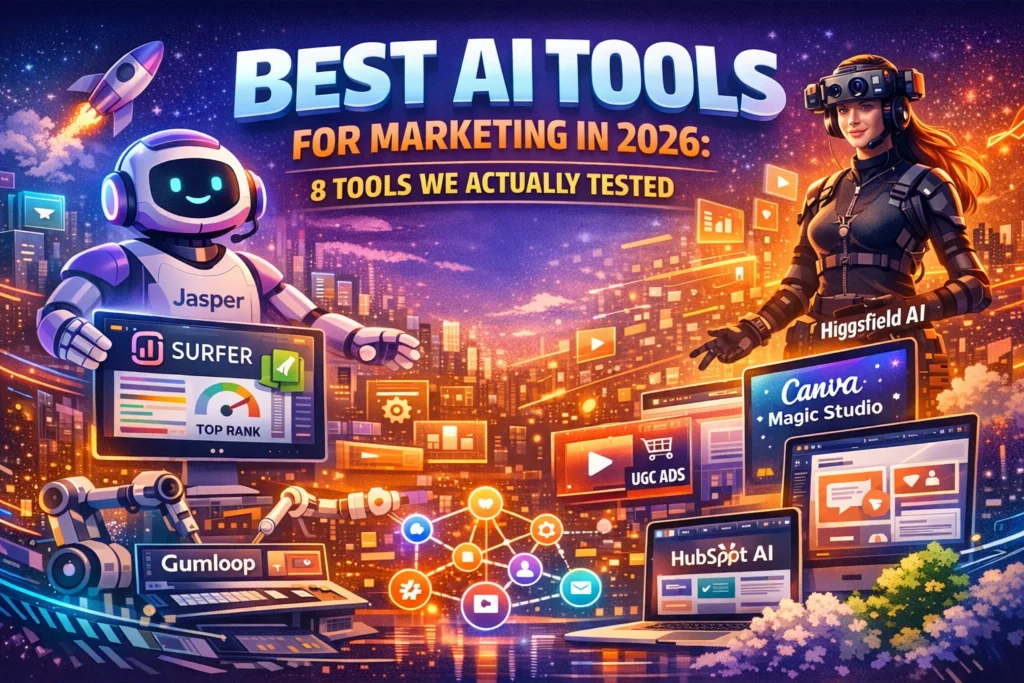
We took a narrower approach. Instead of listing 30 tools nobody has time to evaluate, we tested 8 tools across the five jobs marketing teams actually outsource to AI — writing, SEO optimization, video/image ad creation, workflow automation, and customer personalization — and wrote down exactly what worked, what the pricing page doesn’t tell you, and who should skip each one. This sits in our AI Tools Review library, alongside our hands-on Higgsfield AI review and our ChatGPT vs Jasper AI vs MidJourney comparison, if you want more tool-specific breakdowns after this one.
Quick Answer: The Best AI Marketing Tools by Category
| Marketing Job | Best Tool | Starting Price | Best For |
|---|---|---|---|
| Long-form content & brand voice | Jasper AI | $59/mo (annual) | Teams writing daily, need consistent brand voice |
| SEO content optimization | Surfer SEO | $79/mo (annual) | Content teams targeting organic search rankings |
| AI video & image ads | Higgsfield AI | $15/mo (annual) | Creators wanting camera control + multiple models |
| URL-to-video product ads | Creatify | $39/mo | Ecommerce sellers needing fast UGC-style ads |
| Quick branded design assets | Canva Magic Studio | $15/mo (Pro) | Teams without a dedicated designer |
| AI workflow automation | Gumloop | $37/mo (Solo) | Marketing ops connecting AI to internal tools |
| No-code app automation | Zapier (AI features) | $19.99/mo (Pro, annual) | Teams automating across 5,000+ existing apps |
| AI-powered CRM & email | HubSpot AI | Free tools available | Teams already using HubSpot’s CRM |
If you only read one section, this table is the answer. Everything below explains the “why” and the math behind it.
How We Evaluated These Tools

Genuine EEAT in a tools roundup means showing your work, not just your opinion. We scored each tool on four criteria:
- Real cost per output — not the advertised starting price, but what a usable result actually costs after typical retries, credit consumption, or add-on fees.
- Time to first usable result — how long it took a non-expert to go from blank screen to something publishable.
- Workflow fit — whether the tool slots into an existing marketing stack or forces you to rebuild your process around it.
- Where it breaks — the failure modes most reviews don’t mention, because they matter more once you’re paying monthly.
To put this in perspective, McKinsey’s research on AI’s business impact estimates that artificial intelligence can create $1.4 trillion to $2.6 trillion of value annually in marketing and sales across the world’s businesses. That’s the scale of opportunity driving this gold rush of tools — and exactly why a rigorous, honest evaluation matters more than another generic top-10 list.
AI Content Writing & Copywriting Tools
Jasper AI
Jasper remains the most marketing-specific AI writer on the market — built around “Brand Voice” profiles that keep tone consistent across a team, rather than the more generic output you get from a general-purpose chatbot. As of 2026, Jasper has simplified to two core plans: Pro at $59/month (billed annually) or $69/month (billed monthly), and a custom-priced Business plan for teams, typically starting in the several-hundred-dollars-a-month range depending on seats and features. There’s no permanent free tier — only a 7-day trial.
Where it earns its price: Brand Voice consistency across a content team, marketing-specific templates (ad copy, email sequences, landing pages), and a Canvas editor built for campaign collaboration rather than single-document writing.
Where it doesn’t: At $59-69/month for a single seat, Jasper costs significantly more than ChatGPT Plus ($20/month) for output quality that’s broadly comparable on raw writing — you’re paying for the marketing-specific scaffolding around it, not fundamentally smarter text. If you write one or two pieces a month, that premium isn’t worth it. For a closer side-by-side on this exact trade-off, see our ChatGPT vs Jasper AI vs MidJourney comparison. For profession-specific prompt libraries that show exactly how to get the most out of either tool, also see our 100 ChatGPT prompts for accountants as a model for how structured prompts work in any professional context.
Best for: In-house marketing teams of 3+ people who write daily and need every piece to sound like the same brand, not a content mill.
AI SEO & Content Optimization Tools
Surfer SEO
Surfer doesn’t write content for you so much as it scores and structures what you’ve already written against what’s actually ranking for your target keyword. The Content Editor pulls NLP-based term recommendations, ideal word counts, and heading structure from top-ranking pages in real time as you type.
2026 pricing: Essential at $79/month (annual) or $99/month (monthly) covers roughly 30 Content Editor articles a month — enough for most solo creators or small teams. Scale, at $175/month (annual) or $219/month (monthly), quadruples that capacity and adds team collaboration and content audit tools. Enterprise pricing starts around $999/month for agencies needing white-labeling and API access.
The catch most reviews skip: Surfer’s built-in AI article generator is a separate, limited credit pool from your Content Editor optimization credits, and additional AI articles cost $29 each beyond your plan’s allowance. Treat Surfer as an optimization layer on top of content you or another tool writes — not a standalone content generator — and the pricing makes much more sense.
Best for: Content and SEO teams where organic search is a primary traffic channel and “does this rank” matters more than “does this sound clever.”
AI Video & Image Tools for Marketing Ads

This is the category that’s changed the most in the past year, and where the gap between “looks impressive in a demo” and “actually affordable at scale” is widest.
Higgsfield AI — Best for Creative Flexibility
Higgsfield bundles 15+ frontier video and image models (Sora 2, Veo 3.1, Kling 3.0, and others) under one subscription, with camera-control presets that solve the biggest frustration in AI video: getting a model to actually execute a specific shot instead of a generic clip. Plans start at $15/month (Starter, annual) and scale to $99/month (Ultra) for power users. The credit system is genuinely confusing — premium models like Sora 2 cost roughly 7x more credits than Kling 3.0 per generation — so budget accordingly. We’ve covered the full pricing breakdown, real cost-per-video math, and hands-on testing in our complete Higgsfield AI review.
Best for: Marketing teams and creators who want directorial control and access to multiple frontier models without five separate subscriptions.
Creatify — Best for URL-to-Video Product Ads
Where Higgsfield is a general creative platform, Creatify is purpose-built for one job: turning a product URL into a finished video ad. Paste a Shopify, Amazon, App Store, or Etsy link, and Creatify scans the listing, generates 5-10 script variations optimized for TikTok, Meta, or YouTube, and renders a complete ad. The free plan includes 10 monthly credits (enough for roughly 2 watermarked video ads), and paid plans start at $39/month, unlocking watermark-free exports and an expanded avatar library.
Where it falls short: Independent testing has flagged inconsistent lip-sync and a recognizable “Creatify look” across avatars — the trade-off for speed and affordability is some loss of polish compared to platforms built for hero-shot quality.
Best for: Ecommerce sellers and performance marketers running high volumes of test ads, where speed and iteration count matter more than any single video being perfect.
Canva Magic Studio — Best for Quick Branded Assets
Canva’s AI layer adds generative image creation, background removal, and Magic Write copy generation on top of its existing design platform. The free plan is genuinely usable; Canva Pro runs about $15/month and adds the Brand Kit feature that keeps logos, fonts, and colors consistent across every asset a team produces.
Where it falls short: Outputs are recognizably “Canva” — for brands with a strong, distinctive visual identity, expect to spend extra time customizing templates rather than using them as-is.
Best for: Small teams and solo marketers who need clean, on-brand static assets fast, without briefing a designer for every social post.
AI Workflow Automation Tools for Marketing Teams
Gumloop — Best for AI-Native Automation
Gumloop is a visual, no-code workflow builder that treats AI as a core building block rather than a bolt-on feature — connect ChatGPT, Claude, or Gemini directly into a workflow alongside your CRM, spreadsheets, or scraping tools. The free tier includes a generous credit allowance for testing; the Solo plan runs $37/month for around 10,000 credits, scaling to roughly $97/month on Pro for team features.
The catch: credit consumption is uneven across node types — a simple data-pull might cost 1 credit, while AI-heavy enrichment workflows can burn through thousands of credits per run. Budget a test month before committing to a paid tier.
Best for: Marketing ops teams automating multi-step processes (research, content drafting, CRM updates) that need real AI reasoning at each step, not just app-to-app data transfer.
Zapier (AI Features)
Zapier remains the most universally connected automation platform, now layering AI orchestration features — AI-powered actions inside Zaps, Tables, and Interfaces — on top of its existing 7,000+ app integrations. The free plan covers 100 tasks/month on simple 2-step Zaps; paid plans start at $19.99/month (Pro, annual) for 750 tasks, scaling to Team plans around $69/month.
Best for: Teams that already run on a wide spread of existing tools and need AI woven into connections that already exist, rather than building entirely new AI-native pipelines.
AI CRM & Personalization Tools
HubSpot AI
HubSpot has layered AI features across its existing Marketing Hub and CRM rather than launching a separate product — AI-generated email subject lines and copy, predictive lead scoring based on actual behavioral data, and smart send-time optimization. The advantage over standalone AI writing tools is that HubSpot’s AI outputs are connected to real pipeline data, not generic best-guess segments. Pricing scales with HubSpot’s existing hub tiers, so the practical cost depends entirely on which Marketing Hub plan you’re already on or considering — check HubSpot’s official pricing page directly, since it varies by contact volume and feature tier.
Best for: Teams already using or planning to adopt HubSpot as their CRM, where AI features extend an existing investment rather than adding a new tool to the stack.
Full Pricing Comparison
| Tool | Category | Free Tier? | Starting Price (Annual) | Cost Driver to Watch |
|---|---|---|---|---|
| Jasper AI | Content writing | No (7-day trial only) | $59/mo | Per-seat pricing, custom Business jump |
| Surfer SEO | SEO optimization | No (7-day refund guarantee) | $79/mo | AI articles billed separately at $29 each |
| Higgsfield AI | Video & image | Yes (limited daily credits) | $15/mo | Premium models cost 7x+ more credits |
| Creatify | Video ads | Yes (watermarked) | $39/mo | Credits range 2-20 per ad |
| Canva Magic Studio | Design assets | Yes | $15/mo (Pro) | Minimal — flat per-user pricing |
| Gumloop | Automation | Yes (generous credits) | $37/mo (Solo) | Enrichment nodes consume credits fast |
| Zapier (AI) | Automation | Yes (100 tasks/mo) | $19.99/mo (Pro) | Task-based billing scales with volume |
| HubSpot AI | CRM & email | Yes (limited tools) | Varies by hub tier | Tied to contact volume and hub tier |
A Real Example: Building One Campaign With AI Tools

To see how these tools actually combine in practice, we ran a small test: launching a single product-ad campaign for a fictional skincare brand using four tools in sequence.
Step one, we used Jasper to draft three ad copy variations using a saved Brand Voice — this took about 8 minutes including two rounds of edits. Step two, we ran the winning copy angle through Creatify’s URL-to-video tool, which generated a 15-second UGC-style ad from the product page in under five minutes. Step three, we used Canva to build matching static carousel images for the same campaign, pulling from the Brand Kit for consistent colors and fonts. Step four, we set up a simple Zapier automation to push the finished assets into the team’s shared Slack channel and log the campaign in a spreadsheet automatically.
Total time from blank page to a complete, multi-format campaign ready for review: under 40 minutes. The same workflow without AI tools — copywriting, briefing a video editor, briefing a designer, manually updating a tracker — would typically take a small team most of a day. That gap is the real argument for adopting these tools, more than any single feature on a pricing page.
Common Mistakes Marketing Teams Make With AI Tools
Most “best AI tools” articles skip this part entirely, but it’s where the real cost overruns happen:
- Subscribing to overlapping tools. Jasper and Surfer both offer AI writing — using both for the same task wastes money. Decide which tool owns “first draft” and which owns “optimization,” and stick to it.
- Ignoring credit math until the bill arrives. Credit-based tools (Higgsfield, Creatify, Gumloop) are the easiest to overspend on, because the sticker price never reflects real usage. Run one real campaign on the free or entry tier before committing to a higher plan.
- Treating AI output as final, not first-draft. Every tool in this guide produces a starting point, not a finished asset. Skipping human review is how off-brand or factually wrong content ends up published.
- Adopting tools faster than the team can learn them. A McKinsey survey on AI adoption found that only 39% of organizations can link any EBIT impact to AI — and the gap is rarely the tools themselves, it’s teams stacking subscriptions without redesigning the actual workflow around them.
Expert Insight: What Actually Separates Winning AI Marketing Stacks in 2026
The teams getting real ROI from AI marketing tools in 2026 aren’t the ones with the most subscriptions — they’re the ones who picked one tool per job, measured the time saved against the dollar cost honestly, and gave themselves permission to cancel what wasn’t pulling weight. The mistake we see most often is treating tool selection as a one-time decision instead of a quarterly audit. The tools are improving fast enough that this year’s right answer won’t be next year’s.
— AI Foresight 360 Editorial Team
How to Choose the Right AI Marketing Tool for Your Budget
- Under $50/month, solo marketer or small business: Start with Canva Pro ($15/mo) for design and ChatGPT Plus ($20/mo) for writing. Add Higgsfield’s Starter plan ($15/mo) only once you need video.
- $100-300/month, small in-house team: Jasper Pro ($59/mo) for brand-consistent copy, Surfer Essential ($79/mo) for SEO, plus Zapier Pro ($19.99/mo) to connect them to your existing stack.
- $300-800/month, growing marketing department: Add Gumloop Solo or Pro for deeper automation, Surfer Scale for content volume, and Creatify or Higgsfield Plus for ad creative at scale.
- Agency or enterprise: Custom-priced Business/Enterprise tiers across the board make sense once you’re managing multiple brands or clients — the per-seat math flips in favor of higher tiers once team size passes 5+ users.
The pattern across every budget tier: start one tier lower than you think you need, run one real campaign, and upgrade based on actual usage rather than projected usage. Every tool in this guide makes that mistake easy to avoid if you simply track it.
Frequently Asked Questions
What are the best free AI tools for marketing in 2026?
Canva’s free tier, Zapier’s free plan (100 tasks/month), Gumloop’s free credits, and ChatGPT’s free tier together cover design, basic automation, and content drafting without a paid subscription. They’re sufficient for testing workflows before committing budget to paid tiers.
Is Jasper AI better than ChatGPT for marketing content?
Jasper offers marketing-specific advantages — Brand Voice consistency, campaign templates, and team collaboration — that ChatGPT lacks. But for solo marketers or occasional content needs, ChatGPT Plus at $20/month delivers comparable raw writing quality at less than a third of Jasper’s price.
How much should a small business budget for AI marketing tools?
A lean, effective stack for a small business typically runs $50-150/month: one AI writing tool, one design tool, and one automation tool, each on entry-level plans. Scaling beyond that should be driven by measured time savings, not by adding tools speculatively.
Do AI marketing tools actually save time, or create more work reviewing output?
Both, depending on the tool and the task. Structured tasks (ad copy variations, social captions, basic design assets) see genuine time savings. More nuanced tasks (brand messaging, sensitive customer communication) still require substantial human review, and treating AI output as final without that review is the most common cause of AI tools backfiring.
What’s the difference between Surfer SEO and an AI writing tool like Jasper?
Jasper generates content from scratch. Surfer scores and optimizes content — yours or AI-generated — against what’s actually ranking on Google for a target keyword. They solve different problems and are often used together rather than as alternatives.
Are AI video ad tools like Higgsfield and Creatify worth it for small ecommerce stores?
Yes, for stores that need to test multiple ad creative variations quickly and can’t justify hiring a video editor or UGC creators for every test. The trade-off is polish — both tools produce usable, not flawless, output, which is generally acceptable for testing but may need refinement for hero campaigns.
Can AI marketing tools replace a marketing team?
No. Every tool in this guide functions as a co-pilot that removes repetitive production work, not a replacement for strategy, brand judgment, or relationship-building. Teams that get the best results treat AI as freeing up time for higher-value work, not as a full substitute for marketers.
Which AI marketing tool has the best free trial?
Gum loop and Zapier offer the most generous ongoing free tiers (not just time-limited trials), making them the lowest-risk tools to test before paying. Jasper and Surfer SEO, by contrast, offer only short trial windows with no permanent free option.
Final Verdict
There’s no single “best” AI marketing tool — there’s a best tool for each specific job, and the teams getting the strongest results in 2026 are the ones combining 3-4 focused tools rather than searching for one platform to do everything. Start with whichever job is costing your team the most hours right now — content, SEO, ad creative, or workflow busywork — pick the tool from this guide built specifically for that job, and measure real usage for a month before expanding your stack.
For deeper breakdowns of individual tools mentioned here, see our full Higgsfield AI review. Browse the full AI Tools Review and AI Comparisons libraries on AI Foresight 360 for more hands-on testing like this.

Ahmad Hussain
ACCAAhmad builds advanced Excel models, Power BI dashboards, and AI automation for businesses. He writes AI Foresight 360 himself, and every pricing figure and feature claim is verified against official documentation at the source.
Connect on LinkedIn