What Are AI Agents?
An AI agent is a software system, usually built on a large language model, that can perceive information, reason about a goal, decide on actions, and carry out multi-step tasks using external tools — largely without a human directing every individual step. Where a chatbot answers the question you ask it, an agent works toward the outcome you describe and figures out, on its own, what needs to happen next.
That plain-language version lines up with how the industry defines it in 2026. Google Cloud describes AI agents as software systems that use AI to pursue goals and complete tasks on behalf of users, showing reasoning, planning, and memory, with real autonomy to make decisions, learn, and adapt. IBM frames it similarly: a system that autonomously performs tasks by designing its own workflow from available tools, using an LLM’s language understanding to decide when to call on external resources.
The thread running through every credible definition is the same three ingredients: reasoning, tool use, and meaningful autonomy. A system missing any one of those is something else — a chatbot, a rules engine, or a plain automation script — not an AI agent.
If you’re newer to this space, it helps to place agents inside the bigger picture covered in our complete guide to artificial intelligence: agents sit at the current frontier of that map, built on top of the same large language models that power generative AI tools, but wrapped in a loop that lets them act, not just generate text.
AI Agents vs. AI Assistants vs. Chatbots
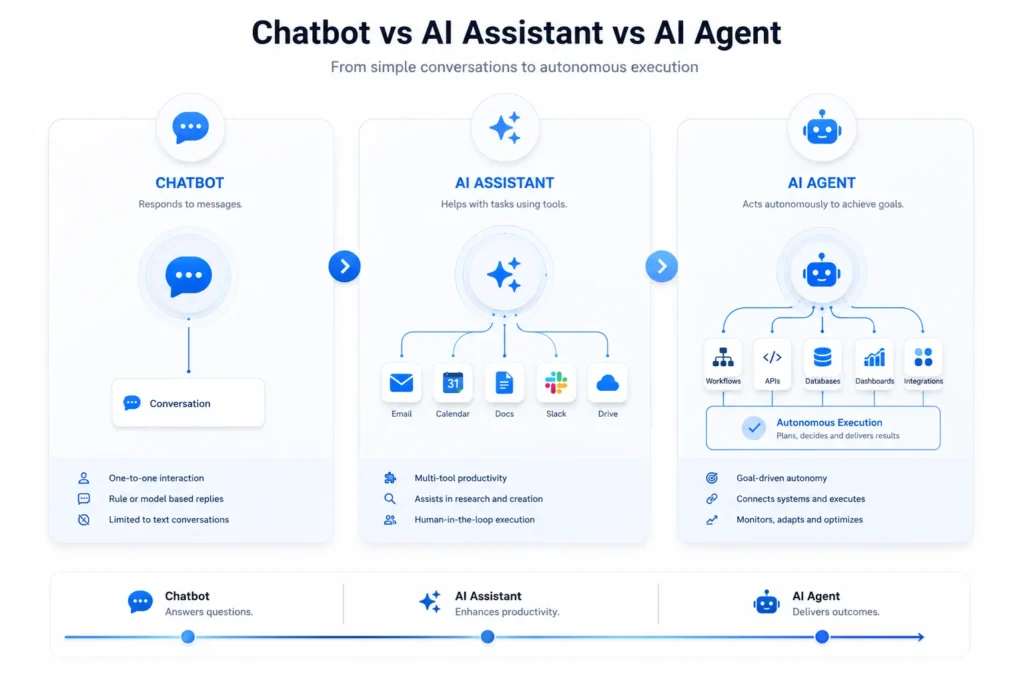
These three terms get used almost interchangeably, and even vendors aren’t consistent about it. The real distinction is about who decides what happens next.
| Chatbot | AI Assistant | AI Agent | |
|---|---|---|---|
| Trigger | Waits for a message | Waits for a prompt | Pursues a goal |
| Autonomy | None — one reply per message | Low — one task per request | High — plans and executes multiple steps |
| Memory | Little to none | Session-based | Short-term + persistent, task-relevant memory |
| Tool use | Rare | Limited, user-approved | Central — calls APIs, databases, other agents |
| Example | A website FAQ bot | “Draft this email for me” | “Research our top 10 competitors and produce a report” |
The practical rule of thumb: if the task fits inside a single prompt-and-response exchange, you’re using an assistant or chatbot. If it requires coordinating multiple steps, tools, or systems toward an outcome, that’s agent territory.
How Do AI Agents Actually Work?
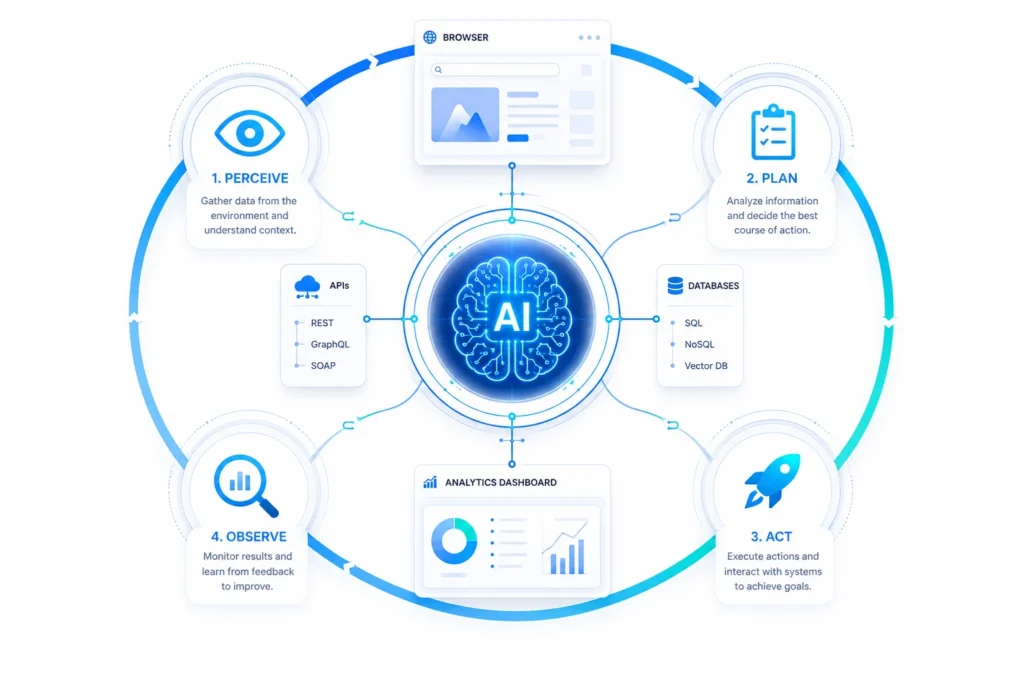
Strip away the marketing language, and most AI agents run on a repeating loop with four stages:
1. Perceive. The agent takes in a goal or instruction, plus any relevant context — a document, a database record, an incoming email.
2. Plan. The underlying LLM reasons about what steps are needed to reach the goal, in what order, and which tools each step requires. This reasoning-plus-acting pattern is widely known in AI research as the ReAct approach.
3. Act. The agent calls a tool — a web search, an API, a database query, another agent — to gather information or make a change in the world.
4. Observe and adapt. The agent checks the result of that action against the goal, updates its plan if needed, and repeats the loop until the task is done or it needs human input.
The “tool-calling” part of that loop increasingly runs through a standardized connection layer rather than one-off custom integrations. Anthropic’s Model Context Protocol (MCP), an open standard for connecting AI systems to external tools and data sources, has become the de facto way agents plug into calendars, CRMs, codebases, and databases without a custom integration for every pairing.
The Classic Types of AI Agents
Long before “AI agent” became a 2026 buzzword, AI research already had a taxonomy for this, based on how much internal state and reasoning a system carries.
| Type | How It Behaves | Example |
|---|---|---|
| Simple reflex agent | Reacts to current input only, using fixed condition-action rules; no memory | A thermostat-style automation that triggers on a single condition |
| Model-based reflex agent | Keeps an internal model of its environment to handle situations not fully visible in the current input | A robot vacuum that tracks which rooms it has already cleaned |
| Goal-based agent | Plans a sequence of actions to reach a defined goal, rather than reacting rule-by-rule | A navigation app choosing a route to a destination |
| Utility-based agent | Chooses among multiple ways to reach the goal, ranking them by a “usefulness” score | A logistics agent picking the cheapest and fastest shipping option |
| Learning agent | Improves its own performance over time based on feedback and outcomes | A fraud-detection agent that adjusts its thresholds as new fraud patterns appear |
Modern LLM-based agents typically combine goal-based and utility-based reasoning with a learning component layered on top. And increasingly, they don’t work alone: multi-agent systems assign different specialized agents — a researcher, a writer, a reviewer, a compliance checker — to the same task, with each handing off work to the next, mirroring how a human team divides labor.
AI Agents vs. Agentic AI: What’s the Real Difference?
This is one of the most confused pairs of terms in AI right now, and the confusion is reasonable — the industry itself hasn’t fully standardized usage.
AI agent typically refers to a specific software system built to handle a task or set of tasks — a customer-support agent, a coding agent, a research agent. Agentic AI is the broader description of the approach: AI that pursues outcomes proactively, plans its own steps, and often coordinates multiple agents rather than just executing a single, scoped task. Put simply, agentic AI is the capability; an AI agent is one instance of a system built using that capability.
In practice, plenty of vendors use the two terms interchangeably, and for a general audience that’s rarely worth arguing over. Where it matters is in scale: a single “AI agent” doing one job is very different from an “agentic AI” system coordinating a dozen agents across a business process — and 2026 buying decisions increasingly hinge on knowing which one you’re actually being sold.
Inside an AI Agent: Core Components
Every production-grade agent, regardless of vendor, is built from the same handful of parts:
- Reasoning engine (the LLM core): The large language model that interprets instructions, plans steps, and decides what to do next.
- Memory: Short-term memory holds context for the current task; longer-term memory (often a vector database) lets an agent recall relevant information across sessions.
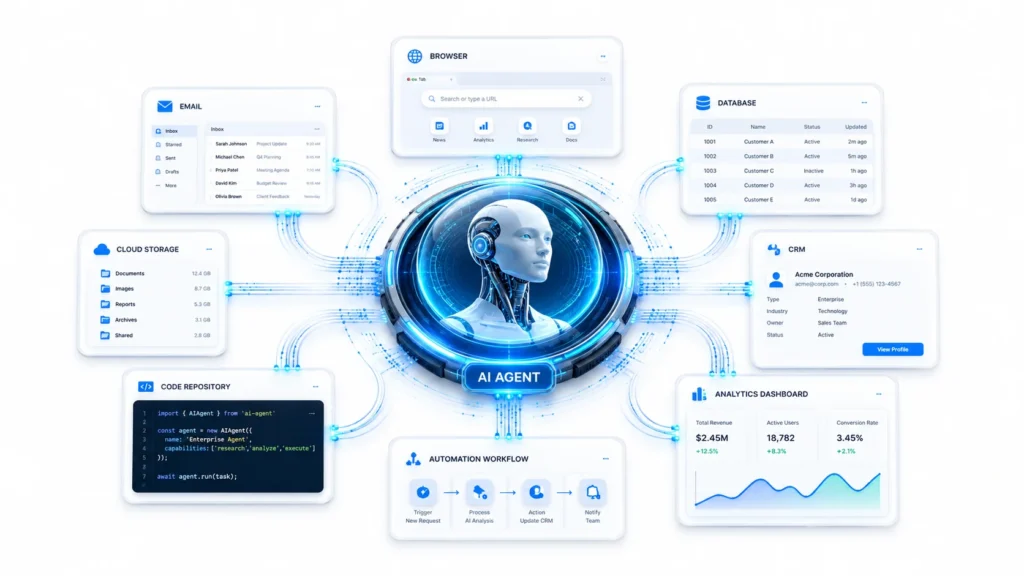
- Tools and APIs: The mechanisms an agent uses to act — searching the web, querying a database, sending an email, updating a CRM record.
- Planning and orchestration layer: The logic that breaks a goal into steps, decides ordering, and handles branching or retries when something fails.
- Connection protocols: Standardized layers that let agents reach tools and other agents without bespoke integration work. The two most relevant in 2026 are Anthropic’s Model Context Protocol (MCP) for connecting an agent to external tools and data, and Google’s Agent2Agent (A2A) protocol for letting agents built on different frameworks discover and collaborate with each other.
Real-World AI Agent Examples in 2026
The landscape splits fairly cleanly into three groups.
Consumer and vendor-built agents — ready to use without building anything yourself: Claude Code and Claude’s computer-use capabilities (Anthropic), ChatGPT Agent and Codex (OpenAI), Devin AI (Cognition), Perplexity Computer, Manus, and Google’s Antigravity agent-first development platform.
Developer frameworks — for teams building custom agents:
| Framework | Best For |
|---|---|
| LangGraph | Complex, stateful workflows needing precise branching and human-in-the-loop control |
| CrewAI | Fast prototyping of role-based multi-agent “crews” (researcher, writer, reviewer) |
| Microsoft AutoGen / AG2 | Conversational multi-agent problem-solving and debate-style collaboration |
| OpenAI Agents SDK | OpenAI-native agents using explicit handoffs between agents |
| Claude Agent SDK | Anthropic-native production agents, with built-in MCP, hooks, and subagents |
| Semantic Kernel | Enterprises standardized on .NET / Microsoft Azure infrastructure |
Enterprise platforms — managed, less code required: Microsoft Copilot Studio, Salesforce Agentforce 360, AWS Bedrock AgentCore, and Google Vertex AI Agent Builder.
Business Use Cases for AI Agents
Customer service: Tier-1 ticket triage, resolution, and escalation without a human touching every routine request.
Sales and SDR work: Lead qualification, personalized outreach drafting, and CRM updates handled end-to-end from a single goal like “qualify this week’s inbound leads.”
Software engineering: Coding agents (Devin, Claude Code, Codex) that write features, fix bugs, run tests, and open pull requests inside a sandboxed environment.
Finance and operations: Invoice matching, reconciliation, and approval routing — high-volume, rules-heavy workflows that are naturally suited to agent automation.
Marketing: Agents increasingly sit behind keyword research, content briefs, and campaign asset production. If you’re evaluating which AI tools actually fit a marketing workflow today — several of which now have agent-like automation features — our best AI tools for marketing guide breaks down real costs and where each tool fits.
Benefits of AI Agents
Multi-step execution without re-prompting. One goal can trigger a dozen coordinated actions instead of a dozen manual prompts.
Cross-system coordination. A single agent can touch a calendar, an inbox, and a CRM in one workflow — something a standalone chatbot can’t do.
Faster resolution on high-volume, repetitive workflows. Ticket triage, data entry, and report compilation are exactly the tasks agents handle best.
Specialization through multi-agent teams. Complex work can be split across agents with narrow, well-defined roles, closer to how a human team operates than a single generalist tool.
Risks, Limitations, and Security Concerns
A trustworthy guide to agents has to take the risks as seriously as the capabilities.
Prompt injection is the top agent-specific security risk. Large language models can’t reliably tell the difference between a trusted instruction and hostile text buried in a webpage, email, or document the agent reads. The OWASP Top 10 for Agentic Applications, published in December 2025, names prompt injection, memory poisoning, and tool or plugin misuse as the three leading risk categories specific to autonomous agents — separate from the earlier OWASP LLM Top 10.
Over-privileged agents. Giving an agent broad tool access “just in case” turns a single successful injection attack into an incident that can touch far more systems than the task ever required.
Hallucination becomes an action problem. A chatbot hallucinating a wrong fact is embarrassing. An agent hallucinating a wrong fact and then acting on it — sending an incorrect invoice, updating the wrong record — is an operational failure.
Cascading failures in multi-agent chains. When one agent hands off flawed output to the next, errors compound rather than staying contained.
Governance is lagging deployment. Gartner has forecast that more than 40% of agentic AI projects will be canceled by the end of 2027, citing rising costs, unclear business value, and inadequate governance as the main causes — a sobering counterweight to the adoption numbers below.
Common Mistakes Businesses Make When Adopting AI Agents
Treating an agent’s tool access like an all-or-nothing switch, rather than scoping it narrowly to what the task actually needs, causes most avoidable incidents. A close second is skipping human-approval checkpoints for irreversible actions — sending money, deleting records, emailing customers — because the agent “usually gets it right.” Many teams also pick a framework based on hype rather than matching it to their workflow shape (a graph-heavy approval process needs LangGraph’s control; a role-based content pipeline is a better fit for CrewAI). Finally, treating a workflow that ran without errors as a workflow that ran correctly is a quiet but common trap — an agent can complete every step successfully and still produce a wrong result.
Best Practices for Deploying AI Agents Safely
Start with one narrow, well-defined task before expanding an agent’s scope. Apply least-privilege tool access, so an agent can only reach the systems its current task genuinely requires. Keep a human-approval step in place for any irreversible action. Treat any external content the agent reads — web pages, emails, uploaded documents — as untrusted input, not neutral data. Log every tool call so failures and unexpected actions are auditable after the fact. And choose the framework or platform that matches your team’s actual skill level and governance needs, not whichever one is trending this month.
The State of AI Agent Adoption in 2026
Gartner projects that 40% of enterprise applications will include task-specific AI agents by the end of 2026, up from less than 5% in 2025 — one of the steepest enterprise software adoption curves on record. Looking further out, Gartner’s best-case scenario has agentic AI driving close to 30% of enterprise application software revenue by 2035, surpassing $450 billion, up from just 2% in 2025.
Adoption is uneven by design maturity, though. McKinsey’s 2025 survey found that 23% of organizations are already scaling an agentic AI system somewhere in their operations — concentrated mostly in IT service automation and knowledge management — while in any single business function, no more than about 10% of organizations report scaling agents at meaningful depth. The infrastructure connecting agents to tools has matured alongside that growth: MCP alone has passed 100 million monthly SDK downloads and is now widely treated as the industry-standard way to connect agents to external systems.
The Future of AI Agents
Gartner expects collaboration between specialized agents, rather than single general-purpose bots, to define the next phase: by 2027, roughly one-third of agentic AI implementations are projected to combine agents with different skills to manage complex tasks within a single application or data environment. Longer term, that points toward “agentic front ends” — interfaces where a user states a goal and a coordinated set of agents handles the underlying steps across multiple applications, rather than the user operating each application directly.
FAQs
What is an AI agent in simple terms? An AI agent is a software system that can understand a goal, plan the steps needed to reach it, and take action using tools like search, APIs, or other software — mostly without a human guiding every step.
What is the difference between an AI agent and an AI assistant? An AI assistant is reactive: it waits for a specific prompt and completes one task at a time. An AI agent is proactive: given a goal, it plans and executes multiple steps on its own, calling tools and adjusting its approach as needed.
What is the difference between AI agents and agentic AI? An AI agent is a specific system built to handle a task. Agentic AI is the broader term for the autonomous, goal-driven approach itself, which often involves multiple agents coordinating together rather than one agent working alone.
What are the main types of AI agents? The classic taxonomy includes simple reflex agents, model-based reflex agents, goal-based agents, utility-based agents, and learning agents. Most modern LLM-powered agents combine goal-based and utility-based reasoning with ongoing learning.
Are AI agents safe to use in a business setting? They can be, with the right safeguards. The main risks are prompt injection, over-privileged tool access, and cascading errors across multi-agent workflows — all manageable with least-privilege access, human approval steps for irreversible actions, and full logging of tool calls.
What is the Model Context Protocol (MCP)? MCP is an open standard, introduced by Anthropic, for connecting AI agents to external tools and data sources through a single, consistent integration rather than a custom connection for every tool.
What are some examples of AI agents in 2026? Claude Code, ChatGPT Agent, Devin AI, Perplexity Computer, and Manus are widely used consumer-facing agents. Developers building custom agents commonly use frameworks like LangGraph, CrewAI, and the OpenAI or Claude Agent SDKs.
Do I need to know how to code to use AI agents? No. Managed platforms like Microsoft Copilot Studio, Salesforce Agentforce, and various no-code builders let non-developers configure agents through a visual interface. Coding is only necessary for custom, framework-level agent development.
Conclusion
An AI agent isn’t a smarter chatbot — it’s a different category of software, built to plan, act, and adapt toward a goal instead of just answering a prompt. The technology moved from research curiosity to enterprise infrastructure faster than almost any comparable shift in software history, and 2026’s data backs that up: rising adoption, a maturing framework ecosystem, and standardized protocols connecting agents to the tools they need. But the same data shows a governance gap that hasn’t closed at the same pace. Understanding what an agent actually is, how it’s built, and where it can fail is the difference between deploying one that saves real time and deploying one that quietly creates a bigger problem than it solved.
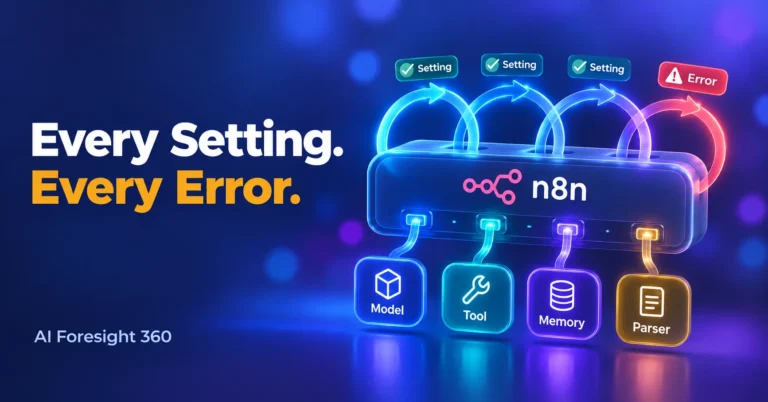
If you are moving from concept to a working build, n8n is where most teams start, and its Agent node is the piece that does the deciding. Our breakdown of every n8n AI Agent node setting covers what each option changes and the errors that show up once real tools are attached.
Key Takeaways
- An AI agent combines reasoning, tool use, and meaningful autonomy to plan and execute multi-step tasks — a chatbot or assistant does neither the planning nor the multi-step execution.
- The classic taxonomy (simple reflex, model-based reflex, goal-based, utility-based, learning agents) still applies; most modern agents blend the goal-based and utility-based types.
- “AI agent” and “agentic AI” aren’t strictly the same thing — an agent is a specific system, agentic AI is the broader autonomous approach, often involving several agents working together.
- MCP and A2A are the two protocols standardizing how agents connect to tools and to each other in 2026.
- Gartner projects 40% of enterprise applications will embed task-specific agents by the end of 2026, but also expects more than 40% of agentic AI projects to be canceled by 2027 over governance and value gaps — adoption and successful adoption are not the same thing.
- Prompt injection, over-privileged tool access, and cascading multi-agent errors are the risks to design around before deploying an agent on anything business-critical.

Ahmad Hussain
ACCAAhmad builds advanced Excel models, Power BI dashboards, and AI automation for businesses. He writes AI Foresight 360 himself, and every pricing figure and feature claim is verified against official documentation at the source.
Connect on LinkedIn