
What Is Artificial Intelligence?
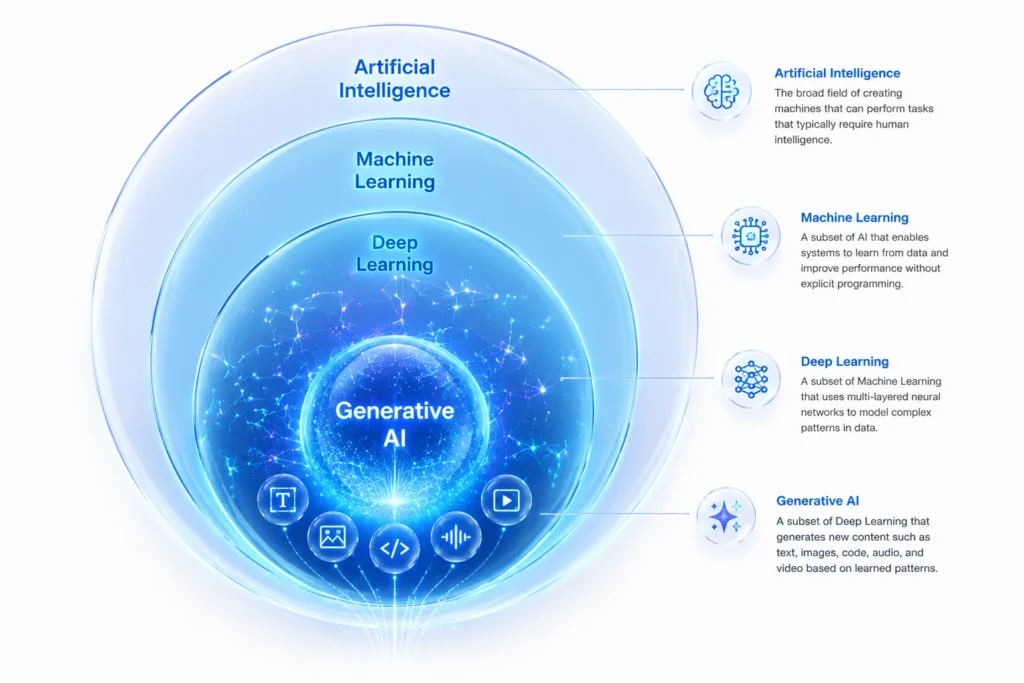
Artificial intelligence (AI) is a branch of computer science focused on building systems that can perform tasks normally associated with human thinking: understanding language, recognizing patterns, making predictions, solving problems, and generating new content.
That’s the plain-language version. A few more precise definitions are worth knowing, because they each capture a different angle:
- IBM describes AI as technology that lets computers and machines simulate human learning, comprehension, problem-solving, decision-making, and creativity. Link
- John McCarthy, who coined the term at the 1956 Dartmouth Conference, defined AI simply as the science and engineering of making intelligent machines.
- Marvin Minsky described it as the science of making machines do things that would require intelligence if a person did them.
- McKinsey frames AI as a machine’s ability to mimic human cognitive functions — perception, reasoning, learning, and problem-solving.
Notice what these definitions have in common: none of them claim AI machines actually think or feel. AI systems simulate the outputs of intelligent behavior using statistics, data, and mathematical models. That distinction matters, and it’s one of the most commonly misunderstood parts of the entire field.
In practice, “AI” today is an umbrella term covering everything from the spam filter in your email to the large language model behind ChatGPT. Not all AI is the same kind of AI, which is exactly why the rest of this guide breaks the field into clear, usable categories.
A Brief History of AI
AI didn’t appear with ChatGPT in 2022. It’s the product of more than 70 years of research, false starts, and genuine breakthroughs.
Britannica — “History of Artificial Intelligence”: Link
| Year | Milestone |
|---|---|
| 1950 | Alan Turing publishes “Computing Machinery and Intelligence,” proposing what became known as the Turing Test |
| 1956 | The Dartmouth Summer Research Project formally coins the term “artificial intelligence” |
| 1957 | Frank Rosenblatt introduces the perceptron, an early neural network |
| 1966 | Joseph Weizenbaum builds ELIZA, one of the first natural language processing programs |
| 1997 | IBM’s Deep Blue defeats world chess champion Garry Kasparov |
| 2011 | IBM Watson defeats human champions on Jeopardy! |
| 2012 | Deep learning breakthroughs in image recognition reignite serious AI investment |
| 2022 | ChatGPT brings generative AI to mainstream public use |
| 2023–2026 | The shift from single-prompt chatbots to multi-step, tool-using AI agents accelerates |
The pattern worth noticing: AI advances in waves, often followed by “AI winters” — periods where funding and interest collapsed because the technology of the time couldn’t deliver on its promises. The current wave, driven by deep learning and large language models, has lasted longer and scaled faster than any prior one, partly because it’s now backed by real commercial revenue, not just research funding.
How Does AI Actually Work?
Strip away the marketing language, and most modern AI systems work through a fairly consistent process:
1. Data collection. AI systems learn from examples, not instructions. A fraud-detection model needs thousands of past transactions labeled as fraudulent or legitimate.
2. Training. An algorithm processes that data repeatedly, adjusting internal parameters until it gets better at predicting the correct answer. In deep learning, this happens inside a neural network — layers of interconnected nodes loosely inspired by neurons in the brain.
3. Inference. Once trained, the model is given new, unseen input (a new transaction, a new sentence, a new image) and produces an output based on the patterns it learned.
4. Feedback and refinement. Many production AI systems continue to be evaluated and retrained as new data comes in, or as users flag mistakes.
None of this involves a system “understanding” anything the way a person does. A large language model predicting the next word in a sentence is doing extremely sophisticated statistical pattern-matching — not reasoning from first principles, even when the output reads like it is. That gap between appearing intelligent and being intelligent is the core of nearly every serious debate in the field today.
AI vs. Machine Learning vs. Deep Learning vs. Generative AI
These four terms get used almost interchangeably in casual conversation, but they describe a nested relationship, not four separate things.
| Term | What It Is | Relationship |
|---|---|---|
| Artificial Intelligence (AI) | The broad field: building systems that perform tasks requiring human-like intelligence | The umbrella category |
| Machine Learning (ML) | A subset of AI where systems learn patterns from data instead of following explicit rules | A method for achieving AI |
| Deep Learning (DL) | A subset of ML using multi-layered neural networks to process complex, unstructured data (images, audio, text) | A specific ML technique |
| Generative AI (GenAI) | A subset of deep learning focused on producing new content — text, images, audio, video, code | An application of deep learning |
Put simply: every generative AI tool is a deep learning system, every deep learning system is a machine learning system, and every machine learning system is a form of AI — but the reverse isn’t true. A simple rule-based chess program from the 1990s is AI, but it’s not machine learning, because it didn’t learn from data; it followed pre-written rules.
A tool like ChatGPT or Claude sits at the narrowest, most specific point of that nesting: it’s a generative AI application built on a large language model, which is a product of deep learning, which is a form of machine learning, which is a form of AI.
Types of AI by Capability
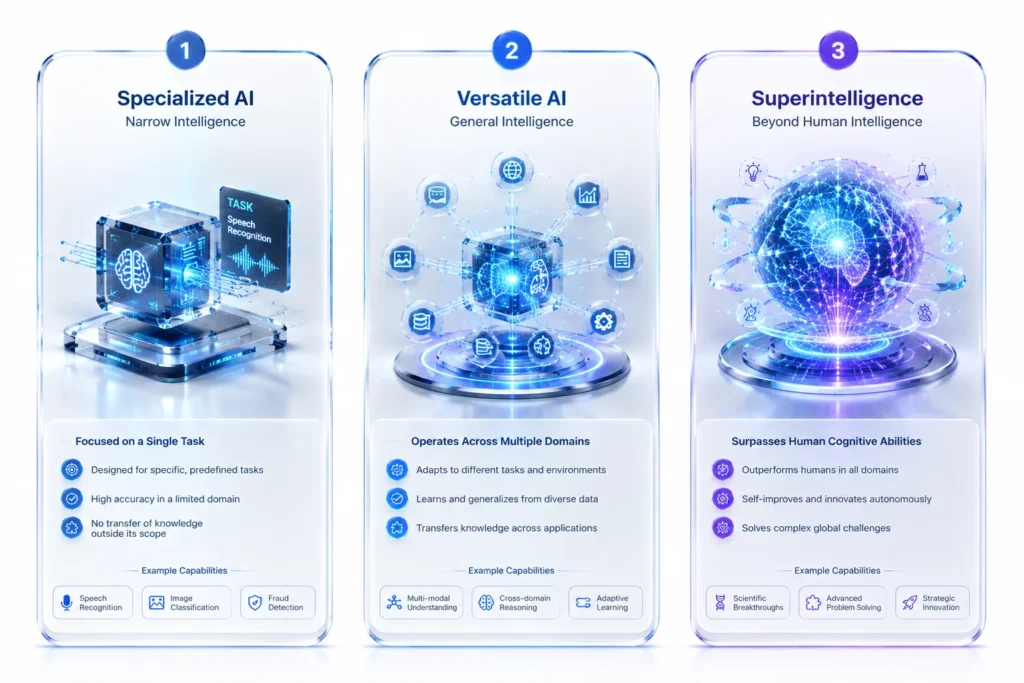
AI is most commonly classified into three levels based on how broadly capable the system is.
| Type | Current Status | Examples |
|---|---|---|
| Narrow AI (Weak AI / ANI) | Exists today — this is the only type of AI currently in real-world use | Voice assistants, recommendation engines, fraud detection, image recognition, chatbots, AI coding assistants |
| General AI (Strong AI / AGI) | Theoretical — no verified system has reached this level | None yet; an active research goal for major AI labs |
| Superintelligence (ASI) | Hypothetical | None; discussed mainly in AI safety and ethics research |
Narrow AI is designed to do one job, or a closely related set of jobs, extremely well. It cannot transfer that skill to an unrelated task. A model that translates languages with superhuman accuracy still can’t diagnose a medical condition — that would require an entirely different system.
General AI (AGI) would be able to learn a new skill, reason about unfamiliar situations, and transfer knowledge across domains the way a human can. Despite genuinely impressive progress in benchmark performance over the past two years, no current system meets this bar. Even the most capable generative AI tools remain narrow systems that are very good at language and pattern recognition specifically.
Superintelligence (ASI) describes a hypothetical AI that would exceed human ability in every domain — creativity, strategy, social reasoning, scientific discovery. It exists only as a subject of research and debate, not as a built system.
A practical note: marketing copy from AI vendors sometimes blurs these categories to sound more impressive than the underlying technology actually is. If a product claims “general intelligence” capability, that claim deserves scrutiny — by the field’s own definitions, AGI doesn’t exist yet.
Types of AI by Functionality
A second, less commonly discussed classification looks at how an AI system relates to memory and context, rather than how broadly capable it is.
Reactive machines have no memory of past interactions and respond only to the current input. IBM’s Deep Blue is the textbook example — it evaluated the board in front of it without “remembering” prior games.
Limited memory AI is what most AI in use today actually is. These systems use recent data (sometimes including conversation history) to inform decisions, but that memory isn’t persistent or self-directed the way human memory is. Most chatbots, recommendation systems, and self-driving car perception systems fall here.
Theory of mind AI is a research-stage concept: systems that could understand that other agents (people or AI systems) have their own beliefs, intentions, and emotions, and adjust behavior accordingly. Early, narrow versions of emotion recognition exist, but genuine theory-of-mind reasoning doesn’t.
Self-aware AI would possess its own internal sense of identity and consciousness. This remains entirely theoretical and is debated as much in philosophy as in computer science.
Core AI Technologies You’ll Hear About
A few subfields show up constantly in AI conversations and are worth defining on their own:
Natural Language Processing (NLP) gives machines the ability to read, interpret, and generate human language — the technology behind chatbots, translation tools, and voice assistants.
Computer Vision allows systems to interpret images and video: facial recognition, medical imaging analysis, and quality inspection on a manufacturing line all rely on it.
Robotics combines AI with physical hardware so machines can sense and act in the real world, from warehouse robots to autonomous vehicles.
Expert Systems are an older form of AI that encode human expert knowledge into if-then rules. They’re less fashionable than machine learning today but still used in some diagnostic and compliance tools.
AI Agents are the newest major category: systems built on top of large language models that can plan multi-step tasks, call external tools or APIs, and execute a workflow with limited human input rather than just answering a single prompt. More on this below.
Real-World Uses of AI by Industry
AI’s reach across industries in 2026 is broad enough that almost every sector now has at least one mature use case:
Healthcare uses AI for medical image analysis, clinical documentation, and diagnostic support — one of the fastest-growing application areas in the most recent Stanford AI Index data.
Finance and accounting rely on AI for fraud detection, risk modeling, and increasingly for day-to-day workflow assistance. If you’re deciding between AI assistants for accounting-specific work, this comparison of ChatGPT vs. Claude for accountants breaks down which tool handles which tasks better.
Marketing has seen some of the most measurable productivity gains from generative AI of any business function, particularly in content production and campaign creation. For a practical breakdown of which tools are worth using right now, see this guide to the best AI tools for marketing.
Retail and e-commerce use AI for personalized recommendations, demand forecasting, and dynamic pricing.
Manufacturing applies computer vision for quality control and predictive maintenance to reduce equipment downtime.
Transportation uses AI in route optimization, logistics, and increasingly autonomous or driver-assist vehicle systems.
Education is experimenting heavily with AI tutoring tools, though — as covered in the risks section below — the research on actual learning outcomes is still mixed.
The State of AI in 2026: What the Data Actually Shows
A lot of “AI is everywhere” claims are vague. Here’s what the most current authoritative research actually measured.
According to Stanford HAI’s 2026 AI Index, organizational AI adoption reached 88% among surveyed companies, and generative AI hit 53% population-level adoption within roughly three years — faster than either the personal computer or the internet reached the same milestone. On a closely watched coding benchmark (SWE-bench Verified), AI model performance climbed from around 60% to nearly 100% of the human baseline in a single year. Link
McKinsey’s November 2025 State of AI survey, covering nearly 2,000 organizations across 105 countries, found a similar adoption number — 88% of organizations now use AI in at least one business function, up from 78% the year before. But adoption and impact aren’t the same thing: McKinsey found only about 39% of organizations report any measurable EBIT impact from AI, and most of those report less than 5% of total earnings attributable to it. The functions seeing the clearest productivity gains, per McKinsey’s data, are software development (around 26%), customer support (14–15%), and marketing output (as high as 50%) — which is exactly why marketing has become one of the most mature AI use cases. Link
Investment is climbing just as fast. The Stanford AI Index reports U.S. private AI investment reached $285.9 billion in 2025, with global corporate AI investment up nearly 130% year-over-year. At the same time, the same report flags a less flattering trend: the Foundation Model Transparency Index — a measure of how openly AI companies disclose training data, compute usage, and safety information — dropped from an average of 58 points to 40 points in a single year, meaning the most capable models are also becoming the least transparent about how they work.
For a running log of what’s actually shipping month to month, our own biggest AI developments in June 2026 roundup tracks the releases and announcements behind these adoption numbers.
AI Agents: The Next Phase

If 2023–2024 was defined by chatbots that answered a single prompt, 2025–2026 has been defined by the rise of AI agents — systems that can plan a multi-step task, call external tools or databases, and carry out a workflow with minimal supervision.
McKinsey’s 2025 survey found that 23% of organizations are already scaling an agentic AI system somewhere in their operations, concentrated mostly in IT service automation and knowledge management. That’s still early-stage: in any single business function, no more than about 10% of organizations report scaling agents at meaningful depth. But the direction is clear, and high-performing organizations are roughly three times more likely than average to be scaling agent use.
Practically, this is the difference between asking a chatbot “draft this email” and instructing an agent to research a topic across multiple sources, compile findings, draft a document, and flag it for your review — without you prompting each individual step.
Benefits of Artificial Intelligence
The genuine, measured benefits of AI tend to cluster around a few categories rather than being evenly spread everywhere:
Speed and scale. AI can process volumes of data — transactions, images, documents — that would be impractical for a human team to review manually.
Pattern detection. Fraud detection, medical imaging analysis, and predictive maintenance all depend on AI’s ability to spot subtle patterns across huge datasets.
Content and code production. McKinsey’s data shows measurable output gains in marketing (around 50%) and software development (around 26%), making these two of the clearest near-term value areas for businesses.
Personalization at scale. Recommendation systems, dynamic pricing, and tailored customer experiences all rely on AI’s ability to adjust to individual behavior in real time.
Accessibility. Tools like real-time translation and text-to-speech have made information and communication more accessible to people who previously faced language or disability barriers.
Risks, Limitations, and Open Problems
A trustworthy guide to AI has to be honest about where the technology falls short, not just where it succeeds.
Hallucination and unreliable output. Generative AI models can produce confident, fluent, and entirely incorrect answers. This isn’t a minor bug; it’s a structural consequence of how these models generate text — by predicting likely sequences, not by verifying facts.
Declining transparency. As noted above, Stanford’s 2026 AI Index found that the most capable frontier models are also disclosing less about their training data, compute usage, and safety testing than earlier generations did — making it harder for outside researchers to evaluate them independently.
Documented safety incidents are rising. The same report tracked 362 documented AI-related incidents in the most recent year, up from 233 the year before.
Labor market effects are real and uneven. Rather than broad job elimination, the clearest early signal so far is structural: data cited in recent AI Index coverage points to a measurable decline in junior-level technical hiring even as senior hiring holds steady or grows, suggesting AI is changing who gets hired more than it’s eliminating roles outright.
Bias and fairness. AI models learn from historical data, which means they can reproduce and even amplify existing biases present in that data, particularly in hiring, lending, and law enforcement applications.
Environmental and compute cost. Training and running large models requires significant energy and data center capacity — a cost that’s grown alongside model capability rather than shrinking.
Education outcomes are still unclear. Despite enormous investment in AI tutoring tools, Stanford’s 2026 Index notes that rigorous evidence on actual learning outcomes remains limited, with some studies showing improvement, others showing no effect, and some suggesting AI assistance can reduce the “productive struggle” that builds real understanding.
Common Misconceptions About AI
A few myths persist even among otherwise well-informed readers:
“AI understands what it’s saying.” It doesn’t, in the human sense. Language models generate statistically likely text based on patterns in training data, not comprehension or intent.
“AGI already exists.” By the field’s own definitions, no system today can transfer learning across arbitrary domains the way a human can. Current systems, however capable, remain narrow AI.
“AI is neutral and objective.” AI systems inherit the biases present in their training data and design choices. Objectivity isn’t a default property of AI; it has to be actively engineered and tested for.
“AI will replace all jobs.” The current data points to task-level automation and role restructuring more than wholesale job elimination, though the effects are uneven across seniority levels and industries, as the junior-hiring data above shows.
“Bigger models always mean better, safer AI.” Capability and transparency have moved in opposite directions recently, according to Stanford’s own tracking — a more capable model isn’t automatically a more accountable one.
How to Start Using AI (Without Wasting Time)
If you’re starting from zero, the fastest path to genuine competence looks like this:
Start with one narrow AI tool tied to a real task you already do, rather than trying to “learn AI” abstractly. A generative AI assistant for writing, a coding assistant, or an industry-specific tool is more useful than a general AI course at the beginning.
Learn to write clear, specific prompts. Vague instructions produce vague output. State the task, the context, the format you want, and any constraints.
Verify anything factual the AI produces. Treat AI output as a draft from a fast, well-read, occasionally wrong collaborator — not as a finished, fact-checked answer.
Pick tools based on the task, not the hype. Different tools are genuinely better at different jobs — the right choice for accounting work isn’t necessarily the right choice for marketing copy.
Common Mistakes Beginners Make
A few patterns show up repeatedly among people new to working with AI:
Treating AI output as automatically correct, especially for numbers, dates, citations, or legal and medical information, is the most common and most costly mistake. A close second is using one tool for every task instead of matching the tool to the job. Many beginners also write prompts that are too vague, then blame the tool for a generic answer rather than refining the instruction. Finally, ignoring data privacy when pasting sensitive business or personal information into a public AI tool remains a widespread and avoidable risk.
Analysis: Where This Is Actually Headed
The following is editorial analysis, not a factual claim.
The gap between AI’s benchmark performance and its real-world reliability is, in our view, the single most important storyline for 2026 and beyond — more important than any individual model release. Capability is climbing faster than the infrastructure needed to verify, govern, and trust that capability, which is exactly the imbalance Stanford’s own researchers flagged in this year’s Index. For businesses, that suggests the smarter near-term strategy isn’t chasing the most powerful model available, but building the workflow discipline, human oversight, and measurement practices that let any given model’s output be verified before it’s acted on.
FAQs
What is the simplest definition of artificial intelligence? Artificial intelligence is technology that enables computers to perform tasks that normally require human intelligence, such as understanding language, recognizing patterns, and making decisions or predictions based on data.
Is ChatGPT considered artificial intelligence? Yes. ChatGPT is a generative AI application built on a large language model, which is itself a product of deep learning — making it AI, machine learning, and deep learning all at once, applied to text generation specifically.
What’s the difference between AI and machine learning? AI is the broad field of building systems that mimic human-like intelligence. Machine learning is one specific method for achieving that: training algorithms to learn patterns from data rather than following hand-written rules.
When was artificial intelligence invented? The field formally began in 1956 at the Dartmouth Summer Research Project, though the theoretical groundwork — including Alan Turing’s 1950 proposal of the Turing Test — dates back further.
Does true artificial general intelligence (AGI) exist yet? No. As of 2026, no system has demonstrated the ability to learn and transfer knowledge across arbitrary domains the way a human can. All current AI, including the most advanced generative models, is classified as narrow AI.
Is AI going to take over most jobs? The current evidence points to task-level automation and workforce restructuring rather than mass job elimination, though the impact is uneven — recent data shows a measurable shift away from junior-level technical hiring specifically, rather than a broad collapse across all roles.
What are some everyday examples of AI? Voice assistants, streaming service recommendations, spam filters, navigation app traffic predictions, language translation apps, and AI chatbots are all examples most people interact with regularly without thinking of them as “AI.”
Is artificial intelligence dangerous? Narrow AI carries real but manageable risks — bias, misinformation, privacy issues, and unreliable output. Concerns about more existential risk are generally tied to hypothetical future general or superintelligent AI, not to the narrow AI systems in use today.
Conclusion
Artificial intelligence isn’t one technology — it’s a layered field running from broad rule-based systems down through machine learning, deep learning, and the generative AI tools that have become part of daily life since 2022. Understanding where a given tool sits in that hierarchy, what it can and can’t actually do, and what the current data says about its real-world impact is far more useful than treating “AI” as a single, vague buzzword. The technology genuinely is reshaping how work gets done in 2026 — just unevenly, and with real limitations that are worth taking as seriously as the genuine progress.
Key Takeaways
- AI is the broad field of building systems that perform tasks requiring human-like intelligence; machine learning, deep learning, and generative AI are progressively narrower subsets of it, not separate technologies.
- Only narrow AI exists today. Artificial general intelligence and superintelligence remain theoretical, despite how advanced current tools feel.
- Stanford’s 2026 AI Index and McKinsey’s 2025 survey both show roughly 88% organizational AI adoption, but actual measured business impact (EBIT) still lags well behind adoption.
- The clearest productivity gains so far are in marketing (~50%), software development (~26%), and customer support (~14–15%).
- AI capability is currently outpacing AI transparency and governance — a gap worth watching closely rather than ignoring.
- AI agents that plan and execute multi-step tasks, not single-prompt chatbots, are the technology’s current frontier.

Ahmad Hussain
ACCAAhmad builds advanced Excel models, Power BI dashboards, and AI automation for businesses. He writes AI Foresight 360 himself, and every pricing figure and feature claim is verified against official documentation at the source.
Connect on LinkedIn