You have a stack of essays and a feeling about three of them. Something in the phrasing is too smooth, too evenly paced, too unlike what that student handed in last month. So you search for the best AI detector for teachers, paste a paragraph into the first free tool you find, and it returns a number: 87% AI.
Now what?
That number is the whole problem. It looks like evidence. It is not evidence. Understanding the difference is the single most important thing a teacher can learn about AI detection, and it is why choosing the best AI detector for teachers is less about the tool than most guides admit. If you are newer to how these systems work, our complete guide to artificial intelligence covers the foundations this article builds on.
This guide ranks the detectors worth using in 2026. It also tells you what they can honestly prove, where they fail, and which students they fail most often. Both halves matter. A detector used without understanding the second half can end a student’s academic career over a statistical artifact.
The One Thing Every Teacher Should Know First
Turnitin is the most widely deployed AI detector in education. Here is what Turnitin’s own documentation says about its AI writing scores:
the model may not always be accurate, may misidentify human-written, AI-generated, and AI-paraphrased text, and should not be used as the sole basis for adverse actions against a student.
That is the vendor. Not a critic, not a competitor. The company selling the detector states plainly that it does not make a determination of misconduct, and that the percentage on the AI writing indicator should not be used as the sole basis for action or as a definitive grading measure.
Read that sentence again, because a great deal follows from it.
An AI detector is not a plagiarism checker. When a plagiarism checker flags a passage, it shows you the source. You can open it, read it, and see the overlap with your own eyes. The evidence is a document. When an AI detector flags a passage, it produces no source, because none exists. It is making a statistical inference about how predictable your student’s word choices were. There is nothing to show the student except the number itself.
This is why the framing of this guide is not “which detector catches the most cheaters.” It is: which detector gives you the most reliable signal, with the fewest innocent students caught in the net, as one input into a decision you make with your own judgment.
Why False Positives Matter More Than Accuracy
Every detector marketing itself as the best AI detector for teachers leads with its accuracy rate. Accuracy is the less important number.
Think about what each error actually costs. A false negative means one AI written essay slips through ungraded as such. That is a bad outcome. A false positive means a student who wrote every word themselves is accused of cheating, has to prove a negative, and carries the anxiety of that accusation through a process where the evidence against them is a number nobody can explain.
Those costs are not symmetrical. Not remotely.
Now apply the arithmetic that convinced Vanderbilt University to switch its detector off in August 2023. Turnitin claimed a 1% false positive rate at launch. Vanderbilt submitted 75,000 papers in 2022. One percent of that is roughly 750 student papers that could have been incorrectly labeled as partly AI written.
Seven hundred and fifty. From a rate that sounds almost negligible when you read it as a percentage.
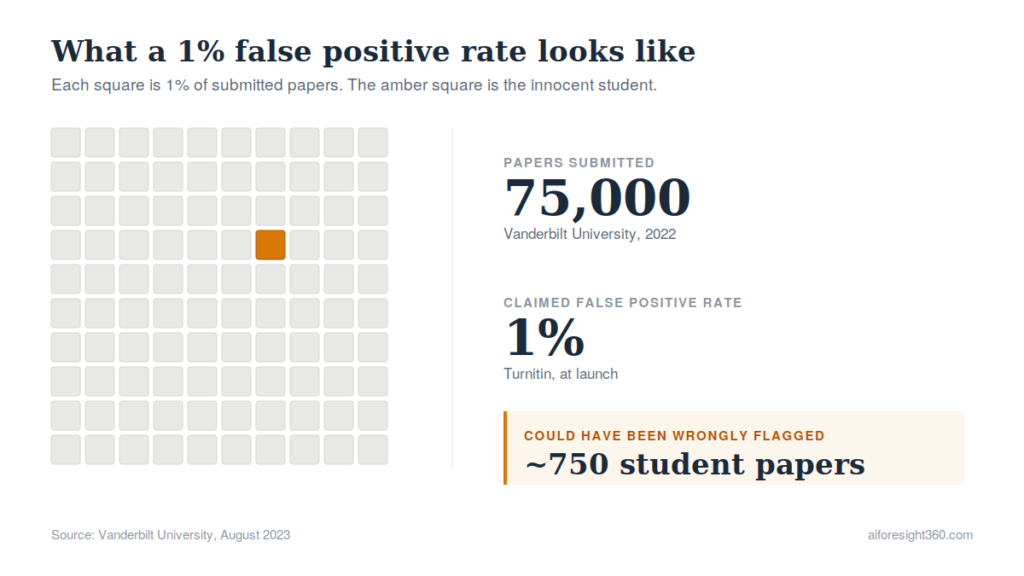
Scale it down to your classroom. For a high school English teacher grading around 750 essays a year, even a 1% false positive rate produces seven or eight wrongly flagged submissions annually. That is roughly one innocent student per marking period, every year, forever.
Vanderbilt’s stated reasoning went beyond the arithmetic. The university cited the lack of insight into how the tool works, the fact that it was enabled with less than 24 hours notice and no option to disable it, and widely reported instances of false accusations at other institutions. Other institutions have since restricted detection in various ways, including Yale, MIT, and the Toronto District School Board.
The lesson is not that detectors are useless. It is that the false positive rate, not the accuracy rate, is the number that should drive your choice.
The Bias Problem You Cannot Ignore
There is a second issue, and it is the reason no teacher should treat a flag as neutral.
The landmark study is Liang, Yuksekgonul, Mao, Wu and Zou, published in the Cell Press journal Patterns in 2023. The researchers ran essays through seven commercial detectors. More than half of the TOEFL essays written by non-native English speakers were incorrectly classified as AI generated, while the same detectors were near-perfect on essays written by US eighth graders. One detector flagged nearly 98% of the TOEFL essays as machine written, while the detectors correctly classified more than 90% of the native speaker essays.
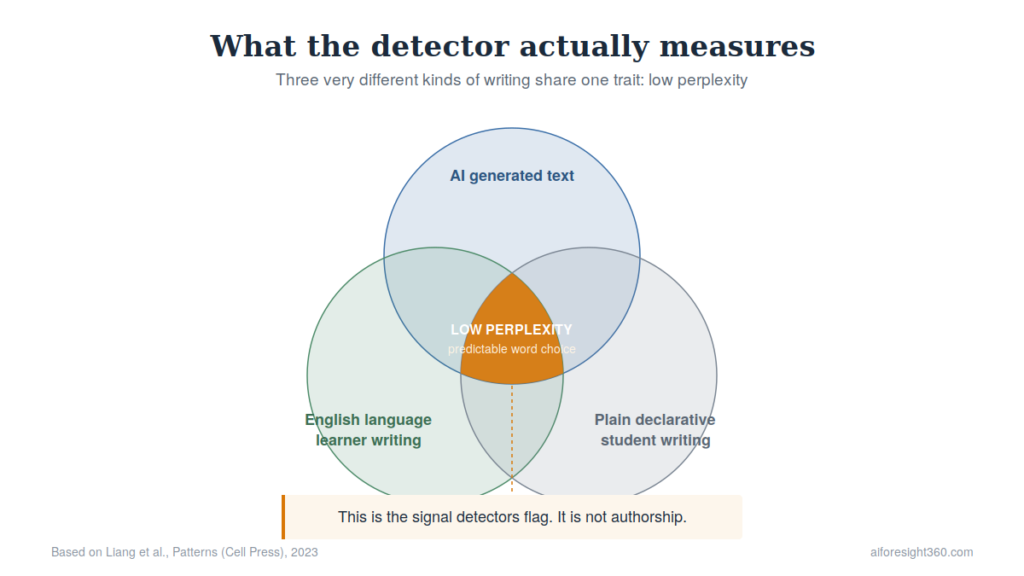
The mechanism is not mysterious, and it matters. Detectors look for low perplexity, meaning text where each word is highly predictable from the words before it. The TOEFL essays that were unanimously misclassified had significantly lower perplexity, which suggests the detectors penalize writers working with a narrower range of linguistic expression. This follows directly from how generative AI actually produces text, selecting each word by statistical likelihood.
Sit with what that means. The detector is not identifying AI. It is identifying simpler vocabulary and more conventional sentence structure. AI happens to write that way. So do English language learners. So, frequently, do students who write in a plain declarative style, students who have been carefully taught to write clear topic sentences, and neurodivergent students whose writing may be more direct, structured, or repetitive in ways detectors mistake for AI generation.
The students most likely to be falsely accused are the students least equipped to defend themselves. That is the ethical core of this entire topic.
Turnitin disputes how directly these findings apply to its own model, citing internal ELL testing that shows minimal bias. That dispute is worth noting. It does not resolve the underlying question, because the study tested the category of tools and the mechanism it identified is common to perplexity based detection generally.
One more data point about how hard this problem is. OpenAI built a detector for its own model’s output and then withdrew it. The company’s note stated that as of July 20, 2023, the AI classifier was no longer available due to its low rate of accuracy. At launch OpenAI had disclosed that the classifier correctly identified only 26% of AI written text while incorrectly labeling human written text as AI 9% of the time. The company that made the model could not reliably detect the model.
How We Evaluated These Tools
Full transparency about method, because you should demand this from any guide claiming to rank the best AI detector for teachers.
AI Foresight 360 did not run detectors against a private corpus of student essays for this article. We are not going to claim testing we did not do, and you should be skeptical of any site that claims a large controlled study without publishing its corpus and methodology.
What this ranking is built on instead:
Independent peer reviewed and academic research, prioritized above everything else. The Liang et al. study in Patterns, and the Jabarian and Imas benchmark from the University of Chicago Booth School of Business, circulated as NBER Working Paper 34223.
Vendor documentation and official pricing pages, verified directly at the source in July 2026 rather than copied from other blogs. This matters more than it sounds. While researching this article we found third party sites reporting at least five different prices for the same Copyleaks plan.
Institutional policy decisions, which tell you what universities concluded after evaluating these tools with far more data than any blogger has.
What we deliberately excluded: vendor self-reported accuracy claims presented as fact, and benchmark numbers from sites that sell competing detectors or AI humanizers. Several sites ranking detectors also sell tools to defeat detectors. Treat their numbers accordingly.
A note on the Chicago Booth paper, stated plainly: NBER working papers are circulated for discussion and comment, and have not been peer reviewed. It is the strongest independent evidence currently available in this category, and it is not a settled verdict.
Best AI Detector for Teachers: The 2026 Ranking
The best AI detector for teachers depends on whether you are one instructor with a stack of essays or an institution making a procurement decision. Here is how the four serious options compare. For evaluations of other tools in this category, see more AI tools reviews.
| Detector | Best for | Free tier | Individual paid | Key strength | Key limitation |
|---|---|---|---|---|---|
| Pangram | Teachers who cannot afford a false accusation | 4 scans/day | $20/mo | Lowest false positive rate in independent research | No plagiarism-only mode, paid tiers required for volume |
| GPTZero | Individual teachers starting out | 10,000 words/mo | $12.99/mo annually | Explainable sentence level scores, generous free tier | Vendor benchmarks are self published |
| Turnitin | Institutions already running it | None | Institutional only | Embedded in existing LMS workflows | Closed model, no public pricing, cannot be independently audited |
| Copyleaks | Multilingual and mixed content settings | Limited | $13.99/mo annually | Broad language coverage, AI and plagiarism in one report | Detection weakens on edited text |
1. Pangram: the strongest evidence for low false positives
Pangram earns the top position as the best AI detector for teachers on the strength of independent research rather than marketing.
The Jabarian and Imas study out of Chicago Booth, circulated as NBER Working Paper 34223, evaluated three leading commercial detectors, Pangram, OriginalityAI and GPTZero, plus the open source RoBERTa, on false negative and false positive rates across a corpus spanning genres, lengths and models. The finding: Pangram dominated the other detectors across all thresholds, and was the only detector meeting a stringent policy cap of a 0.5% false positive rate without compromising its ability to detect AI text.
That policy cap framing is the useful part for a teacher. It asks the right question: if you refuse to tolerate more than a fraction of a percent of wrongful flags, does the tool still catch anything? For most detectors, tightening the threshold that far destroys their detection ability. Pangram’s did not.
The other feature that matters in a classroom is nuance. Pangram distinguishes degrees of AI involvement rather than returning a binary verdict, which reflects how students actually work. A student who used ChatGPT to brainstorm an outline and then wrote the essay themselves is in a different situation from one who pasted in generated text, and your policy probably treats them differently. A single percentage cannot make that distinction.
Pricing, verified on Pangram’s pricing page in July 2026: a free tier with 4 credits per day, Individual at $20 per month for 600 credits monthly, Professional at $65 per month for 3,000 credits. Documents over 1,000 words consume one credit per 1,000 words. Developer API credits run $0.05 per 1,000 word credit. Institutional licensing for schools and universities is quoted directly and includes LMS integration with Canvas, Brightspace, Moodle and Google Classroom, with the stated commitment that they do not train on student data.
Where it falls short: the free tier will not carry a real class load. Four scans a day is an evaluation allowance. And Pangram’s advantage rests substantially on one working paper, which one competing vendor disputes.
2. GPTZero: the best starting point for an individual teacher
For an individual teacher without an institutional budget, GPTZero is the best AI detector for teachers to start with.
The free tier is the reason. Signing up gives you 10,000 words scanned per month at no cost with no credit card, which covers a genuine class load rather than a demo. Turnitin, by contrast, does not offer individual memberships at all and licenses only institution wide.
More importantly, GPTZero shows its work. It provides sentence level breakdowns rather than a single verdict, which changes what you can do with a result. A number gives you an accusation. A highlighted passage gives you a conversation: this paragraph reads very differently from the rest of your essay, walk me through how you wrote it. That conversation is pedagogy. The number alone is just a threat.
GPTZero also states a position most vendors avoid. The company has had a disclaimer on its scan page since 2023 saying results should not be used to punish students, and recommends its Writing Report for a holistic assessment instead.
Pricing, from GPTZero’s own published figures for 2026, billed annually: Free at 10,000 words per month, Premium at $12.99 per month for 300,000 words, Professional at $24.99 per month adding batch scanning of up to 250 files and LMS integration.
Where it falls short: GPTZero’s headline accuracy figures are self published, and its own benchmark comparison against Turnitin dates from November 2023, which the company attributes to Turnitin being closed source and unavailable for independent evaluation. In the independent Chicago Booth benchmark, GPTZero did not lead.
One development to factor into a purchasing decision: GPTZero announced in June 2026 that it plans to join Superhuman. Acquisitions can change pricing, product direction and data handling. Confirm current terms before committing an institution.
3. Turnitin: dominant by deployment, not by evidence
Turnitin is on this list because it is probably already installed at your institution, not because the evidence favors it.
The practical case for it is real. It sits inside the submission workflow you already use, requires no new tool, and combines similarity checking with AI detection in one report. For a large institution, that integration is worth something.
The case against it is also real, and comes from three directions. First, the vendor’s own disclaimer, quoted at the top of this article. Second, transparency: Turnitin is a closed program that cannot be openly evaluated by researchers, and Vanderbilt specifically cited the absence of any detailed information about how the tool determines whether writing is AI generated. You cannot audit it, and neither can anyone else.
Third, and most damning for a tool used in disciplinary proceedings: you cannot show a student the evidence, because the evidence is a model they are not allowed to inspect. There is no principled defense of secret machine evidence in an academic discipline case.
Pricing: Turnitin does not publish its pricing structure, as it is sold at the institutional level rather than to individual teachers. Any specific per-student figure you find on a blog is an estimate, not a published rate.
Use it as: a screening signal that prompts a closer look, exactly as its own documentation instructs. Never as the basis of an allegation.
4. Copyleaks: the multilingual and mixed content option
Copyleaks is the pick when your submissions are not all in English or not all plain text.
Its plans cover AI detection in 30+ languages and plagiarism detection in 100+, with AI and plagiarism returned in a single report, plus image-to-text OCR that lets you scan handwritten work submitted on paper. That OCR capability is genuinely useful for teachers who still collect handwritten assignments. Institutional plans integrate with Canvas, Moodle, D2L Brightspace, Schoology, Sakai, Edsby and Blackboard.
Pricing, verified on the Copyleaks pricing page in July 2026: Personal at $16.99 per month, or $13.99 per month billed annually at $167.88 per year, including 1,200 credits covering up to 300,000 words. Pro at $99.99 per month, or $74.99 billed annually, with 25 user seats and 12,000 credits. One credit covers up to 250 words. Education and enterprise plans, including API access and LMS integration, are custom quoted and priced on the number of full time students at the institution.
Note the credit mechanics before you buy: plans do not stack, and switching plans forfeits unused credits.
Where it falls short: like every detector in this category, its reliability degrades on text that has been substantially edited or paraphrased after generation.
What a Detector Score Actually Proves
Here is the honest summary, and it is worth being blunt about.
A high AI score proves that a passage has statistical properties common in AI generated text. That is all it proves. Those same properties appear in writing by English language learners, in formulaic academic prose, in the work of students who write plainly, and in published textbooks. Run a passage from your own course textbook through a detector sometime. The results are frequently uncomfortable.
A low score proves even less, since detection weakens considerably on humanized or hybrid human-AI text. A student who edits AI output is often harder to flag than a student who writes plainly on their own.
So the detector is a smoke alarm, not a verdict. It tells you where to look. It cannot tell you what you will find.
What Actually Works: Evidence Beyond the Score
If the score is a signal rather than proof, what constitutes proof? Process evidence.
Writing process artifacts. Google Docs version history, draft files, research notes, and revision timelines. A document that evolved across multiple sessions over several days is extremely difficult to fabricate after the fact. This is the strongest evidence available to both teachers and students, and it is why some detectors now offer writing replay features that reconstruct how a document was composed.
The conversation. Ask the student to walk you through their argument, explain a source they cited, or expand on a claim in the essay. A student who wrote the piece can do this. It takes five minutes and is more diagnostic than any percentage.
Citation integrity. AI generated text still fabricates references. A citation that does not resolve, or that resolves to something the paper misrepresents, is concrete and checkable evidence in a way a probability score never is.
Assignment design. The most durable solution is structural. Assignments requiring in-class components, personal reflection tied to specific classroom discussion, staged drafts submitted over time, or oral defense are difficult to outsource to a model. This is more work upfront and it eliminates the problem rather than policing it.
Policy clarity. Write down what AI use is permitted, what must be disclosed, and what is prohibited, before the assignment goes out. A substantial share of academic integrity conflict comes from students genuinely not knowing where the line was.
How to Use a Detector Without Harming a Student
If you take one operational thing from this article, take this sequence.
- Never allege misconduct on a detector score alone. The vendors say this themselves. Put it in your policy in writing.
- Treat a flag as a trigger to look closer, nothing more. Look at the writing, the process artifacts, and the student’s prior work.
- Weight the flag against who wrote it. If the student is an English language learner, the prior probability that this is a false positive rises substantially. This is not a favor to that student. It is the correct reading of the evidence.
- Start with a question, not an accusation. Ask the student to talk through their work before anything formal begins.
- Show the student what you are looking at. Secret evidence has no place in a disciplinary process.
- Check the tool against known human writing. Run a textbook passage or a published paper through your detector. If it flags them, you have calibrated your own expectations correctly.
Which Detector Should You Choose?
There is no single best AI detector for teachers across every situation. Match the tool to your constraint.
An individual teacher, no budget: start with GPTZero’s free tier. The sentence level explanations make it usable for conversations rather than verdicts, and 10,000 words a month is a real allowance.
A teacher or department that can spend a little: Pangram at $20 per month. The independent evidence on false positives is the strongest in the category, and false positives are the number that matters.
An institution already running Turnitin: you do not need to replace it to fix the main problem. Write the vendor’s own disclaimer into your academic integrity policy and require corroborating evidence before any allegation. That single policy change protects more students than switching tools.
Multilingual or handwritten submissions: Copyleaks, for the language coverage and OCR.
An institution making a fresh procurement decision: ask every vendor for their false positive rate under a strict policy cap, their ELL performance data, and whether independent researchers can audit the model. The answers will narrow the field quickly.
Frequently Asked Questions
Can teachers detect ChatGPT reliably?
No detector is reliable enough to be used alone. They detect statistical patterns common in AI writing, and those patterns also appear in human writing, particularly from English language learners. OpenAI withdrew its own detector for ChatGPT output citing its low rate of accuracy. Use detectors as a signal that prompts closer review. For more on what the tool itself can and cannot do, read our full ChatGPT review for professionals.
What is the most accurate AI detector for teachers in 2026?
On independent evidence, Pangram has the strongest case. The Chicago Booth benchmark found it dominated other detectors across all thresholds and was the only one meeting a strict false positive cap without losing detection ability. Note that this is a working paper rather than peer reviewed research.
Is there a good free AI detector for teachers?
GPTZero’s free tier gives 10,000 words per month with no credit card. Pangram offers 4 scans per day free. Both are usable for light checking. Neither changes the rule that a score is not proof.
Can Turnitin’s AI score be used to fail a student?
Not on its own, according to Turnitin. Its documentation states the model may misidentify human written text and should not be used as the sole basis for adverse actions against a student, and that human judgment and institutional policy are required to determine whether misconduct occurred.
Why do AI detectors flag ESL students so often?
Detectors penalize low perplexity, meaning highly predictable word choices, and non-native English writing tends to use a narrower range of expression. In the Stanford study, more than half of non-native TOEFL essays were misclassified as AI while near-perfect accuracy was maintained on native speaker essays. The detector is measuring linguistic range, not authorship.
What should a student do if wrongly flagged?
Preserve everything: version history, drafts, notes, search history, timestamps. Request the actual report and the specific highlighted passages. Ask what corroborating evidence exists beyond the score. Point the panel to the vendor’s own documentation stating the score is not sufficient basis for adverse action.
Do AI humanizers defeat detectors?
Frequently, yes, which is the deeper problem with detection as a strategy. Some sites publishing detector rankings also sell humanizers. That conflict of interest should inform how you read their numbers.
What is the best AI detector for teachers on a budget?
GPTZero’s free tier at 10,000 words per month is the most generous starting point, and Pangram’s Individual plan at $20 per month has the strongest independent evidence behind it. Neither changes the rule that a score is a signal rather than proof.
The Bottom Line
The best AI detector for teachers in 2026 is Pangram, on the strength of the independent false positive evidence. But the tool matters far less than the policy wrapped around it.
No detector, including the best AI detector for teachers on any ranking, can tell you whether a student cheated. It can tell you where to look. Everything that actually establishes authorship, the drafts, the conversation, the citations, the student’s ability to explain their own argument, happens after the tool has done its very limited job.
The teachers who navigate this well are not the ones with the best detector. They are the ones who designed assignments that make outsourcing pointless, wrote down their AI policy before the semester started, and treat a flag as the beginning of a conversation rather than the end of one.
Building AI policy for your institution? AI Foresight 360 works with organisations on AI workflow design and reporting systems, including the policy frameworks and process documentation that make AI use auditable rather than adversarial. Get in touch to discuss your requirements.
For more on how AI is reshaping professional work, explore the AI Insights Hub.

Ahmad Hussain
ACCAAhmad builds advanced Excel models, Power BI dashboards, and AI automation for businesses. He writes AI Foresight 360 himself, and every pricing figure and feature claim is verified against official documentation at the source.
Connect on LinkedIn