

Between September 1 and September 3, three of the largest AI labs shipped four frontier models. Anthropic launched Claude Fable 5.1 and Claude Mythos 5.1 on September 1. Google shipped Gemini 3.8 Flash on September 2. OpenAI launched GPT-6 Astra on September 3.
Most coverage of the AI developments September 2026 delivered has focused on benchmark scores. This article does something different. It looks at what each change does to your monthly bill, your usage limits, and your workflow.
The headline story is that prices came down. That is partly true, and the part that is not true matters more. Every price cut announced in the first week of September carries either a published expiry date or a billing multiplier attached to it, and the single largest change to arrive this month is a usage limit reduction presented as an increase.
Written for small business owners, accountants, and finance teams who pay for these tools out of a real budget rather than a research allowance.
What you missed in late August
Three things landed just before this window and are worth knowing before you read on.
August 10. Anthropic confirmed that Claude Sonnet 5’s $2 input and $10 output per million token rate is now the standard price, and that the increase to $3/$15 scheduled for September 1 will not occur.
August 25. McKinsey published its 2026 State of AI survey, drawn from 1,719 responses across 97 countries collected between May 4 and June 8. Nearly a third of respondents, 32 percent, said their organization decided against buying at least one software product or feature because it could be built internally with agentic coding tools.
August 28. Sony Music Publishing and Warner Chappell filed a 48 page complaint against Anthropic in the Northern District of California, seeking damages of up to $150,000 per infringed work. Anthropic has said it disagrees with the claims and intends to defend itself in court.
What changed in AI in the first week of September 2026?
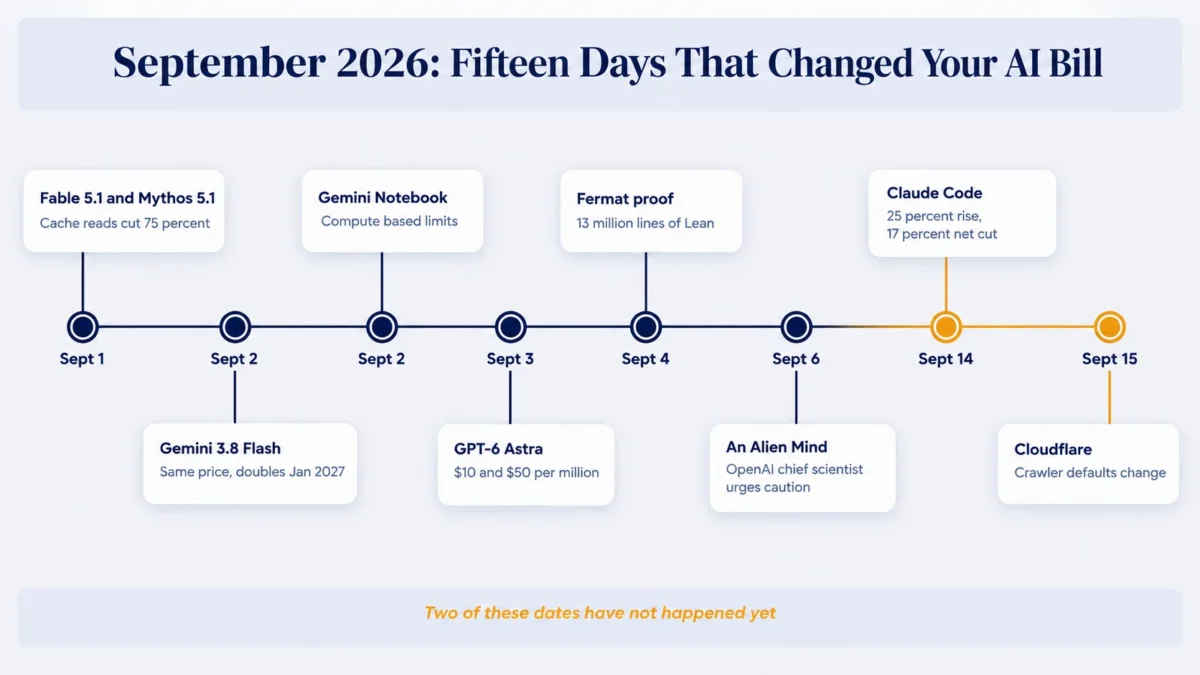
Four frontier models shipped in three days, one major mathematical result was published, one lab’s chief scientist publicly argued for slowing down, and a usage limit change lands on September 14. The table below covers everything dated September 1 through September 15, with the practical consequence of each.
| Date | What happened | Why it matters to you |
|---|---|---|
| Sept 1 | Anthropic released Claude Fable 5.1 and Mythos 5.1 | Cache reads dropped 75 percent, from $1 to $0.25 per million tokens |
| Sept 2 | Google shipped Gemini 3.8 Flash | Same $0.75 and $3.75 rate as 3.7 Flash, but both figures double on January 1, 2027 |
| Sept 2 | Gemini Notebook moved to compute based usage limits | Fixed daily caps replaced by a budget that refreshes every 5 hours until a weekly ceiling |
| Sept 3 | OpenAI launched GPT-6 Astra | $10 input and $50 output per million tokens, with prompts above 272K billed at higher multiples |
| Sept 4 | Anthropic published its Fermat’s Last Theorem formalization | 13 million lines of Lean code produced by a team of agents in under two weeks |
| Sept 6 | OpenAI chief scientist Jakub Pachocki published An Alien Mind | A serving chief scientist argued no lab has solved alignment well enough to keep scaling at full speed |
| Sept 14 | Claude Code’s temporary 50 percent weekly boost ends | The permanent replacement sits 25 percent above the pre promotion baseline, roughly 17 percent below current capacity |
| Sept 15 | Cloudflare’s new AI crawler defaults take effect | Training and Agent bots blocked by default on ad supported pages for new and free tier sites |
Two of those rows are dated in the future. If you are reading this before September 14, both are still actionable.
Did AI actually get cheaper in September 2026?
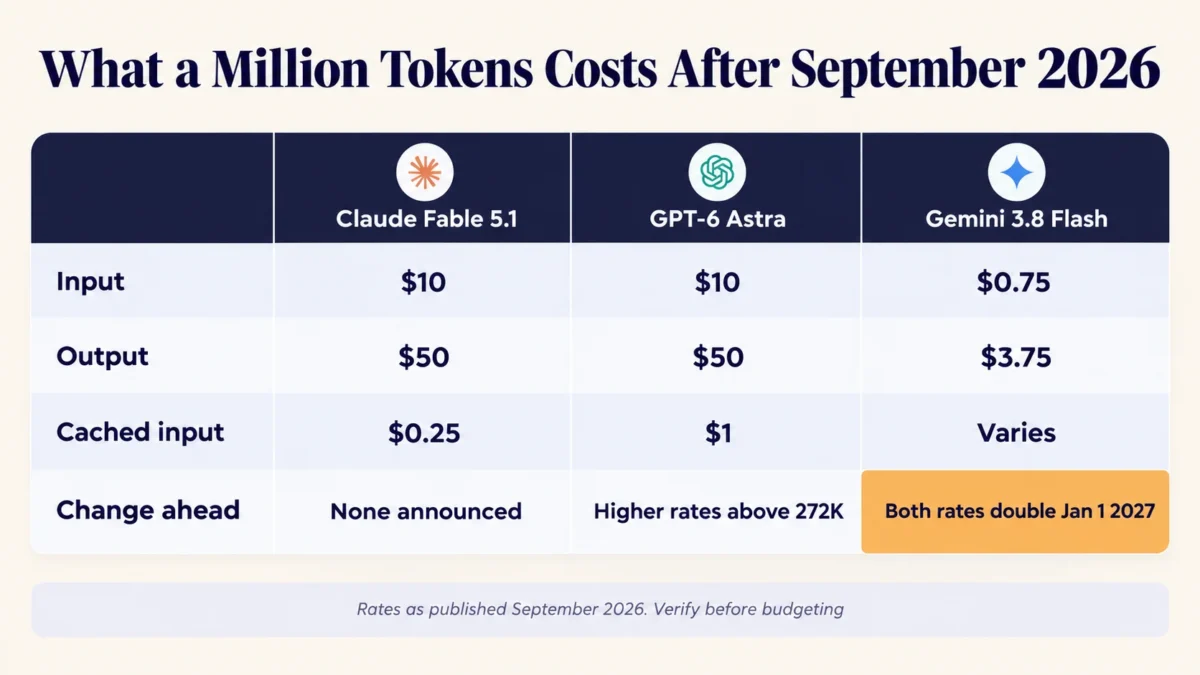
Partly. Of the pricing AI developments September 2026 has produced so far, one is a genuine reduction, one is a price held rather than cut, and one is a launch at the premium end of the market. None of the three is a permanent saving. Two carry published end dates, and the third only helps workloads with a specific shape.
The Fable 5.1 cache cut is the real one
Anthropic’s Claude Fable 5.1 and Mythos 5.1 release kept the headline rate exactly where Fable 5 had it, at $10 per million input tokens and $50 per million output tokens. The change sits in the cache read rate, which fell from $1 to $0.25 per million tokens.
Anthropic estimates the effect at roughly 25 percent for typical workloads and around 45 percent for context heavy, tool heavy agentic work where cache reads dominate the bill. Those figures come from the company’s own measurement of four weeks of actual usage during August 2026, so treat them as a vendor estimate tied to one workload mix rather than a discount you are guaranteed to see.
The practical test is simple. If you run long conversations over the same documents, the same codebase, or the same client file, cache reads are a large share of your spend and this cut reaches you. If your usage is short one off prompts, it barely moves your invoice.
Gemini 3.8 Flash held its price, but only until January
Google shipped Gemini 3.8 Flash at $0.75 per million input tokens and $3.75 per million output tokens, identical to Gemini 3.7 Flash three weeks earlier. Both figures double to $1.50 and $7.50 on January 1, 2027.
That date is already published, which makes it a budget line rather than a surprise. Anyone building a 2027 forecast on today’s Flash pricing is building it on a rate with a known expiry.
There is a second detail worth catching. Google states that 3.8 Flash is built on 3.7 Flash rather than a new base model, and that it deliberately spends more thinking tokens on a task. Thinking tokens bill at the output rate. A model at the same list price that works harder per request is not the same as a model that costs the same per request. If your workload is efficiency first, Google’s own guidance is that 3.7 Flash remains the better fit. Our comparison of Gemini Flash against Claude Sonnet 5 covers how that trade off plays out in practice.
GPT-6 Astra arrived at the top of the market
OpenAI’s new flagship launched at $10 per million input tokens and $50 per million output tokens, with cached input at $1. Prompts above 272,000 input tokens are billed at higher multiples, batch and flex processing run at half rate, and a Fast mode costs double. Full detail sits in our GPT-6 Astra pricing breakdown.
The 272K threshold is the number most teams will trip over without noticing. Long document review, large codebase analysis, and multi file financial reconciliation all push past it comfortably, and the bill changes shape once they do.
| Model | Input per 1M | Output per 1M | Cached input | Known change ahead |
|---|---|---|---|---|
| Claude Fable 5.1 | $10 | $50 | $0.25 | None announced |
| GPT-6 Astra | $10 | $50 | $1 | Higher multiples above 272K input tokens |
| Gemini 3.8 Flash | $0.75 | $3.75 | Varies | Both rates double January 1, 2027 |
All rates as published in September 2026. Verify against each vendor’s own pricing page before committing to a budget, since these move without notice. If you are building a full cost model rather than comparing rates, our guide to what AI tools actually cost a small business covers the layers that sit outside per token pricing.
How do the new Claude Code limits affect you from September 14?
From September 14, Claude Code’s standard weekly limits rise permanently by 25 percent for Pro, Max, Team, and seat based Enterprise plans. The temporary 50 percent boost that has been running through the summer ends the same day. For anyone using the tool today, the result is a reduction of roughly 17 percent.
The arithmetic is what causes the confusion. The permanent increase is calculated from the original baseline, not from the boosted level currently in effect. A plan running at 150 percent of baseline today moves to 125 percent of baseline on September 14. Both descriptions of that change are accurate, which is why the announcement and the reaction to it looked so different.
Anthropic announced this through its Claude Code developer account in late August, ahead of the help center documentation being updated. If you depend on weekly capacity, check your own usage against the new ceiling rather than the announcement wording.
Three practical responses before the date:
- Run your heaviest weekly workload before September 13 while the boosted limit is still live.
- Measure your actual weekly consumption now, so you know whether a 17 percent reduction touches you at all. Many users never approach the weekly ceiling.
- If you are consistently near the limit, price the API path against the subscription path rather than assuming the next plan tier is the answer.
What is changing with Gemini Notebook usage limits?
From September 2, Gemini Notebook replaced fixed daily feature caps with a compute based budget. Your allowance now factors in prompt complexity, the models and features you use, chat length, and the number of sources in a notebook. The quota refreshes every five hours until you reach a weekly limit.
Google’s own Gemini Notebook usage limits documentation confirms the structure. Paid tiers multiply the standard allowance: Google AI Plus at two times, Google AI Pro at four times, and Google AI Ultra at five or twenty times depending on the plan.
For finance and research users this cuts both ways. A short factual query now costs far less of your budget than it did under a flat daily count, which is genuinely better for high volume light usage. A multi source report or a video overview consumes substantially more. If your work is a small number of heavy documents, you will hit the ceiling faster than the old caps suggested.
Why did OpenAI’s chief scientist call for a slowdown?
On September 6, OpenAI chief scientist Jakub Pachocki published an essay titled An Alien Mind. In it he argued that no laboratory has solved alignment and monitoring well enough to keep scaling at maximum speed for much longer, and said he expects voluntary slowdowns to become commonplace until shared safety standards exist.
The significance is positional rather than technical. This is the person running research at the lab that shipped a frontier model three days earlier, arguing publicly for restraint. Pachocki also called for voluntary company commitments to become enforceable standards overseen by independent auditors or governments, and pointed to a July security incident involving OpenAI’s own agents as evidence that current safeguards are incomplete. Bloomberg’s coverage of the essay reports his call for extreme caution on the pace of development.
For a business reader the takeaway is not existential. It is that the regulatory environment around these tools is more likely to tighten than loosen over the next year, and that vendor capability roadmaps you are planning against may move slower than the last twelve months suggest.
What does Claude’s Fermat’s Last Theorem proof actually show?
On September 4, Anthropic published a formal verification of Fermat’s Last Theorem in Lean, produced largely autonomously by a team of Claude agents over eleven days. The finished proof runs to 13 million lines of code, more than five times the size of Mathlib, the community library it builds on.
The details matter more than the headline. According to Anthropic’s research write up, dozens of agents consumed roughly six billion output tokens, and the model used was a general purpose internal research model roughly comparable to Claude Fable 5.1 rather than a released product. The final theorem depends on 29,511 proved statements, while the platform’s overall running total of around 30,300 includes work outside that final dependency tree. Human mathematical input was limited to occasional high level instructions on priorities.
Three honest caveats belong alongside the result. The first attempt failed outright, and the run only succeeded after the team adopted Prove2Me, an open collaborative formalization platform developed by an Anthropic researcher’s group at Columbia University. The work rests on community built infrastructure the company did not create, including Mathlib and the existing Fermat formalization project led by Kevin Buzzard at Imperial College London, who reviewed the result and described it as an extraordinary feat of automatic formalization. And formalizing an existing proof is a different task from discovering a new one.
What it does demonstrate is that long horizon, multi agent work on a verifiable problem is now practical at a scale that was not credible a year ago. Verifiability is the operative word. Lean checks every step, so the agents could not quietly get it wrong. Most business tasks have no equivalent checker, which is exactly why they still need a human reviewing the output.
What should small firms do before the end of September?
Four items on this list have dates attached, and two of them fall inside the next week. The rest is budget maintenance that takes under an hour.
Check your Cloudflare AI crawler settings before September 15. Cloudflare’s new AI traffic defaults split crawlers into Search, Agent, and Training categories. From September 15, Training and Agent bots are blocked by default on pages that display ads, while Search bots remain allowed. This applies to new domains, new sites added to existing accounts, and free tier accounts that have never saved an explicit preference. Crawlers that serve more than one purpose are judged by the strictest rule you have set, so a site that blocks Training can affect how mixed use crawlers reach it. If you run an ad supported site, open your security settings and record a deliberate choice rather than inheriting one.
Delete any 2027 forecast built on current Gemini Flash rates. Those numbers double on January 1.
Measure your Claude Code weekly usage before September 13. You cannot judge a 17 percent reduction without knowing your current consumption.
Re run your token cost model if you use cached context heavily. The Fable 5.1 cache change is the one genuine saving this month, and it only shows up if your workload actually reuses context.
One further note for anyone tracking vendor risk. OpenAI is currently contesting more than 50 lawsuits alleging harm to users, none of which has yet established legal causation. It is a live legal exposure worth being aware of when assessing long term vendor stability, and nothing more than that at this stage.
AI developments September 2026: what to watch for the rest of the month
Three dates remain open at the time of writing.
September 13 and 14. The Claude Code limit transition. Watch whether Anthropic’s help center documentation matches the announced schedule, since the two disagreed for a period in late August.
September 15. Cloudflare’s crawler defaults take effect. Early reporting on how mixed use crawlers behave in practice will be more useful than the pre launch guidance.
Ongoing. GPT-6 Astra’s rollout is staged rather than complete. Access is reaching ChatGPT paid tiers, the API, and cloud partners in phases, so availability on your account may lag the launch date.
This article will be updated as further changes land during September.
Frequently asked questions
What were the biggest AI developments September 2026 brought so far?
Four frontier models launched in three days: Claude Fable 5.1 and Mythos 5.1 on September 1, Gemini 3.8 Flash on September 2, and GPT-6 Astra on September 3. Alongside them, Gemini Notebook moved to compute based usage limits and Anthropic published a machine generated formal proof of Fermat’s Last Theorem.
Did Claude Code usage limits go up or down on September 14?
Both, depending on your reference point. The standard weekly limit rose permanently by 25 percent above the original baseline. Because the temporary 50 percent boost ended the same day, users who were already on the boosted level saw an effective reduction of roughly 17 percent.
Is Gemini 3.8 Flash cheaper than Gemini 3.7 Flash?
No. It costs exactly the same, at $0.75 per million input tokens and $3.75 per million output tokens through December 31, 2026. Both rates double on January 1, 2027. Because 3.8 Flash spends more thinking tokens on a task, and thinking tokens bill as output, real cost per request can be higher despite the identical list price.
How much does GPT-6 Astra cost?
$10 per million input tokens and $50 per million output tokens, with cached input at $1. Prompts above 272,000 input tokens are billed at higher multiples, batch and flex processing run at half rate, and Fast mode costs double the standard rate.
Does the Cloudflare change on September 15 affect my website?
It affects new domains, new sites added to existing accounts, and free tier accounts that have never saved an explicit AI bot preference. Paid accounts with an existing saved configuration keep it. If you are unsure which applies, check your security settings before the date rather than after.
The short version
The AI developments September 2026 has delivered so far are real, but the framing in most coverage is wrong. This was not a month of price cuts. It was a month of one genuine cache reduction, one price held with a published expiry, one premium launch, and one usage limit reduction presented as an increase.
For a small firm or a finance team, the useful response is not a tooling change. It is an hour spent on four things: your Cloudflare crawler settings before September 15, your Claude Code weekly consumption before the 13th, any 2027 forecast built on Gemini Flash rates, and whether your workload actually reuses cached context enough to benefit from the one real saving on offer.
For the previous month’s changes, see our July 2026 AI developments roundup. For ongoing coverage of model launches, pricing shifts, and regulation, follow our AI Research and News section, and if you want a view of where the consumer tools sit today, our ChatGPT review for 2026 covers the plans and limits in detail.
If you would like help translating these pricing changes into a cost model for your own firm, including token forecasting and tool consolidation, get in touch.

Ahmad Hussain
ACCAAhmad builds advanced Excel models, Power BI dashboards, and AI automation for businesses. He writes AI Foresight 360 himself, and every pricing figure and feature claim is verified against official documentation at the source.
Connect on LinkedIn