

The IRS AI guidelines for tax professionals landed on June 24, 2026, and they did something most firms did not expect. They created no new rules at all.
Instead, the IRS Office of Professional Responsibility took the ethics rules that have governed practice before the agency for decades and pointed them directly at generative AI. The message is that nothing in Circular 230 changed, and that is exactly why this matters. Every duty you already owe now runs over your AI output too.
If you are a CPA, an enrolled agent, or a tax attorney, this guide breaks down what the guidance actually says in plain English, which Circular 230 sections now apply to your AI workflow, which tools are genuinely safe to feed client data into, and how to write a firm AI use policy before the next filing season. A ready to adapt policy template is included below.
How this article was researched: every regulatory claim here is drawn from the primary IRS bulletin and the underlying Treasury regulations. Every vendor data handling claim is drawn from the vendor’s own published documentation, verified in July 2026. This is editorial analysis, not legal or tax advice. Route any policy decision through your own counsel.
What Are the IRS AI Guidelines for Tax Professionals?
The IRS AI guidelines for tax professionals are set out in Office of Professional Responsibility Alert 2026-19, titled Introductory Guidelines for Responsible AI Use in Federal Tax Practice, issued June 24, 2026. The alert does not create new regulations. It explains how six existing Circular 230 and Internal Revenue Code provisions apply when practitioners use generative AI.
You can read the full IRS OPR bulletin 2026-19 directly on the IRS distribution site. It is short, it is readable, and every practitioner subject to Circular 230 should read it once in full.
The OPR opens by conceding there is no settled definition of AI, then offers a working one: the use of machines in a way that mimics human cognitive skills, including judgment, perception, and prioritization. It then makes a point that catches many firms off guard. Virtually every professional tax firm already uses some form of AI, whether the partners realize it or not, through research platforms and document review tools that have been embedded in practice for years.
What changed recently is generative AI, which produces original content rather than retrieving existing content. The OPR flags three specific failure modes: fabricated outputs, bias, and lack of transparency. It also raises a confidentiality risk that most firm level discussions miss entirely. Data supplied for one client can be repurposed by the system when responding to a query about a different client, or can spill into an algorithm and combine with a related issue belonging to someone else.
That single sentence in the guidance is the reason the IRS AI guidelines for tax professionals spend as much time on data handling as they do on accuracy.
Why Did the IRS Issue AI Guidance Now?
The IRS AI guidelines for tax professionals arrived because sanctions for improper AI use have already started landing on professionals, and the agency wanted tax practitioners warned before the pattern reached them. The alert cites courts sanctioning lawyers for fabricated citations and one high profile accounting failure, and frames both as previews of what awaits careless tax firms.
On the legal side, the IRS AI guidelines for tax professionals catalog what courts have actually imposed: financial sanctions frequently running to several thousand dollars, public censure, mandatory completion of ethics or professional responsibility courses, default judgments entered against the responsible party, removal from representing a party, and disciplinary referrals to state bar authorities. The OPR notes these penalties usually arrive with reputational damage attached, because the sanctioned professional must notify clients and affected judges.
On the accounting side, the alert points to a case with no legal profession cover at all. The Australian government published a report of more than 230 pages that Deloitte Australia had prepared for it. The report contained quotes invented and attributed to a judge, references to reports that did not exist, and books credited to the wrong authors. The OPR states the material appeared to be generated by AI, and that Deloitte Australia resolved the matter by agreeing to partially refund a portion of its fee.
The Journal of Accountancy summarized the OPR position as a single principle: AI should augment professional judgment rather than replace it. Final decisions rest with qualified professionals.
Which Circular 230 Rules Apply to AI Use?
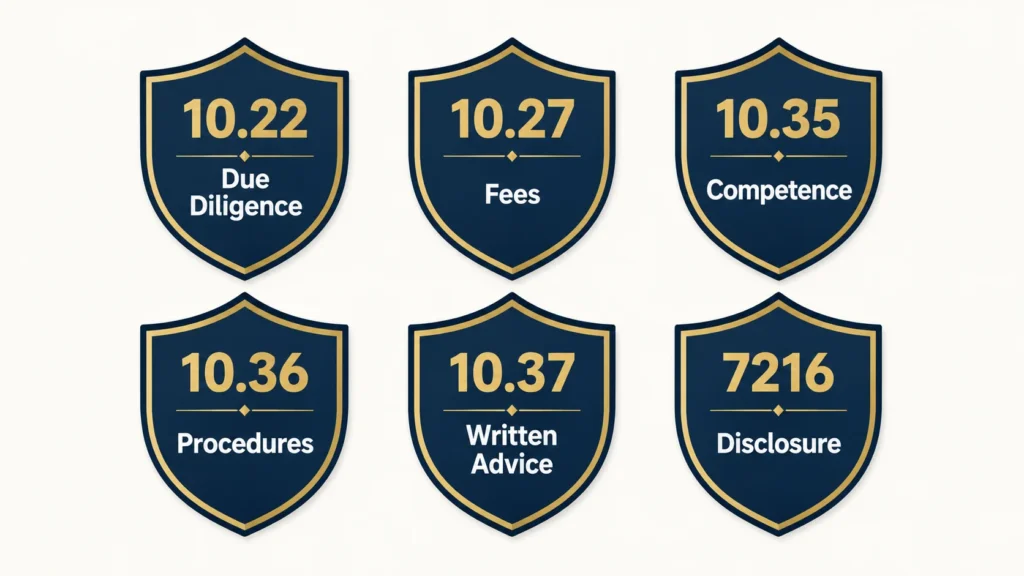
Six provisions apply under the IRS AI guidelines for tax professionals. Five come from Circular 230 itself, covering due diligence, fees, competence, firm procedures, and written advice. The sixth is the criminal and civil preparer penalty regime under Internal Revenue Code sections 7216 and 6713, reinforced by Circular 230 section 10.51(a)(15). Together they cover accuracy, billing, capability, governance, and confidentiality.
| Provision | What it covers | What it means for AI |
|---|---|---|
| Section 10.22 | Due diligence | Verify every fact, citation, and calculation the AI produces |
| Section 10.27(a) | Fees | Do not bill manual hours for AI assisted work |
| Section 10.35 | Competence | You must understand how the tool works and where it fails |
| Section 10.36 | Firm procedures | Firm leadership must implement written AI policies |
| Section 10.37 | Written advice | No reliance on AI assumptions you have not verified |
| IRC 7216 and 6713 | Preparer penalties | Unauthorized disclosure of return information is a crime |
Section 10.22 Due Diligence: Every AI Output Is a Draft
Due diligence requires practitioners to exercise care in preparing returns, documents, affidavits, and other papers relating to IRS matters, and in determining the correctness of representations made to Treasury and to clients. The IRS AI guidelines for tax professionals apply that duty without modification to anything a model produces.
In practice this means reviewing all AI created documents and language before delivery to a client or submission to the IRS, and specifically verifying facts, citations, and calculations. The guidance is blunt that practitioners cannot rely solely on AI. Human scrutiny and editing are described as essential, not advisable.
The practical translation for a firm workflow is simple. Treat model output the way you would treat a first year associate’s first draft on a matter they have never seen before. Useful starting point, zero presumption of correctness.
Section 10.27(a) Fees: You Cannot Bill Manual Hours for AI Work
This is the provision most firms have not thought about, and it is the part of the IRS AI guidelines for tax professionals with real revenue implications. A practitioner may not charge an unconscionable fee for any matter before the IRS. Because AI compresses research and drafting time, billing a client for manual labor or time not actually spent, or double billing for AI assisted tasks, may violate section 10.27.
The OPR says the analysis is facts driven, and identifies two aggravating signals: a noticeable pattern across clients, and the size of the billing differential. It then goes further than most commentators expected. Cost savings should be passed on openly. Practitioners should disclose the AI activities performed, in general or specific terms as the situation requires, and fairly credit resulting cost reductions to the client’s account.
Firms running fixed fee or value pricing models have more room here than hourly firms do. Hourly firms writing up AI assisted work to what the manual task would have cost should treat this paragraph as a direct warning.
Section 10.35 Competence: You Must Understand the Technology
Competent practice requires the appropriate level of knowledge, skill, thoroughness, and preparation for the engagement. The IRS AI guidelines for tax professionals extend that from legal literacy to technological literacy. Practitioners must understand both the law and the technology used in representing clients, including how AI systems operate, what their limitations are, and what risks they carry.
You need to understand how the tool generates content, recognize where bias and error creep in, and be able to judge whether a given output is fit for use in an IRS matter. The guidance states plainly that a lack of technological competence can produce improper advice or flawed filings.
For a practical grounding in how these systems actually behave, our explainer on what AI agents are and how they work covers the mechanics that section 10.35 now expects you to be able to describe.
Section 10.36 Procedures: Firm Leadership Carries the Risk
Section 10.36 is where the IRS AI guidelines for tax professionals become a management problem rather than a practitioner problem. Anyone with principal authority for overseeing a firm’s Circular 230 practice must take reasonable steps to ensure the firm has adequate compliance procedures for all members, associates, and employees.
Discipline attaches where that individual, through willfulness, recklessness, or gross incompetence, fails to put adequate procedures in place, fails to ensure existing procedures are followed, or knows of a pattern of noncompliance and does not act promptly to correct it.
The OPR specifies three coverage areas for firm AI policies: comprehensive staff training on AI risks and requirements, internal rules establishing secure data handling protocols and accuracy monitoring, and vetting of outsourced or third party AI tools before contracting. Every step and process must be documented to demonstrate adherence.
That documentation requirement is the reason a written firm policy is no longer optional. A template appears later in this guide.
Section 10.37 Written Advice: No Blind Reliance
Written advice on federal tax matters must rest on reasonable factual and legal assumptions, reasonably consider all relevant facts and circumstances, use reasonable efforts to ascertain relevant facts, avoid unreasonable reliance on representations and projections, relate law and authorities to facts, and disregard audit probability.
Applied to AI, the IRS AI guidelines for tax professionals draw a hard line. Practitioners cannot rely on AI generated projections or representations without verification. Citations must be checked and the underlying cases actually read. Financial forecasts, inputs, and formulas need confirmation. Where the system’s logic is opaque, reliance itself may be unreasonable under section 10.37.
The phrase to remember is that blind reliance on AI output, particularly where the underlying logic or sources are unclear, may constitute unreasonable reliance.
IRC 7216 and 6713: The Criminal Exposure Nobody Talks About
The sixth provision in the IRS AI guidelines for tax professionals carries the heaviest consequences and receives the least attention. Internal Revenue Code section 7216 imposes criminal penalties on return preparers who knowingly or recklessly make unauthorized disclosures or uses of information furnished in connection with preparing a return. Section 6713 adds a civil penalty. Circular 230 section 10.51(a)(15) separately prohibits willful unauthorized disclosure or use of return information.
A section 7216 violation is a misdemeanor carrying up to one year of imprisonment, a fine of up to 1,000 dollars, or both, together with prosecution costs. The IRS maintains a section 7216 information center covering the regulations and related rulings.
The OPR states that generative AI platforms may present unauthorized disclosure risks, especially where data is uploaded to unsecured or public systems. Its instruction is specific: practitioners must handle all client data using only secure, enterprise approved AI with robust confidentiality safeguards in place. Willful mishandling of taxpayer information through AI may trigger Circular 230 discipline.
Note how broadly the underlying regulation defines the protected data. Treasury Regulation section 301.7216-1(b)(3) captures any information, including a taxpayer’s name, address, or identifying number, furnished in any form for or in connection with preparing that taxpayer’s return. That definition is wide enough to cover a pasted client email.
Can Tax Preparers Use ChatGPT for Client Work?
Tax preparers can use ChatGPT and comparable tools, and the IRS AI guidelines for tax professionals nowhere prohibit them. What the guidance restricts is what goes into them. Using a general purpose consumer chatbot for research, drafting, and explanation is fine. Pasting taxpayer return information into a consumer tier account is where the exposure begins.
Under the IRS AI guidelines for tax professionals, the distinction that matters is not the brand of tool. It is the contract governing the account and the data handling terms attached to it. A consumer subscription is governed by consumer terms that the vendor can amend and that the user administers through a settings toggle. A business or enterprise agreement is a commercial contract with defined data handling obligations, which is what section 10.36 vetting and section 7216 analysis both require.
There is a second distinction worth internalizing. Using AI to explain a code section, draft a client letter with the facts anonymized, summarise a revenue procedure, or build a spreadsheet formula involves no taxpayer return information at all. That category of use carries accuracy risk under section 10.22 but no confidentiality risk under section 7216. Most firms could move eighty percent of their AI usage into that category with nothing more than a habit change.
Our comparison of ChatGPT and Claude for accountants covers where each model performs better on accounting specific tasks, and our library of ChatGPT prompts for accountants is built around prompts that do not require client identifying data.
Which AI Tools Are Safe to Feed Client Data Into?
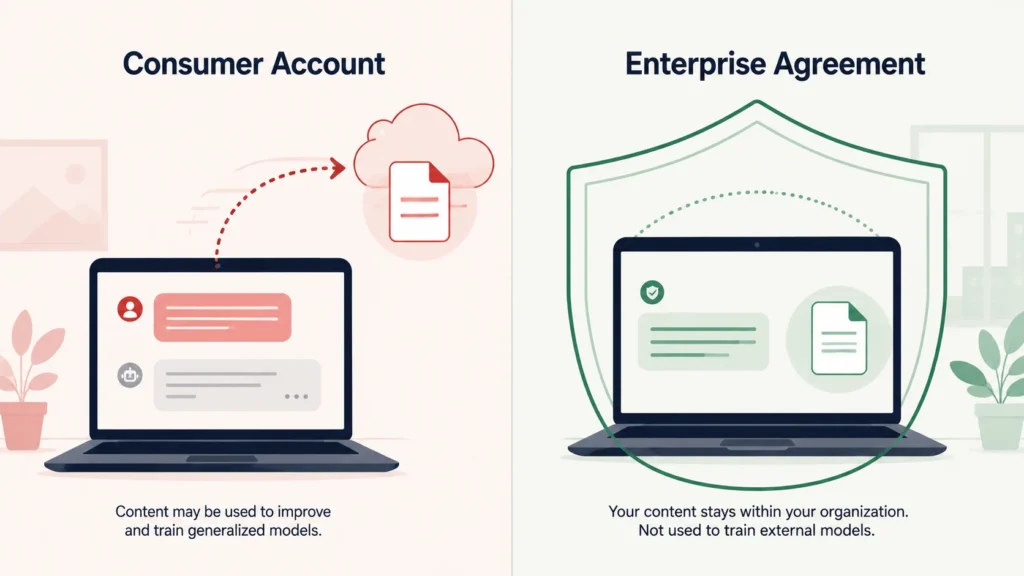
No general purpose AI tool is automatically safe for taxpayer return information, and the IRS AI guidelines for tax professionals name none as approved. Safety depends on the account tier, the governing contract, and a separate section 7216 analysis. As a baseline rule, consumer tiers are unsuitable regardless of vendor, business and enterprise tiers are the minimum viable starting point, and none of them resolve the consent question on their own.
The table below reflects each vendor’s own published documentation, verified in July 2026, and maps it against what the IRS AI guidelines for tax professionals require. Vendor terms change, so re-verify at the source before you rely on any row.
| Tool and tier | Trains on your data by default | Stated retention | Suitable for taxpayer data |
|---|---|---|---|
| ChatGPT Free, Plus, Pro | Governed by consumer terms and a user managed setting | Tied to account settings | No |
| ChatGPT Business, Enterprise, Edu | No, per OpenAI enterprise commitments | Configurable by qualifying organizations | Only with a signed agreement and 7216 analysis |
| OpenAI API | No, not by default | Up to 30 days for abuse monitoring, then deleted unless legally required | Only with a signed agreement and 7216 analysis |
| Claude Free, Pro, Max | Yes, setting defaults on since the August 2025 consumer terms | 5 years if training is on, 30 days if off | No |
| Claude for Work, Enterprise, API | No, excluded under commercial terms | 30 days standard, zero retention available for enterprise | Only with a signed agreement and 7216 analysis |
| Microsoft 365 Copilot, work account | No, per Microsoft enterprise data protection | Stays inside the Microsoft 365 service boundary, logged for audit and eDiscovery | Strongest fit if your firm already runs Microsoft 365 |
| Google Gemini for Workspace | No, per Google Workspace commitments | Governed by Workspace terms | Viable if your firm already runs Workspace |
| Free chatbots, browser extensions, unvetted apps | Assume yes | Unknown and unverifiable | No |
Three rows deserve expansion.
OpenAI’s enterprise privacy documentation states that API inputs and outputs are removed after 30 days unless the company is legally required to retain them. That final clause is not boilerplate. Litigation holds and legal process can override a stated deletion schedule at any vendor, which is why a retention commitment is a policy rather than a guarantee.
Anthropic’s position splits sharply by tier. Under the August 2025 update to Anthropic’s consumer terms, Free, Pro, and Max users choose whether their chats train Claude, retention extends to five years for those who allow it, and the setting requires active management. Commercial products including Claude for Work, Enterprise, and API traffic are excluded from training under separate commercial terms. A practitioner using a personal Pro subscription for client work is on entirely different footing from the same practitioner on a Claude for Work seat.
Microsoft’s enterprise data protection documentation confirms that prompts, responses, and Microsoft Graph data are not used to train foundation models, that Copilot inherits existing tenant permissions, sensitivity labels, and retention policies, and that interactions are auditable. Worth knowing for your vendor vetting file: Microsoft documents both OpenAI and Anthropic as subprocessors within Copilot experiences, so your section 10.36 vetting should follow the chain rather than stopping at the brand on the interface.
Why No Training Is Not the Same as Compliant
This is the point almost every summary of the IRS AI guidelines for tax professionals misses. A vendor commitment not to train on your data addresses one risk. It does not address the disclosure itself.
Section 7216 is not triggered by training. It is triggered by disclosure. Sending taxpayer return information to a third party is a disclosure whether or not that third party subsequently trains on it, deletes it in thirty days, or keeps it in a vault. An enterprise agreement improves your confidentiality posture and satisfies the OPR instruction to use secure, enterprise approved systems. It does not by itself answer whether the disclosure was authorized.
Does Section 7216 Require Client Consent Before Using AI?
Possibly, and the honest answer is that the IRS has not said. The IRS AI guidelines for tax professionals cite sections 7216 and 6713 but issue no section 7216 guidance specific to AI. That leaves firms to run the standard analysis: either a regulatory exception under Treasury Regulation section 301.7216-2 applies, or written consent under section 301.7216-3 is required.
Nothing in the IRS AI guidelines for tax professionals resolves this for you. The regulation lists exceptions that do not require consent, including disclosures to the IRS, certain disclosures to other return preparers, certain disclosures to contractors, and disclosures for quality or peer review. Each exception carries strict requirements that must be met precisely.
The live question is whether a general purpose AI vendor qualifies as an auxiliary service provider. The most widely cited practitioner analysis, from enrolled agent Tom Gorczynski, argues that entering return information into a third party AI tool is a disclosure under the regulations, and that general purpose tools such as ChatGPT or Claude are unlikely to qualify as an auxiliary service, while acknowledging that no IRS guidance exists on the point. AI providers building tax specific products with dedicated data handling agreements require a different analysis.
Until the IRS speaks, the defensible position is the conservative one. Where exception applicability is unclear, treat the transmission as requiring consent.
What a Valid Consent Must Contain
For Form 1040 series clients, consent must follow Revenue Procedure 2013-14, which prescribes the format, content, and mandatory language. For other taxpayers the format is flexible, including an engagement letter, provided every regulatory requirement is satisfied.
Four points cause the most problems when firms apply the IRS AI guidelines for tax professionals in practice:
- The recipient must be named. A consent referring to various AI tools is not valid. You must name the specific provider, whether that is OpenAI, Anthropic, Google, or another vendor.
- Consent must be obtained before disclosure. Retroactive consent does not cure a disclosure already made.
- Consent cannot be a condition of service. If you condition return preparation on the client signing, the consent is invalid.
- Consent is revocable. Clients may terminate at any time, and your workflow needs to handle that.
Naming the provider creates an operational trap worth planning around. Change AI vendors mid season and your existing consents no longer cover the new one.
How Do You Build an AI Use Policy That Satisfies the IRS AI Guidelines for Tax Professionals?
Section 10.36 requires documented firm procedures covering staff training, internal data handling rules, and third party vendor vetting. A compliant policy therefore needs to define permitted uses, prohibited uses, approved tools, the review standard, the consent process, and the documentation trail. The template below covers all six.
It is written to track the IRS AI guidelines for tax professionals section by section. Adapt it to your firm and route it through your own counsel before adoption. It is a starting point, not a finished plan.
Firm AI Use Policy Template
1. Purpose and scope
This policy governs all use of artificial intelligence tools by partners, employees, and contractors of [Firm Name] in connection with federal tax practice. It implements Circular 230 section 10.36 and reflects IRS OPR Alert 2026-19.
2. Responsible individual
[Name, title] is responsible for AI governance, tool approval, training delivery, and annual policy review. This individual reports to firm leadership.
3. Approved tools
Only tools on the approved list may be used for firm work. The current approved list is maintained at [location]. Adding a tool requires written approval from the responsible individual following the vendor vetting procedure in section 8.
4. Classification of use
Green, no taxpayer return information involved. Permitted on approved tools without additional consent. Includes general tax research, plain language explanations, document drafting with no client identifying facts, spreadsheet formulas, and internal training material.
Amber, taxpayer return information involved. Permitted only on approved enterprise tools, only where a valid section 7216 consent or documented exception is on file, and only with the review documented under section 6.
Red, prohibited. Uploading taxpayer return information to any consumer tier account, any free tool, any browser extension, or any tool not on the approved list. Using AI output in a client deliverable or IRS submission without documented review. Using AI to make a final professional judgment.
5. Section 7216 compliance
No taxpayer return information may be transmitted to any AI vendor unless a documented exception applies or a valid written consent naming that specific vendor is on file before transmission. Consents for Form 1040 series clients must comply with Revenue Procedure 2013-14. The responsible individual maintains the consent register.
6. Review and verification standard
All AI output is treated as a draft. Before any AI assisted content reaches a client or the IRS, the responsible practitioner must verify all facts against source documents, read every cited authority in full, recalculate all figures independently, and confirm the analysis reflects current law. Verification is recorded in the engagement file, noting the tool used, the nature of the assistance, and the reviewer.
7. Billing and disclosure
Time billed must reflect time actually spent. AI assisted tasks may not be billed at the manual equivalent. Efficiency gains are credited to the client. The nature of AI assistance is disclosed to clients in the engagement letter.
8. Vendor vetting
Before approval, each tool is assessed for training use of submitted data, retention period and deletion practice, subprocessors and data location, security certifications, contractual confidentiality terms, and breach notification commitments. Assessments are documented and reviewed annually.
9. Training
All personnel complete AI training before using any approved tool and annually thereafter, covering this policy, the Circular 230 obligations in OPR Alert 2026-19, section 7216 requirements, and recognition of AI generated errors.
10. Incident response
Any suspected unauthorized disclosure, any AI generated error reaching a client or the IRS, and any use of an unapproved tool must be reported to the responsible individual immediately and handled under the firm’s written information security plan.
11. Review
This policy is reviewed at least annually and whenever a tool, vendor term, or applicable regulation changes.
How Does This Connect to Your WISP?
Your AI policy and your written information security plan are not separate documents living in separate binders, and the IRS AI guidelines for tax professionals assume both exist. Under the Gramm-Leach-Bliley Act and the FTC Safeguards Rule, tax preparation businesses are treated as financial institutions and must maintain a written information security plan. Adding an AI vendor is a change to your data environment, which means your WISP needs updating.
The IRS supports this through Publication 4557 on safeguarding taxpayer data and Publication 5708, the Security Summit sample plan for tax and accounting practices. Both predate the IRS AI guidelines for tax professionals but neither was written to exclude them. The Safeguards Rule explicitly requires your program to evolve as your business changes, and a new AI tool with a new data flow to a new third party is precisely that kind of change.
Practical sequence for a small firm: update the vendor inventory in your WISP to list every approved AI tool and its data handling terms, add AI specific access controls to your existing controls section, fold AI incidents into your existing breach response procedure, and cross reference your AI use policy from the WISP so an examiner sees one coherent program rather than two documents that do not acknowledge each other.
What Are the Penalties for Getting This Wrong?
Exposure under the IRS AI guidelines for tax professionals runs across four separate tracks, and a single incident can trigger more than one. Circular 230 discipline through OPR, criminal and civil preparer penalties under sections 7216 and 6713, FTC enforcement under the Safeguards Rule, and state licensing board action. Client civil liability sits alongside all four.
Under section 7216, a violation is a misdemeanor carrying up to one year of imprisonment, a fine of up to 1,000 dollars, or both, plus prosecution costs. Section 6713 adds a civil penalty for each unauthorized disclosure or use. OPR discipline under Circular 230 can include censure, suspension, or disbarment from practice before the IRS, and OPR publishes records of disciplinary actions.
The realistic worst case for most firms is not prison. It is an OPR referral following a client complaint, combined with a Safeguards Rule problem surfaced by the same facts, arriving at the same time as a malpractice claim. The IRS AI guidelines for tax professionals make that sequence considerably easier to trigger, because the guidance now establishes a documented standard of care that a plaintiff’s counsel can point to.
What Should Your Firm Do Before the Next Filing Season?
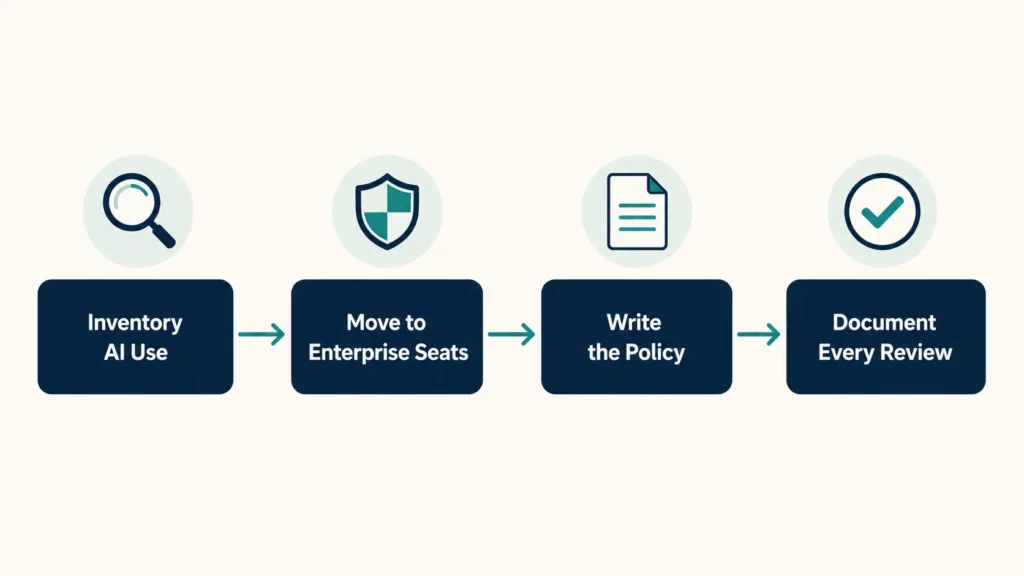
Six actions bring a firm into line with the IRS AI guidelines for tax professionals, in order of priority. None require a consultant and most can be completed in a working week by a firm that decides to take them seriously.
- Inventory actual usage. Ask every staff member which AI tools they use and on what. Expect surprises. Shadow AI on personal accounts is the single most common finding.
- Kill consumer tier client work immediately. This is the highest severity, lowest effort fix available. Move anyone touching client data to a business or enterprise seat, or stop the practice.
- Adopt a written AI use policy. Use the template above as a starting point and have counsel review it.
- Resolve your section 7216 position. Decide whether you are relying on an exception or obtaining consent, document the reasoning, and if consent, name each vendor specifically.
- Update your WISP. Add AI vendors to your inventory, controls, and incident response.
- Train the team and document it. Section 10.36 requires training. Undocumented training is functionally the same as no training.
Firms further along this path may also want to review our guides on Claude and QuickBooks integration for accountants and AI bookkeeping agents for small business, both of which raise the same data handling questions in an automated workflow context. For ongoing coverage of regulatory developments, see our AI research and news section.
Frequently Asked Questions
Do the IRS AI guidelines for tax professionals ban ChatGPT?
No. The IRS AI guidelines for tax professionals do not ban any tool. OPR Alert 2026-19 restricts how tools are used rather than which ones. Using ChatGPT for research, drafting, and explanation is permitted. Uploading taxpayer return information to a consumer tier account conflicts with the guidance instruction to use only secure, enterprise approved AI systems.
When did the IRS issue its AI guidance for tax practitioners?
The IRS Office of Professional Responsibility issued Alert 2026-19, Introductory Guidelines for Responsible AI Use in Federal Tax Practice, on June 24, 2026. It is the agency’s first substantive guidance on generative AI in tax practice and is described by OPR as introductory, with further guidance expected as the technology and regulatory landscape develop.
Do I need client consent to use AI on their tax return?
Possibly. The IRS has issued no section 7216 guidance specific to AI. If no exception under Treasury Regulation section 301.7216-2 applies, written consent under section 301.7216-3 is required before any disclosure. For Form 1040 series clients, that consent must follow Revenue Procedure 2013-14 and must name the specific AI provider. The conservative position is to obtain consent where exception applicability is unclear.
Can I bill clients my normal hourly rate for AI assisted work?
Not if the billed time exceeds time actually spent. Circular 230 section 10.27(a) prohibits unconscionable fees, and the IRS AI guidelines for tax professionals state that billing for manual labor not actually performed, or double billing for AI assisted tasks, may violate that section. OPR expects cost savings to be passed on openly and credited to the client’s account.
Does my firm legally need a written AI policy?
Effectively yes. The IRS AI guidelines for tax professionals point to Circular 230 section 10.36, which requires anyone with principal authority over a firm’s practice to take reasonable steps to ensure adequate compliance procedures exist, and OPR Alert 2026-19 specifies that this includes AI covering staff training, secure data handling, and third party tool vetting, with all steps documented. A written policy is how a firm demonstrates that documentation exists.
Which AI tools can I safely use with taxpayer data?
No tool is safe by default under the IRS AI guidelines for tax professionals. Consumer tiers from any vendor are unsuitable because their terms are user administered rather than contractual. Business and enterprise tiers from OpenAI, Anthropic, Microsoft, and Google carry published commitments against training on customer data and are the minimum viable starting point. Even then, a separate section 7216 consent or exception analysis is required, because the disclosure itself is what the statute regulates.
The Bottom Line
The IRS AI guidelines for tax professionals are best understood as a warning shot rather than a rulebook. Nothing in Circular 230 changed on June 24, 2026. What changed is that OPR has now written down, in public, exactly how it intends to read those rules when an AI assisted filing goes wrong. That documented standard of care is the real development.
The firms that will struggle are not the ones using AI aggressively. They are the ones using it invisibly, on personal accounts, with no policy, no consent position, and no verification trail. The fix is unglamorous and entirely achievable: get everyone onto contracted enterprise seats, write the policy down, resolve your section 7216 position deliberately rather than by accident, and document the review of every AI assisted deliverable.
Do that before the next filing season and the IRS AI guidelines for tax professionals become a competitive advantage rather than a liability, because you will be able to demonstrate a governed AI practice while your competitors are still discovering what their staff have been pasting into free chatbots.
If your firm is building out its AI workflow and wants the reporting layer to keep pace, AI Foresight 360 works with finance teams on Power BI dashboards, financial and CFO reporting, and AI automation designed with data handling controls built in from the start. Get in touch to discuss your requirements, or browse the AI Insights Hub for more practical guidance on AI in finance and accounting.
This article is editorial analysis based on primary regulatory sources and published vendor documentation as of July 2026. It is not legal, tax, or compliance advice. Consult qualified counsel before adopting any policy described here.

Ahmad Hussain
ACCAAhmad builds advanced Excel models, Power BI dashboards, and AI automation for businesses. He writes AI Foresight 360 himself, and every pricing figure and feature claim is verified against official documentation at the source.
Connect on LinkedIn