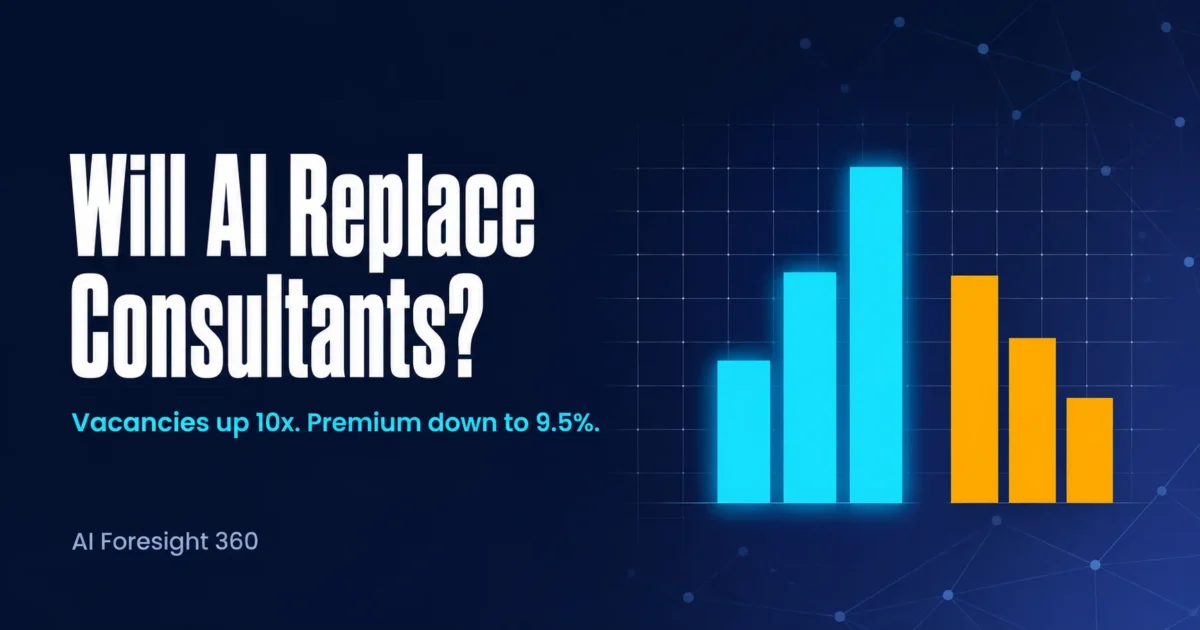
Will AI replace consultants? Demand is rising, pay is not keeping pace, and the work is shifting rather than disappearing. That comes from three datasets rather than an opinion. UK contract vacancies for AI Consultant roles grew tenfold in two years. The US Bureau of Labor Statistics projects consulting employment growing faster than the average occupation through 2035. And the pay premium for AI consulting work collapsed even as demand exploded.
So the honest answer to whether consulting will be replaced by AI is no, but that is not the useful part. The useful part is which specific tasks are already being absorbed, which are growing, and where the evidence simply does not exist yet. Almost every page ranking for this question answers it with reassurance about judgement, trust and empathy, and almost none of them cite a number. This article does the opposite.
Will AI Replace Consultants? The Short Answer
No. Published labour market data through September 2026 shows consulting demand rising in both the US and UK, not falling. What is changing is the task mix inside the job. Research, synthesis, first draft document production and data cleanup are being absorbed quickly. Implementation, governance and change management are growing. Entry level pipelines are the part genuinely under pressure.
That distinction matters more than the headline. A career is not replaced when a technology arrives. It is reshaped, and the people who lose out are usually the ones whose entire value sat in the tasks that got absorbed.
What Does the Hiring Data Actually Show?
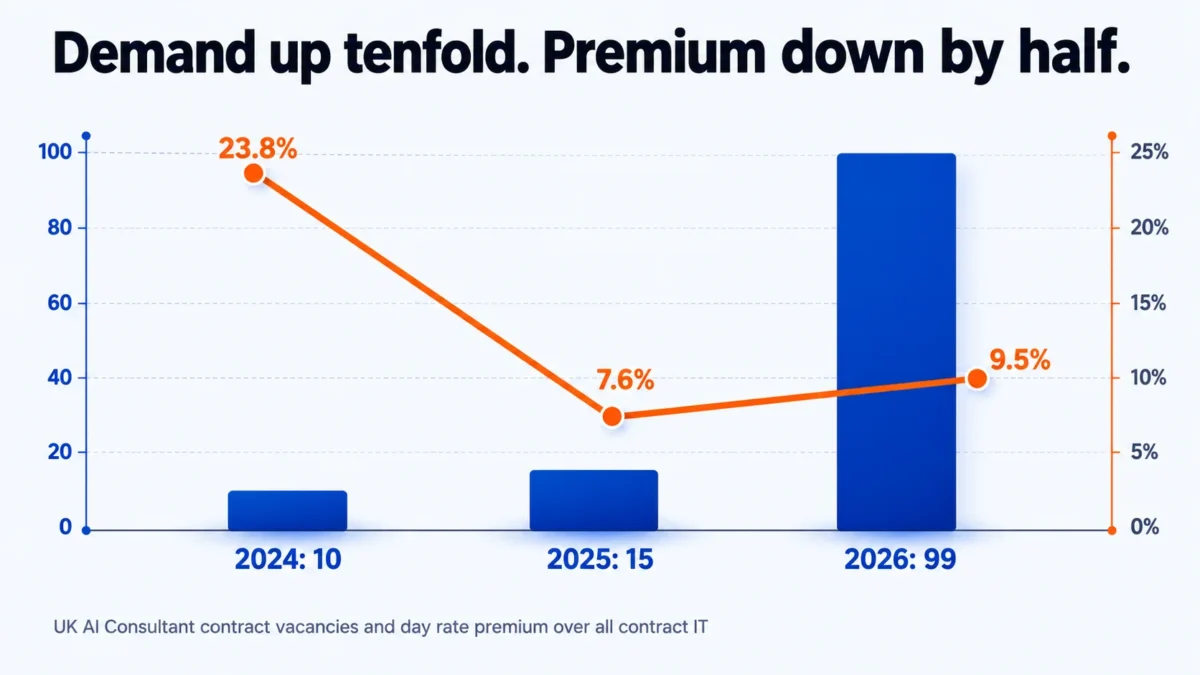
Anyone asking will AI replace consultants deserves numbers with a named source and a stated period rather than reassurance. Three sources carry this section, and two of them are updated continuously, so figures move.
UK contract demand grew tenfold in two years
IT Jobs Watch tracks UK contract technology vacancies by normalised job title. In the six months to 3 September 2026, it recorded 99 contract vacancies specifically titled Artificial Intelligence Consultant. In the same six month period of 2025 the figure was 15. In 2024 it was 10.
As a share of all UK contract technology vacancies, the role moved from 0.026 percent in 2024 to 0.046 percent in 2025 to 0.18 percent in 2026. Whatever AI is doing to consulting, it is not reducing the number of people the UK market is advertising for.
The pay premium collapsed while demand grew
Here is the finding almost nobody publishes, and it complicates the optimistic reading considerably.
| Six months to early September | 2026 | 2025 | 2024 |
|---|---|---|---|
| AI Consultant contract vacancies | 99 | 15 | 10 |
| Daily rates quoted in sample | 71 | 11 | 7 |
| Median AI Consultant day rate | £575 | £538 | £650 |
| Median day rate, all UK contract IT | £525 | £500 | £525 |
| Premium over general contract IT | 9.5% | 7.6% | 23.8% |
Source: IT Jobs Watch, UK contract vacancies, six months to 3 September 2026 and the equivalent periods in 2025 and 2024. Figures are recalculated daily.
Two years ago the title carried roughly a 24 percent premium over ordinary contract technology work. Today it carries under 10 percent. The median day rate is actually lower in nominal terms than it was in 2024, while the number of roles went up tenfold.
One honesty note that matters. The 2024 median rests on only seven quoted daily rates and the 2025 median on eleven, so both are fragile and a handful of unusual postings could move them. The 2026 figure rests on 71 quoted rates and is the sturdiest of the three. The safe conclusion is not that rates crashed, but that the AI premium is now under 10 percent on a decent sample, and that supply is arriving faster than pricing power.
The US picture is stronger than the panic suggests
The US Bureau of Labor Statistics classifies most consultants as management analysts. In its Occupational Outlook Handbook, BLS projects employment of management analysts growing 10 percent from 2025 to 2035, described as much faster than the average for all occupations, with about 94,100 openings each year across the decade. Median annual wage was $101,860 in May 2025, against $50,980 across all US occupations.
This is the US federal government projecting growth over precisely the decade people are worried about, published after generative AI was already in mainstream use. It is not a forecast anyone should treat as certain, since BLS projections are models rather than measurements, but it is the closest thing to an official position and it points the opposite way to the doom narrative.
The global signal
Stanford HAI’s 2026 AI Index Report gives the adoption backdrop. Organisational AI adoption reached 88 percent of surveyed organisations in 2025, up from 78 percent in 2024, and generative AI use in at least one business function reached 79 percent.
But adoption is broad and shallow. The same report found AI agent deployment still in the single digits across nearly all business functions, with a majority of respondents reporting no agent use at all. For professional, scientific and technical services, the sector containing management consulting, AI skills appeared in 6.49 percent of US job postings in 2025, up from 4.41 percent. That sector also covers legal, accounting and engineering, so treat it as directional rather than consulting specific.
Which Consulting Work Is Actually Shrinking?
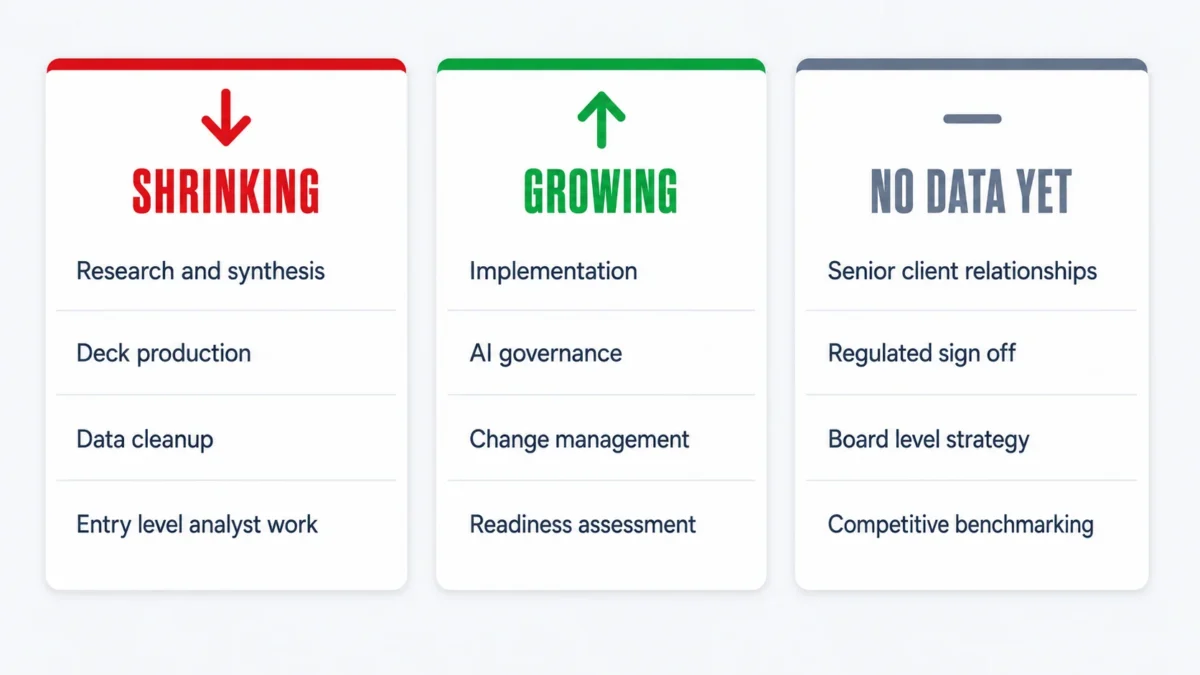
This is the table the question deserves. Every row carries either a supporting data point or an explicit note that no dataset exists for it.
| Shrinking | Growing | No measurable change yet |
|---|---|---|
| Research and synthesis. Knowledge management in business, legal and professional services is the single highest adoption industry and function pairing in the AI Index at 58 percent. | Implementation. Intelligent automation appeared in 12.12 percent of UK AI Consultant contract ads and retrieval augmented generation in 10.10 percent, against a role count that grew tenfold. | Senior client relationship work. No dataset tracks this. Any claim about trust based advisory work being safe or unsafe is currently opinion, including the reassuring version. |
| First draft document and deck production. Ju and Aral (2025), cited in the AI Index, found marketing teams using multimodal AI produced 50 percent more output per worker. | Governance and AI assurance. ISO/IEC 42001 and the EU AI Act each appeared in 3.03 percent of UK AI Consultant contract ads, NIST in 4.04 percent. Small shares, but from a base of essentially zero. | Regulated sign off. Professional responsibility for signed accounts, audit opinions and regulated filings remains a legal obligation attached to a named human. No data shows movement. |
| Data cleanup and reconciliation. Choi and Xie (2025), cited in the AI Index, found AI based accounting raised weekly client support throughput 55 percent, with experienced accountants benefiting most. | Change management and enablement. Workshop facilitation appeared in 10.10 percent of UK AI Consultant ads, stakeholder management in 9.09 percent, use case definition in 19.19 percent. | Board level strategy. The AI Index reports that strategy and corporate finance is among the lowest adoption functions across most sectors, alongside risk and compliance. |
| Entry level analyst work. The clearest displacement signal in the data. See the timeline section below. | AI readiness assessment. Roadmaps appeared in 12.12 percent of UK AI Consultant contract ads. The 88 percent adoption against single digit agent deployment gap is where most of this work sits. | Competitive benchmarking. No occupation level dataset tracks how benchmarking work has changed. It is widely assumed to be exposed. That assumption is untested. |
Sources for this table: IT Jobs Watch UK contract vacancy skill co-occurrence data for the six months to 3 September 2026, and Stanford HAI’s 2026 AI Index Report, Chapter 4. Percentages describe advertised requirements, not the work consultants actually perform, which is a real limitation of any job posting dataset.
When Will This Actually Happen?
No competitor answers the timing question, usually because answering it honestly means admitting how much is unknown. Here is what the evidence supports, split by confidence.
Already happening, with hard evidence. The entry level pipeline is the one area where displacement is measurable rather than anticipated. In the AI Index, employment among workers aged 22 to 25 in the most AI exposed occupations has fallen roughly 16 percent relative to the least exposed, controlling for firm effects, with the gap widening since mid 2024. For software developers specifically, headcount for the 22 to 25 age group fell close to 20 percent from its 2022 peak by September 2025. Research, synthesis and drafting inside professional services is the other, evidenced by that 58 percent knowledge management adoption figure.
Early signals, next 12 to 24 months. Roughly one third of organisations surveyed expect AI to reduce their workforce over the coming year, while 43 percent expect little or no change. Across nearly all business functions, expected decreases outpace decreases already observed, with the largest anticipated reductions in service operations, supply chain and software engineering. These are expectations, not outcomes, and employer sentiment has a poor forecasting record.
No evidence either way. Senior advisory work, regulated sign off, and consulting specific task composition over time. There is no dataset that tracks what consultants spend their hours on year by year. Anyone telling you exactly when partner level advisory work gets automated is guessing, in either direction.
One finding deserves particular attention because it cuts against the narrative on both sides. Between 2022 and early 2025, unemployment rose across all occupation groups regardless of AI exposure. For the most exposed quintile it rose 0.30 percentage points. For the least exposed it rose 0.94 percentage points. Unemployment went up more for the workers least exposed to AI. Whatever is currently moving the labour market, AI exposure is not the dominant variable.
What Has Changed in Finance Consulting Work, and What Has Not
The following is professional analysis of task structure in finance and reporting consulting, informed by practice. It does not report measured results from a controlled test.
Finance consulting is a useful test case because its tasks are unusually well defined, which is exactly the condition under which the AI Index found productivity gains to be largest. Structured work with clear quality monitoring is where the technology performs. Ambiguous work is where it does not.
The parts of a reporting and automation engagement that are structurally exposed are the ones with a known correct answer. Drafting the first version of a DAX measure or a SQL query. Producing initial variance commentary once the numbers are agreed. Reformatting inconsistent client data into a usable shape. Writing documentation. These share one property: the output can be checked immediately against a definition, so an error surfaces fast and cheaply.
The parts that are not exposed share the opposite property. Deciding whether a client’s chart of accounts is actually mapped the way they think it is. Judging whether a number that looks wrong is wrong or merely surprising. Agreeing what a metric should mean before anyone builds it. Telling a client the automation they asked for should not be built. None of these have a checkable answer, and getting them wrong produces failures that surface months later in a board pack.
That pattern matches the research. Choi and Xie found experienced accountants gained most from AI accounting tools, using confidence scores to target their oversight rather than replacing their judgement. In the opposite direction, METR found experienced open source developers were 19 percent slower using AI assistance, with a notable gap between how helpful they believed the tools were and how they actually performed. The tools help where verification is cheap and cost time where it is expensive.
The implication is uncomfortable but simple. If your billable value sits in producing artefacts, it is compressing. If it sits in deciding which artefact should exist and whether the output can be trusted, it is not.
Should You Still Enter Consulting in 2026?
Yes, with a condition. The evidence supports entering the field, and it also explains why the traditional entry route is now the riskiest part of it.
That route ran through exactly the work compressing fastest. Junior consultants historically earned their position by doing research, building decks, cleaning data and running benchmarks, then acquired judgement through exposure. That apprenticeship is thinning, and the 16 percent relative employment decline for 22 to 25 year olds in AI exposed occupations is what thinning looks like in the data.
So the entry strategy has to change. Rather than expecting to be hired for the absorbed tasks, arrive with domain credibility in something specific and evidence that you have delivered a real thing. Our guide on how to become an AI consultant covers rate benchmarking and the portfolio side in detail, including why business skills like use case definition appear far more often than Python in AI Consultant advertisements.
Two pieces of grounding are worth having before you pitch. Understanding how AI agents work matters because agentic systems are the default thing clients ask about, and understanding what AI agents can actually do today matters more, because the gap between marketing and deployable reality is where consultants earn their fee. If you are moving between roles, positioning your resume for AI era roles is worth reading alongside this.
For anyone already established, the defensive move is not learning to prompt better. It is moving billable time toward scoping, judgement and accountability, and away from artefact production.
Frequently Asked Questions
Will AI replace management consultants?
No, on current published data. The US Bureau of Labor Statistics projects employment of management analysts, the category covering most consultants, growing 10 percent between 2025 and 2035, faster than the average occupation, with about 94,100 annual openings. UK contract vacancies for AI Consultant roles rose from 10 in the six months to September 2024 to 99 in the same period of 2026 according to IT Jobs Watch. Every demand measure points up. So when people ask will AI replace consultants, the evidence says the task mix inside the role is changing far faster than the headcount.
Which consulting jobs are most at risk from AI?
Entry level and analyst roles carry the clearest measurable risk. Stanford HAI’s 2026 AI Index found employment among workers aged 22 to 25 in the most AI exposed occupations has fallen roughly 16 percent relative to the least exposed, with the gap widening since mid 2024. Within the work itself, research, synthesis, first draft deck production and data cleanup are absorbing fastest. Senior advisory, regulated sign off and board level strategy show no measurable change, though no dataset tracks these specifically.
Is consulting still a good career in 2026?
The demand data says yes. BLS projects 10 percent growth for management analysts through 2035 with a May 2025 median wage of $101,860, roughly double the $50,980 median across all US occupations. The caution is on pricing rather than employment. In the UK, the AI Consultant day rate premium over general contract technology work fell from about 24 percent in 2024 to under 10 percent by September 2026, on IT Jobs Watch data, which suggests supply is arriving faster than pricing power.
Should I still train as a consultant?
Yes, provided you do not rely on the traditional apprenticeship route. The tasks juniors historically used to build judgement, meaning research, deck production and data cleanup, are the ones compressing fastest, which is why early career employment in exposed occupations is falling. Enter with specific domain expertise and a documented delivered project rather than expecting to learn the trade through absorbed tasks. Stanford HAI’s 2026 AI Index also found AI agent deployment still in single digits across nearly all business functions, so the implementation and governance work that replaces the old entry route is genuinely available now.
The Honest Verdict
Will AI replace consultants? Not on any timeline the current evidence supports, but the question was always slightly wrong. The job is being unbundled rather than eliminated. Research, synthesis and artefact production are compressing, implementation and governance are expanding, and the entry level pipeline is absorbing most of the damage while senior advisory work shows no measurable movement at all.
The gap between 88 percent organisational adoption and single digit agent deployment is not a sign the technology failed. It is the size of the current consulting opportunity, and it is why UK vacancies grew tenfold while the pay premium shrank to under 10 percent. More work, more competition for it, thinner margins.
Where the evidence runs out, this article has said so rather than filling the gap with a confident guess. Nobody publishes consulting task composition over time, so anyone giving you a precise date for partner level automation is guessing.
If you want more analysis of where AI genuinely fits in professional and finance work, explore our Business and AI section, or get in touch to discuss a scoped assessment of your own reporting and workflow processes.
Written by Ahmad Hussain, ACCA. Data in this article is drawn from IT Jobs Watch UK contract vacancy analysis for the six months to 3 September 2026 and equivalent prior periods, US Bureau of Labor Statistics Occupational Outlook Handbook projections for 2025 to 2035 and wage data for May 2025, and Stanford HAI’s 2026 AI Index Report, Chapter 4. IT Jobs Watch figures are recalculated daily and small samples move; sample sizes are stated in the table above. Where no dataset exists for a claim, that is stated rather than estimated. This article reports verified research analysis and does not claim results from controlled testing.

Ahmad Hussain
ACCAAhmad builds advanced Excel models, Power BI dashboards, and AI automation for businesses. He writes AI Foresight 360 himself, and every pricing figure and feature claim is verified against official documentation at the source.
Connect on LinkedIn