Search for advice on how to become an AI consultant and you will find a wall of pages promising $500 an hour, six figures within ninety days, and a certification that supposedly unlocks it all. Almost none of those pages cite a source you can check. Most are published by consulting firms that benefit from making the market look richer than it is.
This guide takes the opposite approach, and it covers the United States, the United Kingdom, and the wider global market separately, because they behave differently and are measured differently. Every figure below comes from a named source with a stated methodology: the US Bureau of Labor Statistics, the General Services Administration, IT Jobs Watch contract vacancy data, and Stanford HAI’s 2026 AI Index Report. Where reliable data does not exist, that gap is stated plainly rather than filled with a plausible sounding number.
The short answer on how to become an AI consultant is that the work is real, demand is rising fast almost everywhere, and the pay premium over ordinary technology contracting is smaller than the marketing suggests. The people succeeding are usually not the strongest engineers. They are the ones who can sit with a finance director, identify which process is worth automating, and say honestly when the answer is that nothing is.
I write this as a practising ACCA accountant who runs an AI and analytics consulting practice alongside this publication, building Power BI reporting, financial workflow automation, and AI tooling for finance teams. That shapes what follows, particularly the sections on scoping and pricing.
What Is an AI Consultant, and What Do They Actually Do?
An AI consultant helps an organization decide where artificial intelligence will and will not create value, then guides or delivers the implementation. The role sits between the business and the technology. Typical work includes running discovery workshops, mapping candidate use cases, building proofs of concept, writing AI policy, and training staff. Very few AI consultants train models.
That surprises people. The popular image involves fine tuning large language models. In practice, most engagements look closer to business analysis with a technical edge. A client has a document heavy process, a reporting bottleneck, or a customer service queue, and wants to know whether current tools can help, what it would cost, and what could go wrong.
The three types of AI consulting work
Strategy and advisory work covers readiness assessments, use case prioritization, roadmaps, and governance. It is the most senior work and the least technical. Deliverables are documents, workshops, and decisions.
Implementation work covers building the thing: an automation, a retrieval system over company documents, an agent that handles a defined task. This requires genuine technical capability, though usually configuration and integration rather than research.
Enablement work covers training, prompt libraries, internal guidelines, and change management. It is often undervalued and is frequently where the largest measurable return sits, because a team that uses existing licences well often outperforms a team that buys new ones badly.
Most independent consultants sell some combination of all three. Understanding how AI agents work matters across every category, because agentic systems are now the default thing clients ask about.
How to Become an AI Consultant Without a Computer Science Degree
You do not need a computer science degree to become an AI consultant. What you need is verifiable domain expertise, working fluency with current AI tooling, and evidence that you have delivered something. Career changers from accounting, operations, law, healthcare administration, and marketing routinely succeed, because clients buy understanding of their problem more than understanding of transformer architecture.
The advantage of a domain background is specific and underrated. An accountant already knows what a month end close involves, which controls cannot be bypassed, and why the finance director is nervous about an automated journal entry. A generalist AI engineer has to learn all of that before the project can be scoped correctly, and often learns it by getting something wrong first.
The realistic entry paths look like this. Domain specialists move sideways by becoming the AI person inside their existing employer, delivering two or three internal projects, then going independent with that track record. Technologists move into consulting by deliberately building commercial and communication skills, which is usually the harder direction. Analysts and data professionals have the shortest distance to travel, because the tooling overlaps heavily.
What none of these paths skip is proof. Before your first paid engagement you need something concrete to show, whether that is an internal automation you built, a public write up of a working prototype, or a documented pilot. Guidance on how to build your AI portfolio and resume is worth reading before you start pitching, because the portfolio is what closes the first client.
How Big Is the AI Consulting Market Worldwide?
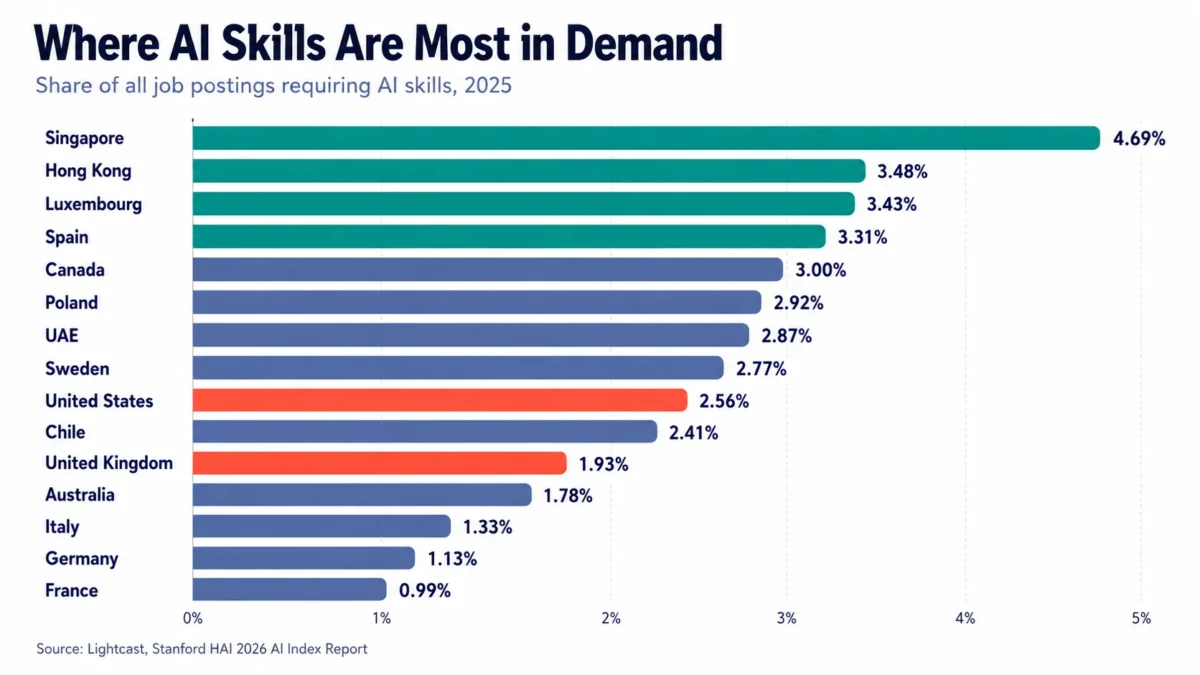
AI demand is growing globally but its intensity varies enormously by country, and understanding that map matters if you intend to work remotely or relocate. According to Stanford HAI’s 2026 AI Index Report, which draws on Lightcast analysis of job postings, Singapore led the world in 2025 with 4.69 percent of all job postings requiring AI skills, followed by Hong Kong at 3.48 percent, Luxembourg at 3.43 percent, and Spain at 3.31 percent.
Where AI demand is most intense
The rankings contain a genuine surprise for anyone assuming the US dominates everything.
| Country | AI share of all job postings, 2025 |
|---|---|
| Singapore | 4.69% |
| Hong Kong | 3.48% |
| Luxembourg | 3.43% |
| Spain | 3.31% |
| Canada | 3.00% |
| Poland | 2.92% |
| United Arab Emirates | 2.87% |
| Sweden | 2.77% |
| United States | 2.56% |
| Chile | 2.41% |
| United Kingdom | 1.93% |
| Australia | 1.78% |
| Italy | 1.33% |
| Germany | 1.13% |
| France | 0.99% |
Source: Lightcast data published in Stanford HAI’s 2026 AI Index Report.
Canada outranks the United States. Spain outranks both. The United Kingdom, despite being a major AI investment destination, sits at 1.93 percent. Job posting intensity is not the same as market size, since the US produces far more absolute postings, but it does tell you where AI skills are unusually scarce relative to the local labor market, and scarcity is what supports rates. For anyone building a practice outside the major hubs, that scarcity map is more useful than any headline rate.
Population level adoption tells a similar story. The AI Index reports second half 2025 adoption at 64.0 percent in the United Arab Emirates and 60.9 percent in Singapore, against 38.9 percent in the United Kingdom, 36.9 percent in Australia, 35.0 percent in Canada, and 28.3 percent in the United States, which ranked 24th despite leading global AI investment.
Talent concentration adds a third angle. Israel had the highest concentration of AI talent among LinkedIn members in 2025 at 2.1 percent, followed by Singapore at 1.8 percent and Luxembourg at 1.6 percent. The United Arab Emirates, India, and Saudi Arabia showed the fastest growth, each increasing over 100 percent between 2019 and 2025.
Which industries are hiring
Sector matters more than country for most consultants, and here the US data is detailed. AI skills appeared in 13.22 percent of information sector job postings in 2025, up from 7.82 percent in 2024. Professional, scientific, and technical services followed at 6.49 percent, finance and insurance at 5.33 percent, and manufacturing at 4.66 percent.
Finance and insurance rising 62.94 percent year over year is the single most relevant line in that dataset for anyone with an accounting or financial background. It confirms that the sector is buying, not just talking.
Adoption is broad but shallow. The AI Index reports that 88 percent of surveyed organizations used AI in at least one business function in 2025, up from 78 percent in 2024, while AI agent deployment remained in the single digits across nearly all business functions. That gap between adoption and agent maturity is where most consulting work currently sits.
Where the money is going
Global corporate AI investment reached $581.69 billion in 2025, a 129.9 percent increase on the previous year. Private investment alone was $344.66 billion. Geographically it is extremely concentrated: the United States attracted $285.88 billion, roughly 23 times China’s $12.41 billion and 48 times the United Kingdom’s $5.90 billion.
Investment concentration matters to consultants for a practical reason. Funded companies buy consulting. The US produced 1,953 newly funded AI companies in 2025 against 172 in the United Kingdom, 161 in China, and 108 in India, which is a direct signal of where new buyers are appearing.
What AI Consultant Skills Do Clients Actually Pay For?
The most in demand AI consultant skills are business skills, not coding skills, and that single fact reshapes the whole career path. In UK contract advertisements for AI Consultant roles over the six months to 1 September 2026, IT Jobs Watch recorded Python in 6.06 percent of postings. Use case work appeared in 20.20 percent, roadmaps in 13.13 percent, and workshop facilitation in 10.10 percent.
That comparison is the most useful thing in this guide. The market is not primarily hiring people to write code. It is hiring people to work out what to build.
| Requirement | Share of AI Consultant contract ads |
|---|---|
| Artificial intelligence, general | 71.72% |
| Microsoft | 29.29% |
| Public sector experience | 27.27% |
| Microsoft Copilot | 23.23% |
| Azure | 20.20% |
| Use case definition | 20.20% |
| Generative AI | 18.18% |
| Large language models | 17.17% |
| Security clearance | 14.14% |
| Finance domain | 14.14% |
| Roadmaps | 13.13% |
| Machine learning | 12.12% |
| Prompt engineering | 12.12% |
| Intelligent automation | 12.12% |
| Workshop facilitation | 10.10% |
| Retrieval augmented generation | 10.10% |
| Stakeholder management | 9.09% |
| MLOps | 8.08% |
| Python | 6.06% |
Source: IT Jobs Watch, UK contract vacancies citing Artificial Intelligence Consultant, six months to 1 September 2026. Percentages describe advertised requirements, not the work consultants actually perform.
The business skills that dominate
Use case definition is the single most valuable skill on that list. Clients arrive with either a vague ambition or a specific bad idea. Your job is to convert that into a scoped problem with a measurable outcome and a realistic cost. Most failed AI projects failed at this step, before a single line of code existed.
Workshop facilitation and stakeholder management appear because AI projects cross departments. You will be in rooms with people who want the project to fail, usually for rational reasons involving their own workload or job security. Handling that is a skill, and it is not taught in any technical course.
Domain credibility matters more than any of it. Finance appearing in 14.14 percent of these advertisements is notable given how narrow that category is, and it lines up with the 5.33 percent AI posting share in US finance and insurance. Two independent datasets pointing the same way is a stronger signal than either alone.
The technical skills that still matter
You do need real technical fluency, just less of it than expected, and different from what people assume. Working knowledge of the major model families and their limits is essential. So is understanding retrieval augmented generation, which appeared in 10.10 percent of UK ads and is the architecture behind almost every request to chat with company documents.
Familiarity with the Microsoft stack is close to mandatory in the UK market, given Copilot at 23.23 percent and Azure at 20.20 percent. Prompt engineering appears in 12.12 percent, though as a discipline it is now table stakes rather than a differentiator.
The direction of travel globally is toward operations rather than experimentation. In US AI postings, the fastest growing specialized skills compared with the 2013 to 2015 baseline were Amazon Web Services at plus 1,358 percent, workflow management at plus 818 percent, and scalability at plus 733 percent. Employers are hiring people who can keep systems running, not just prototype them.
Data literacy underpins everything. If you cannot assess whether a client’s data is clean enough, structured enough, and permitted for the intended use, you cannot scope the project honestly. This is where analytics and finance backgrounds pay off immediately.
You should also speak credibly about risk. Clients increasingly ask about data leakage, hallucination in regulated outputs, and vendor lock in. Knowing the practical shape of AI agent security risks separates you from consultants who only discuss upside.
Why the US and UK skill data appear to disagree
One apparent contradiction is worth resolving directly, because it trips up a lot of readers. The AI Index found Python to be the single most requested specialized AI skill in US postings, appearing in 258,674 of them, a 391 percent increase on the 2013 to 2015 baseline. The UK data above shows Python in only 6.06 percent of AI Consultant advertisements.
Both are true, and the gap is the whole point. The AI Index measures every posting that mentions AI skills, the large majority of which are engineering, data, and infrastructure roles. The IT Jobs Watch figure measures the narrow set of jobs actually titled AI Consultant. Building AI is a Python job. Advising on AI is not. If you want to be an AI engineer, learn Python properly. If you want to be an AI consultant, learn to scope.
What Is the Real AI Consultant Hourly Rate in 2026?
Anyone entering this field eventually reaches the money question, and the honest answer differs by market. Only three genuinely published rate anchors exist worldwide: US government wage data, US federal awarded contract rates, and UK contract vacancy data. Everything else circulating online is vendor marketing. Each is covered below, followed by a method for benchmarking anywhere else.
United States
The Bureau of Labor Statistics reports that management analysts, the occupational category covering management consultants, had a median annual wage of $101,860 in May 2025. The lowest ten percent earned under $60,640 and the highest ten percent above $171,640. Employment is projected to grow ten percent from 2025 to 2035, with about 94,100 openings a year.
At the more technical end, BLS reports that data scientists had a median annual wage of $120,230 in May 2025, with employment projected to grow 35 percent through 2035 and roughly 24,800 openings a year. The median across all US occupations was $50,980.
Those are employment figures, so converting them into an independent consulting rate takes one more step, and it is the step most guides skip. A salaried consultant on $101,860 bills close to full time while an employer absorbs benefits, tax, sales effort, and gaps between projects. An independent carries all of it.
The practical calculation is to divide your target gross income by realistic billable hours rather than by working hours. A solo consultant who genuinely bills 1,000 hours a year, which is realistic once selling, admin, and unpaid discovery are accounted for, needs roughly $150 an hour to reach $150,000 gross before costs and tax. That is how a defensible rate is built. It is not derived from what someone else claims the market pays.
US demand is also highly concentrated. California recorded 170,881 AI job postings in 2025, about 17.2 percent of the national total, followed by Texas at 80,547 and New York at 66,029. Those three states account for roughly a third of all US AI postings. By density rather than volume, Washington DC stands out at a 6.2 percent AI share of its postings, followed by Delaware at 4.4 percent.
How to check real US rates yourself
The closest thing to published US hourly rate data is the General Services Administration’s Contract-Awarded Labor Category tool, now hosted on GSA’s buying platform. It lets anyone search fully burdened hourly rates actually awarded on GSA and VA Multiple Award Schedule contracts, filtered by labor category, education level, and years of experience.
Two caveats. These are ceiling rates awarded at master contract level, so task order rates are often lower, and they are worldwide rates rather than locality adjusted. Even so, searching terms like data scientist or management consultant returns a real, government published, checkable number, which is more than any consulting firm blog offers.
United Kingdom
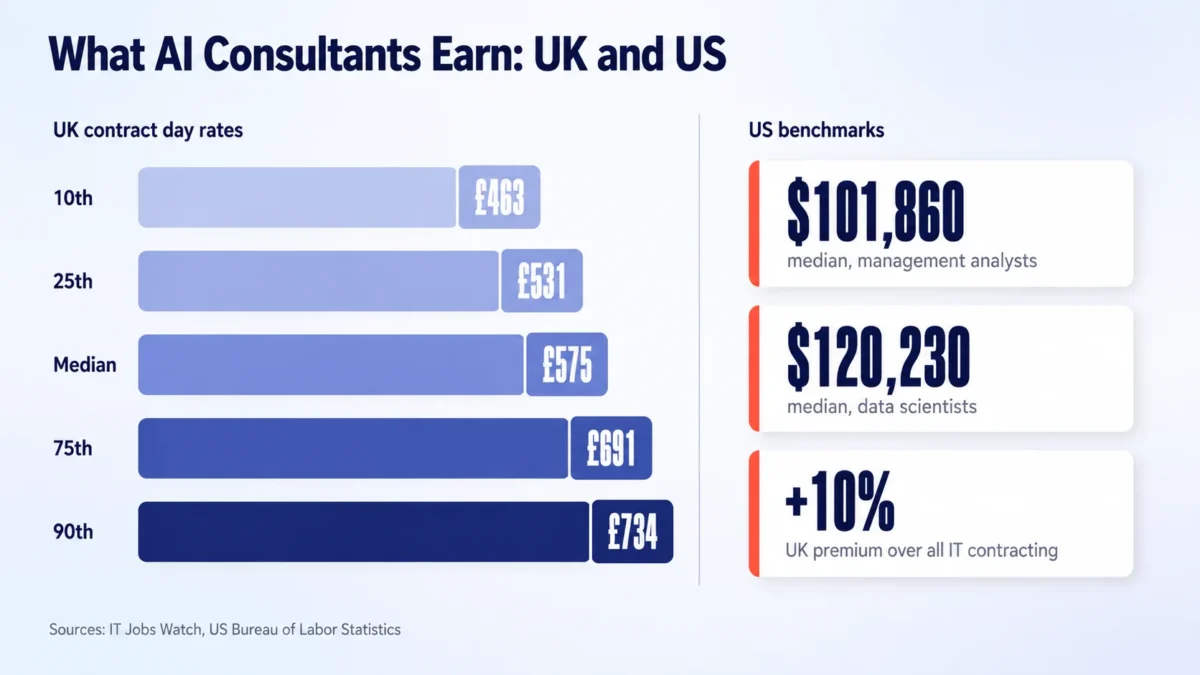
The median AI Consultant daily rate in the UK was £575 in the six months to 1 September 2026, according to IT Jobs Watch. On an eight hour day that is roughly £72 per hour.
| Percentile | Daily rate |
|---|---|
| 10th | £463 |
| 25th | £531 |
| Median | £575 |
| 75th | £691 |
| 90th | £734 |
Two caveats matter. First, the sample is 72 quoted daily rates from 99 matching vacancies, small enough that individual postings move the figures. Second, these are advertised contractor rates for an individual filling a defined role, not the price an independent charges for a scoped project.
The demand signal is far stronger than the rate signal. Those 99 contract vacancies compare with 16 in the equivalent period of 2025 and 10 in 2024. The role climbed from 0.026 percent of all UK contract technology vacancies in 2024 to 0.18 percent in 2026.
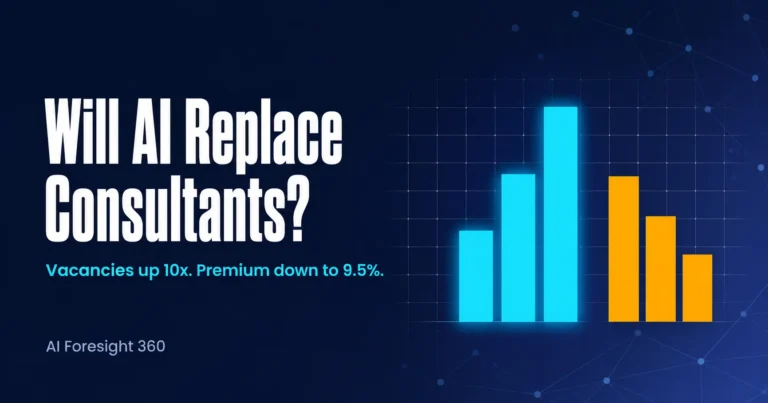
Now the finding almost nobody publishes. Across all UK contract technology roles in the same period, the median daily rate was £525. The AI Consultant premium over general contract technology work was therefore around ten percent, not the multiple that vendor marketing implies. Demand is growing quickly. Rates are not.
That combination of rising demand and a shrinking premium sits at the centre of the wider question of whether AI will replace consultants, where the same UK vacancy data is tracked back to 2024 alongside US employment projections through 2035.
Regional variation was modest. London, the UK excluding London, and England all showed a £575 median, while the North West showed £723 and the Midlands £501.
Everywhere else: how to benchmark without a rate dataset
For Canada, Australia, the EU, the Gulf, India, and most other markets, no equivalent AI consulting rate series is published. This is the hardest part of pricing yourself outside the US and UK. Rather than borrow a US figure that will not survive contact with your local market, build the number from three inputs.
Start with your national statistics office or official careers service for the salaried equivalent of your role, since most developed economies publish occupational wage data comparable to BLS. Adjust for the independence premium using the billable hours calculation above. Then sense check against local demand intensity using the AI posting shares in the table earlier, remembering that a market like Canada at 3.00 percent or Spain at 3.31 percent has proportionally tighter supply than the United Kingdom at 1.93 percent.
If you plan to serve clients remotely across borders, price in the client’s currency and market, not your own. A consultant in a lower cost country billing US clients at US rates is competing on capability, which is defensible. Billing US clients at local rates simply leaves money on the table.
Why the big hourly rate claims are unreliable
You will find pages confidently stating that AI consultants charge $150, $400, or $1,200 an hour. Trace those figures and they almost always originate in a blog post published by a firm that sells AI consulting. None publish a methodology, a sample size, or a collection period, and all benefit commercially from anchoring the market high.
This guide will not repeat those numbers as measurements. Every figure above comes from BLS, awarded federal contracts, IT Jobs Watch, or Stanford HAI. If you see a specific average AI consultant hourly rate quoted elsewhere, check who published it before pricing your own work against it.
Do You Need an AI Consultant Certification?
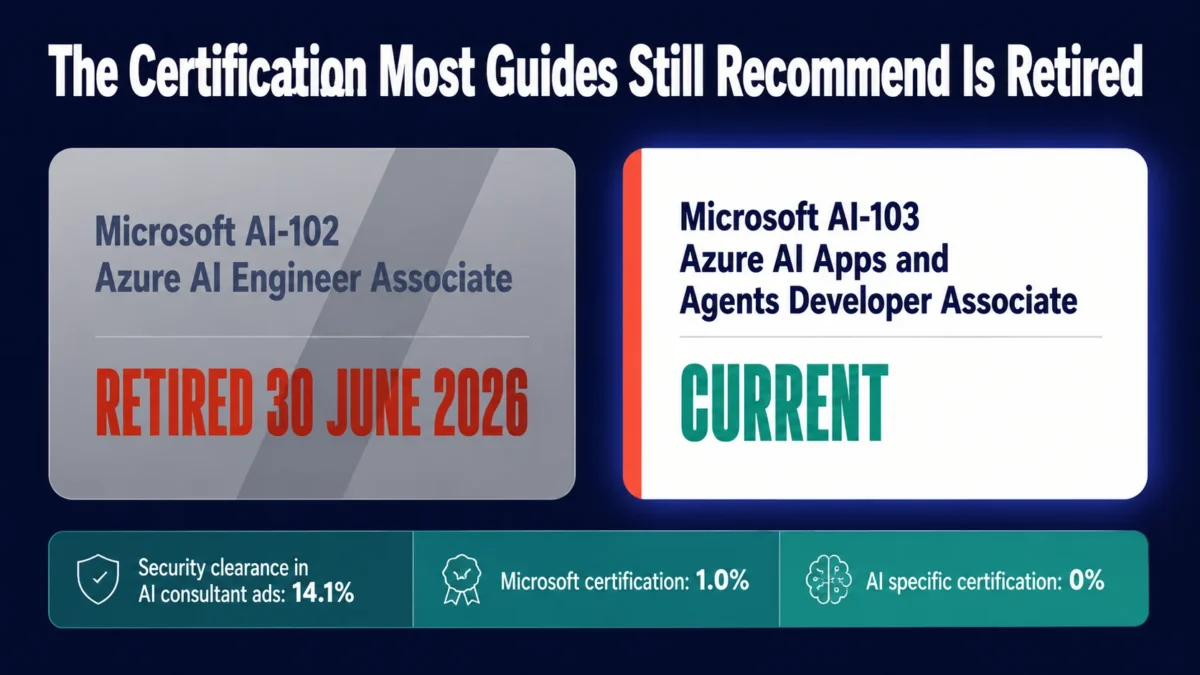
Certification is the most searched aspect of this career, yet no AI consultant certification is required to work in this field, and the market data suggests clients rarely ask for one. In the IT Jobs Watch qualifications breakdown for AI Consultant contract roles, the most cited requirements were security clearance at 14.14 percent and SC clearance at 11.11 percent. Azure Certification and Microsoft Certification each appeared in 1.01 percent. No AI specific certification appeared at all.
That is worth sitting with, because the certification industry around AI consulting is now substantial and much of its marketing implies the opposite.
Certifications still have three legitimate uses. They impose study structure, they help when you have no delivery track record, and a small number are genuinely demanded in regulated or governance heavy work. What they do not do is substitute for evidence that you have delivered something.
If you pursue one, verify its current status before paying. This field retires credentials quickly. The widely recommended Microsoft AI-102 exam and its Azure AI Engineer Associate certification retired on 30 June 2026. The current Microsoft credential is Azure AI Apps and Agents Developer Associate, earned through Exam AI-103, covering generative AI, agentic workflows, and responsible AI using Microsoft Foundry. Many career guides published this year still recommend the retired one.
| Credential | Awarding body | Best suited to |
|---|---|---|
| Azure AI Apps and Agents Developer Associate (AI-103) | Microsoft | Consultants delivering on the Microsoft and Azure stack |
| Artificial Intelligence Governance Professional (AIGP) | IAPP | Policy, compliance, and governance advisory work |
| ISO/IEC 42001 Lead Implementer or Lead Auditor | Accredited training providers | Consultants building or auditing AI management systems |
The AIGP certification launched in March 2024 and has no formal prerequisites. It is a three hour, one hundred question exam, with a two year term maintained through twenty continuing education credits. It suits consultants focused on AI policy, risk, and regulatory alignment rather than delivery.
For governance work, familiarity with ISO/IEC 42001 is increasingly valuable worldwide. Published in December 2023, it is the first international standard specifying requirements for an artificial intelligence management system, and it appeared alongside the EU AI Act in 3.03 percent of the UK contract advertisements analysed above. Note that ISO itself does not certify organizations; independent accredited certification bodies do that.
My recommendation is unglamorous. Build one real deliverable before buying any certification. A working prototype with a written case behind it wins more engagements than any credential on that list.
How Do You Choose a Niche Before You Start?
The most important early decision is narrowing your focus, so choose a niche by intersecting an industry you already understand with a process that is document heavy, repetitive, and expensive. Generalists compete against every other generalist and against large firms with better brands. Specialists compete against almost nobody and can charge more because their scoping is faster and more accurate.
The strongest niches share three features. The domain has expensive human time going into structured, repeatable tasks. The buyer has a budget and a clear pain. And you can speak their language without a translator.
Examples meeting all three include accounting practices drowning in client document handling, law firms doing contract review at volume, healthcare administrators processing prior authorizations, recruitment agencies screening applications, and property managers handling maintenance triage. The sector data supports this: finance and insurance AI posting share rose 62.94 percent year over year in the US, and finance appeared in 14.14 percent of UK AI Consultant ads.
Resist keeping your niche broad so you do not miss opportunities. In practice, breadth reduces enquiries rather than increasing them, because nothing tells a specific buyer that you understand their specific problem.
How Do You Land Your First AI Consulting Client?
Your first AI consulting clients almost always come from your existing network rather than from marketing, and this is where most new consultants stall. The reliable pattern is a small, paid, scoped piece of work for someone who already trusts you, delivered well, then used as a reference. Cold outreach and content marketing work, but they typically produce results in months, not weeks, and they work far better once you have one delivered project to point at.
Where the first three clients come from
The first is usually your current or former employer. If you have built anything internally, that is both a case study and a potential retainer. Many consultants start by going part time and keeping their old employer as client number one.
The second usually comes from a professional peer who has heard you talk about the work. This is why speaking at a small industry event or writing something specific and useful about a problem in your niche outperforms generic AI content. You are not trying to reach everyone. You are trying to be the obvious call for one type of problem.
The third often comes from the first two as a referral, which is why delivery quality on early projects matters more than the price you charged.
Start with a paid discovery engagement
Do not begin with a large fixed price build. Begin with a paid discovery engagement: a short, scoped assessment that maps the client’s processes, identifies candidate use cases, estimates value and cost for each, and delivers a written recommendation.
This protects both sides. The client makes a small commitment before a large one. You learn whether their data and their organization can support the project before committing to a delivery price. And a discovery engagement can honestly conclude that the client should not proceed, which builds more trust than any successful build.
How Should You Price Your First AI Consulting Engagement?
Pricing is where the commercial side of the business becomes real, so price early engagements by project rather than by hour, and set the price against the value of the outcome rather than the time it takes. Hourly pricing punishes you for getting faster, invites scope disputes, and anchors the client on your cost rather than their return.
Three practical rules from delivering this kind of work, and they matter more to a sustainable practice than any rate benchmark.
Scope the deliverable, not the effort. A working prototype that extracts six named fields from defined document types at an agreed accuracy, plus a handover session, is a scope. Four weeks of AI consulting is an invitation to an argument.
Price discovery separately and never for free. Free discovery attracts clients who were never going to buy and trains the ones who do to undervalue the thinking, which is the part you are actually selling.
Build running costs into the conversation early. Clients frequently budget for your fee and forget the model, licence, and infrastructure costs that follow. Being straight about what AI tools actually cost at proposal stage prevents an unpleasant conversation later and marks you as someone who has done this before.
What Does an AI Consulting Business Cost to Start?
One of the more encouraging aspects of this career is cost, because an AI consulting business has unusually low startup costs. There is no inventory, no premises requirement, and no expensive equipment. The meaningful costs are professional indemnity insurance, business registration and accounting, model and tool subscriptions, and your own time while you have no revenue.
Time is the real cost. Most independents need several months between deciding to start and receiving consistent income, and that runway determines whether the business survives. Treat it as the primary budget line.
The tooling budget is smaller than expected initially. You need access to the major model providers, a cloud account, and whatever automation platform suits your niche. Costs scale with client work and can usually be passed through or billed directly.
Commercial infrastructure is where new consultants under invest. A written contract with clear scope, a defined change process, professional indemnity cover, and straightforward invoicing are not optional once you have a real client. Get these in place before the first engagement rather than during it.
If part of your offer involves deploying AI agents for small business clients, budget for ongoing support too. Agentic systems need monitoring, and clients will assume that is included unless your contract says otherwise.
What Mistakes Should New AI Consultants Avoid?
The most damaging early mistake is selling technology instead of outcomes. Clients do not want an agent, a retrieval system, or a fine tuned model. They want a shorter close, a smaller backlog, or fewer errors. Lead with the problem and the measurable result.
Overpromising accuracy is the second. Language models are probabilistic, and any claim of near perfect extraction or classification in a real client environment will eventually be tested and found wanting. Quote a realistic accuracy range, agree how it will be measured, and build human review into anything with financial or legal consequence.
Ignoring data readiness is the third. Many AI projects fail because the underlying data is inconsistent, incomplete, or not legally usable for the intended purpose. Assess this during discovery, in writing.
Competing on price is the fourth. There will always be a cheaper offshore team or a keener beginner. Competing on domain depth and honest scoping is defensible; competing on rate is not.
The fifth is neglecting governance. Clients in regulated sectors will ask how you handle data residency, retention, auditability, and compliance with emerging AI regulation. Having a considered answer converts enquiries that would otherwise stall.
Finally, avoid claiming capabilities you have not built. This industry is small and references circulate. Being the consultant who says honestly that something is outside what you would deliver well, and naming who to call instead, earns more work over time. When clients ask about tool selection, explaining a genuine trade off such as how Claude and ChatGPT differ for professional work is more persuasive than declaring one universally best.
How to Become an AI Consultant in 90 Days: A Realistic Plan
This plan assumes you are starting alongside existing work rather than quitting first, which is the lower risk route and the one most successful independents took.
Days 1 to 30 are for positioning and capability. Choose your niche using the intersection test above. Audit what you already know that a buyer in that niche would pay for. Get genuinely fluent with the major models, one automation platform, and the basics of retrieval augmented generation. Write down the three processes in your niche most likely to justify an AI project.
Days 31 to 60 are for proof. Build one real thing, ideally solving a genuine problem for your current employer or a peer. Document it properly: the problem, the approach, the measured result, and what did not work. This document is your portfolio. Publish a version publicly if you can without breaching confidentiality.
Days 61 to 90 are for commercial setup and first revenue. Write your discovery engagement offer with a fixed scope and price. Put contract, insurance, and invoicing in place. Then approach ten people in your network directly, not with a broadcast, describing the specific problem you solve and offering the discovery engagement. Ten targeted conversations reliably outperform a hundred generic messages.
Expect the first paid engagement somewhere between month three and month six. Anyone promising faster is selling something.
Frequently Asked Questions
How long does it take to become an AI consultant?
Most people who work out how to become an AI consultant and reach paid delivery within a year came in with existing domain expertise and spent three to six months building AI specific capability and proof before their first engagement. Starting from no professional background at all takes considerably longer, because the domain credibility clients buy cannot be compressed into a short course.
Can you become an AI consultant without coding?
Yes. Learning how to become an AI consultant without writing production code is entirely realistic, particularly in strategy, governance, and enablement work. Python appeared in only 6.06 percent of UK AI Consultant contract advertisements in the six months to September 2026, while use case definition, roadmaps, and workshop facilitation were far more common. You still need technical fluency to scope work honestly and to recognise when something is not feasible.
What is a realistic AI consultant hourly rate for a beginner?
In the US, build the number rather than borrow it: divide target gross income by realistic billable hours, which for a solo consultant is closer to 1,000 a year than 2,000, putting $150,000 gross at roughly $150 an hour. Cross check against awarded federal rates in the GSA CALC tool. In the UK, published contract data puts the tenth percentile AI Consultant daily rate at £463 and the median at £575 for the six months to 1 September 2026. Elsewhere, start from your national statistics office’s salaried equivalent and adjust upward for independence.
Which countries have the strongest demand for AI consultants?
By share of job postings requiring AI skills in 2025, Singapore led at 4.69 percent, followed by Hong Kong at 3.48 percent, Luxembourg at 3.43 percent, and Spain at 3.31 percent. Canada reached 3.00 percent, the United States 2.56 percent, and the United Kingdom 1.93 percent. High share relative to a small labor market usually means tighter supply, which supports rates for qualified consultants.
Is AI consulting a saturated market?
Not yet by demand measures, although more people enter the field every month. Stanford HAI’s 2026 AI Index found AI skills requested in 2.56 percent of all US job postings, and UK contract vacancies for AI Consultant roles rose from 10 in the six months to September 2024 to 99 in the same period of 2026. However, the UK median day rate premium over all contract technology roles was only about ten percent, suggesting supply is growing alongside demand. Specialization is the practical defence.
Do AI consultants need professional indemnity insurance?
Yes. If you advise on or build a system a client relies on for financial, legal, or operational decisions, you carry professional risk, and most serious clients will ask for evidence of cover before contracting. Arrange it before your first paid engagement and confirm the policy explicitly covers technology consulting work.
Which AI certification is most respected by clients?
None dominates, and market data suggests clients rarely require any certification at all. Where a credential helps, follow your specialism: the Microsoft Azure AI Apps and Agents Developer Associate for delivery on the Microsoft stack, the IAPP AIGP for governance and compliance advisory, and ISO/IEC 42001 training for consultants building AI management systems. A documented delivered project outperforms all of them.
The Honest Summary
Learning how to become an AI consultant is less about mastering the technology than most guides suggest and more about becoming the person a specific type of client trusts with a specific type of problem. The published evidence supports this. Business skills like use case definition and workshop facilitation appear far more often in AI Consultant advertisements than Python does, and no AI certification appears in the qualifications employers actually list.
The opportunity is real and genuinely global. AI skills now appear in 2.56 percent of US job postings and as much as 4.69 percent in Singapore, organizational adoption reached 88 percent, and global corporate AI investment more than doubled to $581.69 billion in 2025. But the UK pay premium over ordinary contract technology work is currently around ten percent, not the multiple vendor marketing implies, and anyone planning finances around $500 an hour is planning around a number nobody has substantiated.
Start narrow, build one real thing, charge for discovery, and be honest when the answer is that the client should not proceed. That last habit is rarer than it should be, and it is the one that generates referrals.
If you are a finance professional or business owner weighing where AI genuinely fits in your own operations, explore more analysis in our Business and AI section, or get in touch to discuss a scoped assessment of your reporting and workflow processes.
Data in this article is drawn from IT Jobs Watch UK contract vacancy analysis for the six months to 1 September 2026, US Bureau of Labor Statistics Occupational Outlook Handbook figures for May 2025, Stanford HAI’s 2026 AI Index Report, and the GSA Contract-Awarded Labor Category tool. Certification details were verified against the awarding bodies’ own published pages in September 2026. Rates and credentials in this field change quickly, so confirm current figures before making financial decisions.

Ahmad Hussain
ACCAAhmad builds advanced Excel models, Power BI dashboards, and AI automation for businesses. He writes AI Foresight 360 himself, and every pricing figure and feature claim is verified against official documentation at the source.
Connect on LinkedIn