
By AI Foresight 360
Quick Answer: The best ChatGPT prompts for accountants in 2026 are specific, role-aware, and context-rich. They replace vague instructions like “summarize my financials” with precise commands that tell the AI your exact role, client situation, and desired output format. This guide gives you 100 of them — organized by accounting function — plus a prompt engineering framework you can apply to every future query.
Introduction
Picture this: It’s 9:47 p.m. in early April. You have seventeen client files open, a stack of extension requests to draft, and three emails you’ve been putting off for a week because you just don’t have the bandwidth to make them sound right. You know the work. You just need something to help you do it faster.
That’s the moment ChatGPT was built for.
Except here’s the problem — most accountants walk into it with a “write me an email” prompt and get back something that reads like it was written by a robot trained on corporate memos from 2003. The result is disappointment, skepticism, and then the tool gets abandoned.
The difference between accountants who save 3–5 hours a week with AI and those who think it’s overhyped comes down to one thing: prompt quality.
This guide fixes that. Inside, you’ll find 100 field-tested, copy-paste-ready ChatGPT prompts organized across ten accounting functions — from financial statement analysis to practice management. Each prompt is written the way a senior accountant would actually communicate the task to a knowledgeable assistant. You’ll also find a prompt engineering framework, a security checklist, and a no-fluff comparison of the leading AI tools available to accounting professionals in 2026.
Let’s get into it.
Why Accountants Are Turning to ChatGPT in 2026
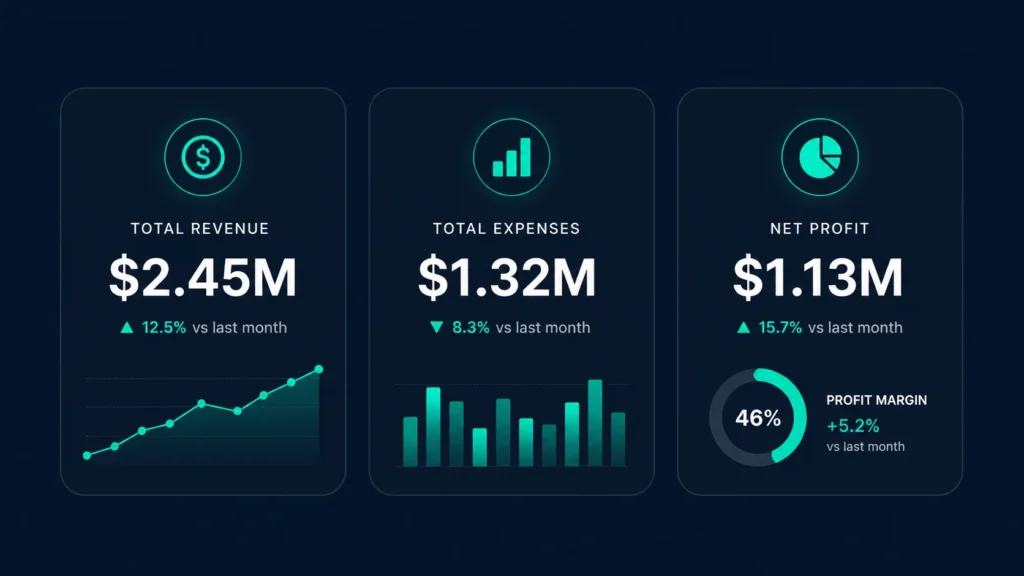
The numbers aren’t really debatable anymore. A Stanford and MIT study published in 2025 found that accountants using generative AI freed up approximately 3.5 hours per week — with a remarkable 55% increase in weekly client support compared to non-AI users. Separately, AI accounting agents built on OpenAI’s models have helped firms save up to 30% of their total working time.
Karbon’s 2025 State of AI in Accounting report added another striking figure: firms that invested in structured AI training unlocked the equivalent of seven extra weeks of capacity per employee per year. That’s not marginal. That’s transformational for a profession where billable hours are the lifeblood.
Despite this, adoption remains uneven. Research from Thomson Reuters shows that roughly 52% of tax firm respondents use open-source AI tools like ChatGPT — but only 17% have moved to industry-specific AI solutions. The opportunity gap is enormous for firms willing to go beyond basic use cases.
If your team works in Google Sheets rather than Excel, our set of Gemini prompts for Google Sheets covers the same finance tasks using the side panel and the AI function.
Here’s what’s changed specifically in 2026 that makes this guide different from anything published before:
- ChatGPT’s reasoning capabilities are dramatically stronger. The o3 and GPT-4.1 models can handle multi-step financial reasoning, not just text generation.
- Custom GPT usage grew 19x in 2025, meaning firms can now train focused accounting assistants on their own documentation and workflows.
- New tax legislation — including provisions from the One Big Beautiful Bill Act — creates fresh research needs that AI handles well as a first-pass tool.
- Regulatory scrutiny on AI use is increasing, making proper data hygiene more important than ever (we cover this later).
Before You Start — The Prompt Engineering Framework That Changes Everything
Before we hand you 100 prompts, you need to understand why they’re structured the way they are. Most bad prompts suffer from the same three problems: they’re vague, they’re contextless, and they don’t define the desired output.
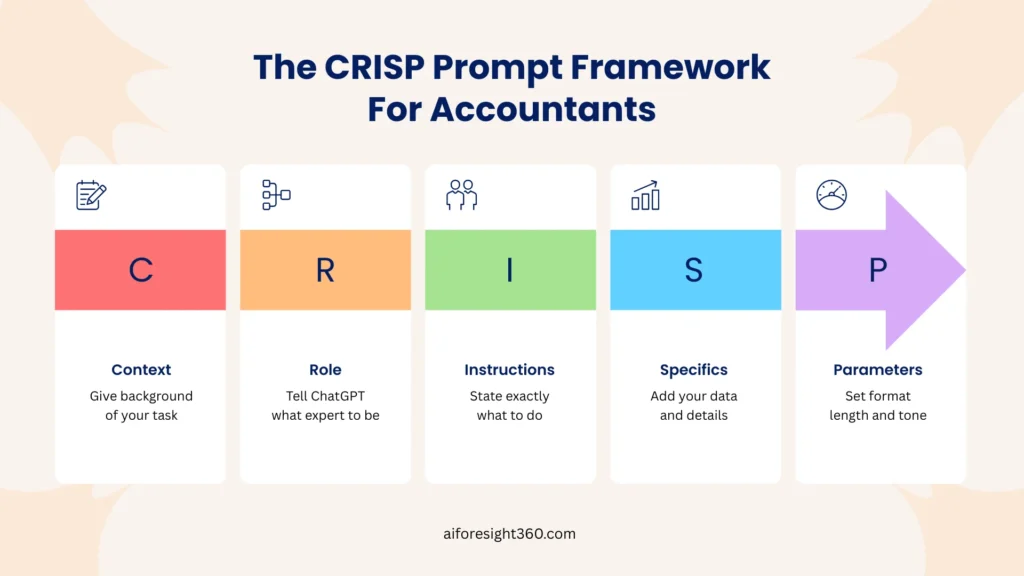
The framework used to build every prompt in this guide is called CRISP:
| Element | What It Means | Example |
|---|---|---|
| C — Context | What’s the situation or background? | “I’m a CPA advising a small S-Corp with $2M in revenue” |
| R — Role | What role should ChatGPT play? | “Act as a senior tax advisor” |
| I — Instructions | What exactly should it do? | “Analyze the following income statement for red flags” |
| S — Specifics | What details, data, or constraints apply? | “Focus on COGS margin and SG&A trends over 3 years” |
| P — Parameters | What’s the output format, length, tone? | “Return a bullet-point summary, max 200 words, professional tone” |
Bad prompt: “Summarize my client’s finances.”
CRISP prompt: “You are a senior financial advisor preparing a client brief. I’m a CPA at a mid-size firm. My client is a manufacturing company with $4.5M in annual revenue. Based on the income statement I’ll paste below, write a 3-paragraph executive summary for a non-financial audience that highlights profit margin trends, the biggest cost drivers, and one actionable recommendation. Keep the tone professional but accessible.”
The second prompt takes 30 more seconds to write and produces output you can actually send to a client with light editing.
Every prompt in this guide follows the CRISP model. Wherever you see square brackets like [client industry], replace them with your specifics.
100 ChatGPT Prompts for Accountants in 2026
Category 1: Financial Statement Analysis (Prompts 1–10)
These prompts are designed for financial review, client reporting, and spotting anomalies in the numbers.
1. Income Statement Red Flag Scan
Act as a forensic accounting analyst. Review the income statement I'm pasting below for a [industry] business with $[revenue] in annual revenue. Identify any line items that appear unusual relative to industry norms, flag significant year-over-year changes greater than 15%, and summarize your findings in a concise bullet list. Note: I will verify all conclusions independently.

[Paste income statement here]
2. Balance Sheet Health Check
You are a senior CPA preparing a financial health memo. Using the balance sheet below for a [business type] company, calculate the current ratio, quick ratio, and debt-to-equity ratio. Explain what each ratio means for this business's liquidity and solvency position in plain English. Flag any areas of concern. Output: 3 labeled sections, no more than 150 words each.

[Paste balance sheet here]
3. Year-Over-Year Variance Narrative
Act as a financial analyst drafting a board-level commentary. I'll provide two years of income statement data. Write a concise narrative (under 300 words) explaining the most significant year-over-year changes in revenue, gross margin, operating expenses, and net income. Avoid jargon. Use specific dollar and percentage figures from the data I provide.

Year 1: [paste data]
Year 2: [paste data]
4. Executive Financial Summary for a Non-Accounting Client
Translate the following financial statements into plain language for a business owner with no accounting background. Focus on three things: (1) Is the business profitable? (2) Can it pay its bills? (3) Is it growing or declining? Keep the summary under 250 words and avoid all accounting terminology.

[Paste statements here]
5. EBITDA Explanation and Calculation Memo
Write a short client memo explaining EBITDA, why it matters for [industry type] businesses, and how their current EBITDA of $[amount] compares to typical valuation multiples in their sector. Keep it under 200 words. Tone: professional but approachable.
6. Financial Ratio Comparison Table
Create a formatted comparison table showing the following financial ratios for my client versus the industry average I'll provide. Include: current ratio, quick ratio, gross margin %, net margin %, return on assets, and debt-to-equity. For each ratio, add a one-sentence interpretation of what the gap means.

Client data: [paste]
Industry averages: [paste]
7. Trend Analysis Over 5 Years
Act as a financial analyst. I'll provide five years of revenue, gross profit, and operating income data for a [industry] company. Identify the key trends, calculate compound annual growth rates (CAGR) where relevant, and write a 4-sentence executive summary of what the trajectory suggests about the business's health.

Data: [paste]
8. Accounts Receivable Aging Analysis
Review the following accounts receivable aging report for a [industry] business. Identify which customers represent the greatest collection risk, calculate the total amount at risk if customers over 90 days cannot pay, and suggest three specific actions to improve collections. Output as a numbered list.

[Paste aging report]
9. Monthly Management Accounts Commentary
You are a management accountant. Write a professional commentary for the monthly management accounts pack for [month, year]. The business is a [business type] with [number] employees. Highlight budget variances greater than 10%, explain the most likely causes, and recommend one management action per major variance. Format: bullet points under each financial section.

Budget vs Actual data: [paste]
10. Consolidation Discrepancy Finder
I'm consolidating financials for [number] entities. I'll paste the individual trial balances below. Identify any intercompany balances that don't match, flag any accounts where the sum of subsidiaries doesn't reconcile to the parent, and list the discrepancies in a numbered table with entity names, account names, and difference amounts.

[Paste trial balances]
Category 2: Tax Planning & Compliance (Prompts 11–20)
Use these prompts for research, planning, and communicating tax strategy. Always verify outputs with authoritative sources before relying on them for client advice.
11. Year-End Tax Planning Checklist for a Small Business
Act as a CPA specializing in small business tax planning. Create a comprehensive year-end tax planning checklist for a [business entity type — e.g., S-Corp, LLC] in the [industry] sector with approximately $[revenue] in gross revenue. Include strategies related to timing income and expenses, retirement contributions, depreciation, estimated payments, and any 2026-relevant provisions. Format as a numbered checklist with brief explanations for each item.
12. Deduction Identification for a Freelancer/Self-Employed Client
My client is a self-employed [profession] earning approximately $[amount] per year. List all legitimate business deductions they may be overlooking, organized by category (home office, vehicle, professional development, technology, etc.). For each, include the general IRS rule and a practical example of what qualifies. Note: I will verify all tax positions with current IRS guidance.
13. Tax Bracket Optimization Strategy
A married couple filing jointly has ordinary income of $[amount] and long-term capital gains of $[amount] in 2026. Explain how to optimize their tax liability by leveraging the preferential capital gains tax rates, considering Roth conversion opportunities, and timing charitable contributions. Present as a strategic memo with 3-4 specific recommendations.
14. Quarterly Estimated Tax Calculation Explainer
Write a clear client explainer (under 200 words) describing how quarterly estimated taxes work for a self-employed individual, why underpayment penalties arise, and how to calculate the safe harbor amount for 2026. Include the four due dates. Tone: helpful, not condescending.
15. Tax Research Summary — New 2026 Provision
Summarize the key provisions of [specific tax law or provision] enacted in 2025–2026 that affect [business type or individual type]. For each provision, explain: (1) who it applies to, (2) what changed from prior law, and (3) what action a taxpayer or advisor should consider before year-end. Format: table with three columns.

Note: I will cross-reference your summary with the official IRS guidance before advising clients.
16. S-Corp vs. LLC Tax Comparison
My client is considering converting from a single-member LLC to an S-Corporation. They earn $[net income] annually. Write a side-by-side comparison of the tax implications, including self-employment tax savings, payroll requirements, state-level considerations, and potential downsides. Present in a comparison table, then add a 2-paragraph recommendation based on the numbers.
17. Depreciation Strategy Memo
Act as a tax advisor. My client purchased the following assets in [year]: [list assets with costs]. Analyze whether Section 179 expensing, bonus depreciation, or MACRS straight-line provides the most advantageous tax outcome given their taxable income of $[amount] and expected income trajectory. Present the options in a table showing the tax impact in Year 1 and Years 2–5.
18. Retirement Contribution Optimization for a Business Owner
My client is a 52-year-old self-employed consultant earning $[amount] net profit. Compare the maximum contribution limits and tax advantages of the following retirement plans for 2026: SEP-IRA, Solo 401(k), SIMPLE IRA, and Defined Benefit Plan. Include catch-up contribution options and create a table ranking each option by total tax deduction potential for their income level.
19. State Tax Nexus Risk Assessment
My client is an e-commerce business based in [state] that sells to customers in all 50 states. Their sales by state are [paste or describe]. Based on general economic nexus thresholds (note: I will verify current thresholds for each state), identify which states likely trigger sales tax nexus and what the likely registration and filing obligations are. Format as a state-by-state risk table.
20. Tax Deadline Master Calendar
Create a comprehensive 2026 tax deadline calendar for a CPA firm serving a mix of individual, S-Corp, C-Corp, and partnership clients. Include original due dates, extended due dates, estimated tax payment dates, and payroll deposit deadlines. Format as a month-by-month table. Include footnotes for common exceptions.
Category 3: Client Communication & Email Writing (Prompts 21–30)
These prompts eliminate the blank-page problem for every type of client communication.
21. New Client Welcome Email
Write a warm, professional welcome email to a new [individual/small business] client who just signed our engagement letter for [services — e.g., tax preparation and bookkeeping]. The email should: thank them for choosing our firm, set expectations for the onboarding process, list the documents we'll need to get started, explain how to reach us, and end with a friendly closing. Tone: professional but human. Length: under 300 words.

Firm name: [name]
Primary contact: [name and title]
22. Document Request Email (Tax Season)
Draft a polite but specific email to an individual tax client requesting their documents for the 2025 tax year. Include: W-2s, 1099s (investment, freelance, retirement), mortgage interest statement, charitable donation receipts, and any business income records. Include a deadline of [date], specify preferred format (PDF), and provide instructions for uploading to our secure portal at [link/portal name]. Keep the tone friendly, not clinical.
23. Tax Deadline Reminder Email
Write a reminder email to [individual/business] clients about the [specific deadline — e.g., April 15 filing deadline or September 15 estimated tax payment]. Include: what action they need to take, what happens if they miss it, and the extension option if relevant. Include a clear subject line suggestion. Length: under 200 words. Tone: helpful, not alarming.
24. Year-End Tax Planning Invitation Email
Write an email to our current client base inviting them to schedule a year-end tax planning meeting. Emphasize that year-end planning before December 31 can make a meaningful difference to their tax bill. Include 3 specific examples of what we'd discuss (retirement contributions, asset purchases, income deferral). Include a call-to-action with scheduling instructions. Tone: proactive and valuable, not salesy. Under 250 words.
25. Engagement Letter Cover Email
Write a cover email to accompany an engagement letter being sent to a new [individual/business] client. The email should briefly explain what the engagement letter is, why we use one, what to look for in it, and what to do next (sign and return). Keep it reassuring, under 150 words, and avoid making it feel like legal boilerplate.
26. Delivering Unwelcome Tax News
Write a professional, empathetic email informing a client that they owe $[amount] in taxes, which is significantly higher than they expected. Explain that there are a few reasons for this: [list 2-3 causes]. Offer to schedule a call to walk through the details and discuss payment options. Avoid being defensive. Make the client feel supported, not blindsided. Under 250 words.
27. Fee Increase Notification Letter
Write a professional letter informing existing clients of a fee increase effective [date]. Our fees are increasing by approximately [percentage or fixed amount] due to rising operational costs and expanded service capabilities. Frame the increase in terms of the value clients receive. Offer a brief window to discuss any concerns. Tone: confident, not apologetic. Under 300 words.
28. Referral Request Email
Write a natural-sounding email to a satisfied long-term client asking if they know anyone who might benefit from our accounting services. Do not make it feel like a form letter. Reference the length of our relationship and the work we've done together (use [describe relationship here] placeholder). Include a simple referral CTA. Under 150 words. Tone: genuine, not pushy.
29. Monthly Client Newsletter — [Month] Edition
Draft a monthly email newsletter for our accounting firm's clients. Include: one timely tax tip for [current month], one important upcoming deadline for [month], one brief piece of financial news that affects small business owners, and one short firm update or announcement. Keep total length under 300 words. Include a suggested subject line. Tone: informative, conversational.
30. Post-Meeting Follow-Up Email
Write a follow-up email after a [type of meeting — e.g., tax planning, year-end review, onboarding] with [individual/business] client. Summarize the 3-4 key points discussed, list any action items with responsibility (client vs. firm) and due dates, and close with next steps. Keep the format clean and easy to skim. Professional but warm. Under 250 words.
Category 4: Bookkeeping & Data Management (Prompts 31–40)
31. Chart of Accounts Setup for a New Business
Act as a bookkeeper setting up a new QuickBooks/Xero/[software] file for a [industry type] business. Generate a recommended chart of accounts structure, organized by account type (Assets, Liabilities, Equity, Revenue, COGS, Operating Expenses). For each major category, list the most common sub-accounts for this industry. Format as a numbered list with account names and a brief description of what goes in each.
32. Journal Entry Explanation for a Client
A client is confused about a journal entry their bookkeeper made. Explain in plain English what the following journal entry means, why it was made, and how it affects their financial statements. Avoid accounting jargon. Use an analogy if helpful.

Debit: [account name] $[amount]
Credit: [account name] $[amount]
Memo: [description]
33. Month-End Close Checklist
Create a comprehensive month-end close checklist for a [small/medium] [industry] business. Include tasks for bank reconciliation, accounts receivable review, accounts payable review, prepaid amortization, fixed asset depreciation, payroll reconciliation, accrual entries, and financial report generation. Assign a suggested sequence and estimated time for each task. Format as a numbered checklist with columns for task, owner, and estimated time.
34. Expense Categorization Policy Document
Draft an internal expense categorization policy for a [business type] company with [number] employees. The document should clearly define what types of expenses go into each major category: Cost of Goods Sold, Marketing, Rent & Occupancy, Payroll, Professional Services, Technology & Software, Travel & Entertainment, and Miscellaneous. Include clear examples and edge cases for each category. Tone: clear and practical, not legal.
35. Bookkeeping Catch-Up Plan
A new client has not kept their books since [start date]. I'll be catching up [number] months of transactions for a [industry type] business with approximately [transaction volume] per month. Create a step-by-step catch-up plan, including how to prioritize tasks, what documents to request from the client, the sequence of reconciliation steps, and quality checks before closing each month. Format: numbered workflow with sub-steps.
36. Accounts Payable Process Documentation
Write a clear, step-by-step accounts payable process document for a [business type] company. Include the full cycle from invoice receipt to payment approval to posting to reconciliation. Note where approval thresholds apply and who is responsible at each stage. This document will be used to train new administrative staff. Format: numbered procedure with responsible party noted for each step.
37. Expense Report Review Memo
Review the expense report below and flag any items that: (1) appear to violate standard company expense policies, (2) lack sufficient description or documentation, (3) seem inconsistent with the employee's role or travel schedule. Produce a numbered list of flagged items with the reason for flagging and recommended action.

[Paste expense report data]
38. Inventory Reconciliation Procedure
Describe a step-by-step procedure for reconciling physical inventory counts to the accounting records for a [retail/manufacturing/wholesale] business. Include how to handle count discrepancies, when to write off shrinkage, how to document the reconciliation, and what journal entries are required for adjustments. Target audience: junior bookkeeper.
39. QuickBooks/Xero Error Troubleshooting
I'm seeing the following error or issue in [QuickBooks/Xero]: [describe the problem]. My client's books show [describe the symptom — e.g., bank balance doesn't match, duplicate transactions, accounts not reconciling]. Walk me through the most likely causes and step-by-step troubleshooting actions to resolve this. List steps in order of likelihood and simplicity.
40. Accounts Receivable Collection Script
Write a professional but firm phone call script for a staff member following up on an invoice that is [number] days overdue from [client type] for $[amount]. The script should: open warmly, reference the specific invoice, inquire about payment status, offer a payment plan option if necessary, and close with a clear commitment. Keep it under 200 words. Tone: assertive but not aggressive.
Category 5: Audit & Internal Controls (Prompts 41–50)
41. Audit Planning Memo
Act as a senior auditor preparing for a year-end financial statement audit of a [industry] company with $[revenue] in revenue and [number] employees. Draft an audit planning memo that covers: preliminary risk assessment, key accounts requiring focused testing, areas with high inherent risk, materiality threshold rationale, and planned audit approach. Professional tone, structured format.
42. Internal Control Assessment for Small Business
Create an internal controls assessment questionnaire for a [industry type] small business with [number] employees. Cover the following areas: segregation of duties, authorization controls, physical controls over assets, IT access controls, and financial reporting controls. For each area, include 3-4 yes/no questions and note the risk if the answer is "no." Format: table with control area, question, and risk description columns.
43. Audit Finding Summary for Management
I've completed fieldwork for an internal audit. Write a professional, clear audit finding summary memo to [client's management/board] summarizing the following findings. For each finding, include: (1) condition (what we found), (2) criteria (what should be happening), (3) cause (why it's happening), (4) effect (risk or impact), and (5) recommendation. Keep each finding to one structured paragraph.

Findings: [paste your field notes here]
44. Fraud Risk Assessment Checklist
Create a fraud risk assessment checklist for a [business type] company. Cover three fraud categories: asset misappropriation, financial statement fraud, and corruption/bribery. For each category, list the top 5 red flags and the corresponding internal control that would mitigate each risk. Format: three-section table with columns for fraud category, red flag, and recommended control.
45. Management Letter Draft
Draft a professional management letter following a completed financial statement audit of a [entity type]. The letter should address the following control deficiencies I identified: [list deficiencies]. For each, write the finding in professional audit language and include a practical recommendation for management action. Keep the tone constructive, not accusatory. Format: numbered findings with recommendations.
46. Substantive Testing Procedure — Revenue
Design a substantive testing procedure for the revenue account of a [industry] company with $[revenue]. Include the audit objective, population definition, sampling approach, specific tests to perform (e.g., vouching, tracing, cutoff testing, confirmation), and the documentation required. Target: a senior audit associate with 2 years of experience.
47. SOX Compliance Self-Assessment Checklist
Create a SOX Section 404 management assessment checklist for a publicly traded [industry] company. Cover the five COSO components: Control Environment, Risk Assessment, Control Activities, Information & Communication, and Monitoring Activities. For each component, list 5 key questions management should be able to answer with supporting evidence. Format: checklist with evidence column.
48. Control Deficiency Classification Guide
Explain the difference between a control deficiency, a significant deficiency, and a material weakness in auditing terms. Use plain language with one practical example of each classification in a [industry] context. Then create a simple decision tree diagram in text format that auditors can use to classify findings in the field.
49. Audit Workpaper Review Checklist
Create a senior auditor workpaper review checklist. Include quality checks for: completeness of procedures performed, adequacy of documentation, logical flow of conclusions to evidence, cross-referencing accuracy, sign-off requirements, and GAAS/PCAOB compliance points. Format: numbered checklist, grouped by review category. Designed for efficient 15-minute workpaper reviews.
50. Going Concern Assessment Framework
A client's financial statements show [describe situation — e.g., two consecutive years of operating losses, declining cash reserves, upcoming debt covenant breach]. Walk me through the going concern assessment framework under ASC 205-40, including the conditions that trigger disclosure, the look-forward period required, and what the auditor's report should say under each scenario (no doubt, substantial doubt mitigated, substantial doubt not mitigated).
Category 6: Cash Flow & Forecasting (Prompts 51–60)
51. 13-Week Cash Flow Forecast Template Builder
Create a 13-week cash flow forecast structure for a [industry] business with monthly revenue of approximately $[amount]. Include rows for: operating cash inflows (broken by revenue type), operating cash outflows (payroll, rent, COGS, marketing, loan payments, other), net cash from operations, financing activities, and ending cash balance. Provide a template layout I can build in Excel, with week columns and row categories clearly labeled.
52. Cash Flow Problem Diagnosis
My client's business is profitable on paper ($[net income] per year) but constantly runs out of cash. Based on these general operating characteristics [describe: industry, billing cycle, payment terms, inventory type, seasonality], diagnose the most likely cash flow gap causes and provide 3 specific, actionable recommendations to improve cash timing without taking on more debt.
53. Break-Even Analysis for a New Product/Service
Help me build a break-even analysis for a [business type] launching [new product/service]. Fixed costs are $[amount] per month. Variable cost per unit/sale is $[amount]. Proposed selling price is $[amount]. Calculate the break-even point in units and dollars. Show the math step-by-step. Then provide a sensitivity table showing how the break-even point changes if the price drops by 10%, 20%, or the variable cost increases by 15%.
54. Working Capital Improvement Memo
My client's working capital ratio has declined from [X] to [Y] over 18 months. Their current assets are $[amount] and current liabilities are $[amount]. Write a one-page working capital improvement memo for management that explains the current position, identifies the likely drivers (based on the data below), and recommends 4 specific operational actions to improve working capital within 90 days.

Data: [paste current assets/liabilities breakdown]
55. Revenue Forecast Narrative
Write an executive summary narrative for a sales forecast I've prepared. The forecast projects revenue of $[amount] in [year], representing a [percentage] increase over the prior year. Key assumptions include [list 3-4 assumptions]. Acknowledge the key risks to the forecast. Keep the language confident but measured. This will be presented to the company's bank as part of a loan application. Under 300 words.
56. Seasonal Cash Flow Planning for a Retail/Seasonal Business
My client runs a [type of seasonal business] that generates [percentage]% of annual revenue between [months]. Help me create a seasonal cash flow planning framework that: identifies their peak cash need months, recommends credit facility sizing, suggests strategies to pre-fund inventory without over-borrowing, and provides a 12-month cash reserve guideline. Output: structured monthly plan with recommendations.
57. Days Sales Outstanding (DSO) Improvement Plan
My client's DSO has climbed from [X days] to [Y days] over the past two quarters. Current accounts receivable balance is $[amount]. Write a 5-step DSO reduction action plan, including changes to invoicing practices, payment terms, collections follow-up procedures, and early payment incentives. Include an estimate of the cash flow improvement if DSO returns to [target days].
58. Cash Flow Forecast vs. Actual Variance Analysis
Compare the following cash flow forecast to actual results for [month/quarter]. Identify the top 3 variances, explain the most likely causes, and recommend adjustments to the forecasting methodology going forward. Present findings in a two-column table (forecast vs. actual) followed by a variance explanation section.

Forecast data: [paste]
Actual data: [paste]
59. Liquidity Ratio Interpretation for a Lender Presentation
My client is applying for a $[amount] business loan. Their current ratio is [X], quick ratio is [Y], and cash ratio is [Z]. Write a 2-paragraph talking-points memo explaining what these ratios indicate about the business's ability to service new debt, framing the figures in the most favorable but accurate light for presentation to a commercial lender. Note any ratios that may need additional explanation.
60. Burn Rate and Runway Calculation for a Startup
My startup client raised $[amount] in funding [number] months ago. Their current monthly burn rate is $[amount], broken down as: [list major expense categories and amounts]. Calculate their current cash runway, identify the top 2 areas where burn could be reduced without harming core operations, and describe what financial metrics would make them attractive to the next funding round. Keep it concise and startup-appropriate in tone.
Category 7: Business Advisory & Strategic Consulting (Prompts 61–70)
61. Business Valuation Summary for Client Discussion
Explain the three primary business valuation approaches (income approach, market approach, and asset approach) to a business owner considering selling their company. Use plain language with an illustrative example for each. Then, based on the following financial data, provide a rough indicative valuation range using the income approach (EBITDA multiple) based on current [industry] market multiples. Note: this is for discussion purposes only, not a formal valuation opinion.

Financial data: [paste EBITDA, revenue, growth rate]
Industry: [specify]
62. KPI Dashboard Setup for a Small Business
I'm helping a [industry] business owner set up their first financial KPI dashboard. Recommend the 10 most important financial and operational KPIs for their sector, explain what each measures and why it matters, and suggest a target range or benchmark for each. Format: a table with columns for KPI name, definition, formula, target range, and frequency of measurement.
63. Profit Improvement Diagnostic
Act as a business advisor. My client's net profit margin has declined from [X]% to [Y]% over two years despite revenue growing from $[amount] to $[amount]. Based on the P&L data below, identify the top 3 profit leakage areas and provide specific, quantified recommendations for recovery. Be concrete — avoid generic advice like "reduce costs." Identify which line items to target and by how much.

P&L data: [paste]
64. Industry Benchmarking Report
My client is a [industry type] business with $[revenue] in annual revenue. Using standard industry benchmarks, create a benchmarking report comparing their key financial metrics to industry norms. Include gross margin, EBITDA margin, overhead ratio, revenue per employee, and debt-to-equity. For each metric, note whether the client is above, at, or below benchmark and what the implication is. Format: comparison table with interpretation column.

Client metrics: [paste]
65. Business Loan Readiness Assessment
Assess whether my client is ready to apply for a [loan type and amount] from a commercial bank. Evaluate the following factors: credit history indicators, current debt service coverage ratio (DSCR), collateral available, business age and revenue stability, and management team experience. For each factor, give a green/yellow/red status and one recommendation. Client data: [paste key financials].
66. Exit Planning Overview for a Business Owner
My client is a 58-year-old business owner who wants to exit their [business type] in 3–5 years. Write a structured exit planning overview that covers: business valuation readiness (what to improve), tax efficiency of different exit structures (sale to third party, ESOP, management buyout, family transfer), succession planning considerations, and the next 3 steps they should take this year. Professional but accessible tone. Under 500 words.
67. M&A Due Diligence Checklist
My client is acquiring a [industry] business with $[revenue] in annual revenue. Create a financial due diligence checklist covering: historical financial statements (3–5 years), quality of earnings analysis, working capital normalization, customer concentration risk, debt and contingent liabilities, tax compliance review, and management representations. Format as a categorized checklist with document request and analysis note columns.
68. Strategic Planning Session Agenda
Design a structured 3-hour strategic planning session agenda for a [business type] with [number] employees. The goal is to align on a 3-year financial and operational plan. Include sections for: reviewing the prior year's performance, assessing current market conditions, identifying top 3 strategic priorities, setting 12-month financial targets, and assigning ownership of key initiatives. Format: time-blocked agenda with facilitator notes.
69. Cost-Benefit Analysis Framework
My client is deciding whether to [specific business decision — e.g., hire a full-time CFO, invest in new equipment, open a second location]. Build a cost-benefit analysis framework for this decision over a 3-year time horizon. Include: upfront costs, ongoing costs, expected benefits (quantified where possible), break-even timeline, and a go/no-go recommendation criteria. Format: structured table followed by a 2-sentence recommendation.
70. Pricing Strategy Analysis
My client is a [service/product] business that hasn't raised prices in [number] years. Their current average price is $[amount]. Inflation has increased their costs by [percentage]. Analyze three pricing strategies they could implement: (1) across-the-board increase, (2) tiered/value-based pricing, (3) grandfather existing clients and raise for new. For each, describe the financial impact, client relationship risk, and implementation approach. Recommend one.
Category 8: Payroll & HR Accounting (Prompts 71–80)
71. Payroll Process Documentation
Create a comprehensive payroll processing procedure document for a [company size] company with [number] employees paid [frequency — weekly/biweekly/semimonthly]. Cover the full cycle from timesheet submission to direct deposit confirmation and payroll tax filing. Include approval checkpoints, system steps for [payroll software name], and error resolution procedures. Target audience: payroll administrator. Format: numbered procedure.
72. Independent Contractor vs. Employee Classification Guide
My client is using [number] contractors to perform [type of work]. Summarize the IRS common law test and the ABC test criteria used in many states to determine worker classification. Then apply the factors to the following work arrangement [describe] and flag whether it presents a misclassification risk. Include the potential tax and penalty exposure if the arrangement is reclassified. Note: I'll verify with current IRS and state guidance.
73. Payroll Tax Compliance Checklist
Create a payroll tax compliance checklist for a [size] employer with employees in [states]. Include federal requirements (FUTA, FICA, income tax withholding), state-level requirements, filing frequencies based on deposit schedules, year-end W-2 and 1099 deadlines, and common compliance errors to watch for. Format: quarterly calendar view with specific actions for each period.
74. Benefits Cost Analysis
My client is evaluating their employee benefits package. They currently offer [describe current benefits]. Annual headcount is [number]. Help me build a cost-per-employee benefits analysis and compare the following three benefits plan options on: employer cost, employee cost, coverage quality, and retention value. Present as a comparison table, then add a recommendation with rationale.

Plan details: [paste or describe]
75. Year-End Payroll Reconciliation Checklist
Create a year-end payroll reconciliation checklist ensuring that the total wages on W-2s equal payroll tax returns (941, 940), general ledger payroll accounts, and state unemployment returns. Include steps for reconciling total gross wages, Social Security/Medicare taxes, federal and state income tax withholding, and year-end accruals. Format: step-by-step reconciliation procedure with where-to-look references.
76. PTO Accrual Policy Explanation
Explain three common PTO accrual models (lump-sum grant, per-pay-period accrual, and unlimited PTO) to a small business owner deciding which to implement. For each, describe the accounting implications (is PTO accrued as a liability?), administrative complexity, and the typical employee perception of each approach. Recommend one model for a [number]-employee [industry] company. Plain English, under 350 words.
77. Compensation Benchmarking Memo
Draft a brief compensation benchmarking memo for a [business type] considering a salary review. My client wants to know if their compensation for the following roles is competitive: [list roles and current salaries]. Use general 2026 benchmarking guidance (note: I will verify against current salary survey data). Flag any roles where compensation appears significantly above or below market and suggest an adjustment range.
78. Payroll Discrepancy Investigation Procedure
An employee has flagged that their net pay was $[amount] lower than expected this period. Walk me through a step-by-step procedure to investigate the discrepancy, covering: gross pay verification, deduction review (benefits, garnishments, retirement), tax withholding check, and system error investigation. Include what documentation to retain and when to involve HR vs. the employee directly.
79. Multi-State Payroll Compliance Guide
My client has employees in [list states]. Create a state-by-state compliance summary covering: income tax withholding requirements, unemployment tax obligations, workers' compensation registration, any state-specific payroll laws (minimum wage, overtime, pay frequency, final paycheck rules) that differ from federal requirements. Format: one section per state with bullet-point requirements. Note: I will verify all state requirements with current official sources.
80. Payroll Onboarding Documentation Template
Create a new employee payroll onboarding document package checklist. Include: required federal forms (W-4, I-9), state withholding forms, direct deposit authorization, benefits enrollment forms, and any company-specific payroll policy acknowledgments. For each document, note the purpose, who completes it, and the retention period under federal law. Format: master checklist table with document name, purpose, responsible party, and retention period columns.
Category 9: Management Accounting & Budgeting (Prompts 81–90)
81. Annual Budget Process Framework
Design an annual budgeting process framework for a [size] [industry] company targeting a [date] budget approval deadline. Include: pre-budget communication to department heads, assumptions-setting process, departmental submission template, consolidation and review steps, board approval process, and post-approval communication. Format as a project timeline with responsibilities and milestones.
82. Zero-Based Budget Justification Template
Create a zero-based budget justification template that a department head in a [company type] can use to defend their budget request. The template should prompt them to: state the purpose of each budget line, explain what would happen if the item were unfunded, link the expense to a specific company objective, and provide a cost-benefit rationale. Format: fillable template with guiding questions for each section.
83. Budget vs. Actual Variance Report Commentary
Write the narrative commentary section for a Q[number] budget-versus-actual report. The [department/company] has: revenue [X% above/below] budget due to [cause], and operating expenses [X% above/below] budget primarily driven by [cause]. Write three paragraphs: (1) overall performance summary, (2) key favorable variances and their drivers, (3) key adverse variances and recommended corrective actions. Professional tone, specific numbers.

Data: [paste your variance figures]
84. Product Line Profitability Analysis
My client sells [number] product lines/service categories. I'll provide revenue and direct cost data for each. Calculate the gross margin and gross margin percentage for each line, rank them by profitability, and identify which products appear to be margin dilutive. Suggest one strategic question management should ask about each low-margin line. Format: ranked table followed by management questions.

Data: [paste]
85. Cost Allocation Methodology Design
Design a fair and practical overhead cost allocation methodology for a [multi-department/multi-product] business with total overhead of $[amount]. Current cost centers are [list]. Evaluate three allocation bases (revenue %, headcount, and square footage) and recommend which creates the most meaningful cost visibility for decision-making. Include a worked example using the following data: [paste].
86. Capital Expenditure Justification Analysis
My client is considering a capital expenditure of $[amount] to purchase/replace [asset]. Expected useful life: [years]. Expected annual savings or revenue benefit: $[amount]. Provide: a simple payback period calculation, net present value (NPV) at an 8% discount rate, and an internal rate of return (IRR). Present the math clearly and give a go/no-go recommendation with one sentence of rationale.
87. Balanced Scorecard Design for a Small Business
Design a simplified balanced scorecard for a [industry] business with $[revenue] in revenue. Include KPIs across four perspectives: Financial, Customer, Internal Process, and Learning & Growth. For each perspective, suggest 2-3 KPIs, the measurement methodology, target values, and reporting frequency. Make the metrics specific to [industry] rather than generic. Format: four-section table.
88. Departmental Budget Review Meeting Agenda
Create an agenda for a 90-minute departmental budget review meeting with the [department] head. Include: review of YTD actuals vs. budget, open Q&A on major variances, next-quarter forecast revision, review of upcoming significant expenditures, and agreement on corrective actions. Include facilitator notes and time allocations for each section. Format: structured agenda with time blocks.
89. Management Report Pack Structure
Design a monthly management report pack structure for a [size] [industry] business. Include: executive summary dashboard, P&L with variance commentary, balance sheet highlights, cash flow summary, sales pipeline update, and key operational metrics. For each section, describe the format (chart, table, narrative), the audience (CEO, CFO, board), and the data inputs required. Keep the pack to a maximum of 8 pages.
90. Rolling Forecast Methodology Guide
Explain how a rolling 12-month forecast works and why it may be more effective than a static annual budget for a [industry type] business experiencing [describe situation — e.g., rapid growth, high seasonality, market volatility]. Include: how to structure the rolling update process, how often to update, who should be involved, and how to integrate it with the existing accounting software [name]. Under 400 words, practical and specific.
Category 10: Practice Management & Business Development (Prompts 91–100)
91. Service Pricing Proposal for a New Client
Draft a professional service pricing proposal for a potential [industry] client with the following profile: [describe business size, complexity, services needed]. Our services include [list services]. Create a tiered proposal showing three engagement options (basic, standard, premium) with pricing, scope, and included deliverables for each. Framing should emphasize value, not just task lists. Keep the proposal document under 2 pages.
92. Client Onboarding Process SOP
Write a standard operating procedure for onboarding a new [individual/small business] client to our accounting firm. Cover the full process from signed engagement letter to active client status, including: kickoff call agenda, document collection, system setup in [accounting software], internal team briefing, and 30-day check-in. Format: step-by-step numbered procedure with assigned roles and target completion timeline for each step.
93. LinkedIn Post — Thought Leadership for an Accountant
Write a LinkedIn post for an accounting professional sharing an insight or lesson from a recent client experience (anonymized). The post should be conversational, avoid jargon, deliver genuine value, and end with a question that invites engagement. Topic: [describe topic — e.g., the hidden cost of missing year-end tax planning, why profitable companies run out of cash]. Length: 150-200 words. Do not use bullet points or hashtag spam.
94. Niche Market Identification Framework
Help me identify a profitable accounting niche for a small practice currently serving general small business clients. Based on the following criteria — [firm size, team expertise, geographic location, existing client mix] — suggest 3 high-potential niches with rationale. For each niche, describe: the typical client profile, main service needs, pricing potential, competition level, and how to begin establishing authority. Practical, not theoretical.
95. Service Agreement / Engagement Scope Expander Email
Write a professional email to an existing tax-only client introducing our bookkeeping and advisory services. The goal is to expand the engagement, not feel like a sales pitch. Frame it as a natural conversation about how additional support could benefit their specific business situation. Reference their industry [mention] and a relevant pain point for that type of business. Under 200 words. Tone: advisory, not transactional.
96. Competitor Differentiation Statement
Help me articulate what makes our accounting firm different from larger, generalist competitors. We specialize in [niche], work exclusively with [client type], and focus on [specific deliverable or outcome]. Write a clear, compelling 3-sentence differentiation statement for our website About page and a matching 2-sentence elevator pitch for networking events. Avoid clichés like "trusted advisor" or "partner in your success."
97. Staff Training Module — Using AI Tools in Our Firm
Create an outline for a 1-hour internal training session on how our accounting team should use AI tools (specifically ChatGPT) in their daily workflows. Cover: what AI is and isn't good at in accounting, the CRISP prompt framework, our data security rules (what never to paste in), 5 practice exercises, and a Q&A. Include speaker notes for the presenter. Format: structured training outline with time allocations.
98. Capacity Planning Model for an Accounting Firm
Help me build a simple capacity planning model for an accounting firm with [number] professional staff. We currently serve [number] clients and have the following service mix by time allocation: [describe]. If we want to add [number] clients in the next 12 months, calculate how many additional staff hours are required, whether we can absorb growth with existing staff through efficiency gains, and at what growth rate we need to hire. Show the math and assumptions clearly.
99. Tech Stack Evaluation Scorecard
Create an evaluation scorecard for comparing accounting technology tools. We are evaluating [list 3 tools or categories — e.g., practice management software options]. Criteria should include: core feature fit, integration with existing systems, pricing per user, customer support quality, learning curve, and data security standards. Build a weighted scoring matrix with suggested weights based on priority for a [size] accounting firm. Format: Excel-ready table.
100. Annual Client Satisfaction Survey
Design a 10-question client satisfaction survey for an accounting firm to send after tax season or year-end. Questions should measure: overall satisfaction, responsiveness, communication clarity, value for fees paid, likelihood to refer, and one open-ended question capturing what we could improve. Include a suggested rating scale (1–5 or NPS). Keep the survey concise enough to achieve a high completion rate. Format: numbered survey questions with response options.
ChatGPT vs. Other AI Tools for Accountants — 2026 Comparison
Not every accounting task is best served by ChatGPT. Here’s how the leading AI tools stack up for accounting-specific use cases:
| Feature / Tool | ChatGPT (GPT-4o/o3) | Claude (Sonnet/Opus) | Gemini Advanced | Harvey (Legal/Tax AI) | Copilot for Microsoft 365 |
|---|---|---|---|---|---|
| Long document analysis | Good | Excellent (200k context) | Good | Good | Good |
| Tax research | Good (verify output) | Good (verify output) | Good | Better (legal reasoning) | Fair |
| Excel formula help | Excellent | Excellent | Good | Fair | Excellent (native) |
| Email drafting | Excellent | Excellent | Good | Good | Good |
| Accounting software integration | Limited (API) | Limited (API) | Limited | N/A | Excellent (native M365) |
| Data privacy / security | Enterprise plan needed | Enterprise plan needed | Enterprise plan needed | Built-in | Via M365 compliance |
| Custom GPT/persona | Excellent | Good (Projects) | Fair | N/A | Limited |
| Price (approx. 2026) | $20–$30/mo (Pro) | $20/mo (Pro) | $20/mo (One AI) | Custom/enterprise | Included with M365 |
| Best for | General tasks, email, analysis | Long docs, nuanced writing | Research, web grounding | Legal/tax memos | Office-native workflows |
Bottom line: ChatGPT remains the most versatile daily-use tool for most accounting professionals. For extended document review, Claude’s longer context window gives it an edge. For firms already in the Microsoft ecosystem, Copilot integration can eliminate the copy-paste workflow entirely.
How to Integrate ChatGPT with Your Accounting Software in 2026
The prompts in this guide work as standalone copy-paste tools. But the real productivity jump happens when you connect AI to your existing workflows.
QuickBooks + ChatGPT: Export reports as CSV, paste data directly into a prompt context. ChatGPT can interpret and narrate the data, or generate journal entry descriptions to paste back. Several third-party Zapier/Make workflows now automate this loop.
Xero + ChatGPT: Xero’s API allows developers to pull live financial data. Teams with technical resources are building automated reporting assistants that feed Xero data to GPT-4o and return formatted management commentary each month.
Practice Management Software (TaxDome, Karbon, Canopy): Use ChatGPT to draft client messages, SOPs, and training materials — then paste the output into your practice management platform. Karbon’s 2026 report notes firms using structured AI workflows are saving an additional seven weeks of capacity per employee per year.
Microsoft 365 Users: If your firm uses Outlook, Word, and Excel, Copilot for Microsoft 365 offers native AI integration without the copy-paste step. It can draft emails from calendar meeting notes, generate financial commentary directly inside Excel, and summarize long email threads automatically.
Data Security: What You Should Never Paste into ChatGPT
This section matters. A 2025 Thomson Reuters survey found that 96% of CFOs cite privacy and ethics as top AI concerns — and rightfully so. Standard ChatGPT accounts (free and Pro) may use conversation data to train future models unless you actively opt out in settings.
Never paste into a standard ChatGPT session:
- Full client tax returns (SSNs, EINs, financials)
- Social Security numbers, bank account numbers, or routing numbers
- Client email addresses or contact information
- Confidential M&A data or sensitive business plans
- Engagement letters with identifying client details
- Payroll data with employee names and salaries
What you can safely do:
- Anonymize data before pasting (replace names with “Client A,” replace specific numbers with approximations)
- Use ChatGPT Enterprise or API access with zero data retention settings
- Describe scenarios conceptually without including identifying information
- Use on-premise AI tools or private LLM deployments for the most sensitive work
Recommended practice: Create a firm-level AI Acceptable Use Policy that specifies exactly what information staff may and may not input into public AI tools. This is quickly becoming standard practice at mid-size and large firms.
Expert Tips to Get 10x More Value from These Prompts
After testing these prompts across multiple scenarios, here are the techniques that consistently improve output quality:
1. Give ChatGPT a role. “Act as a senior CPA” performs better than no role instruction. The model calibrates its vocabulary, depth, and assumptions based on the role you assign.
2. Provide the output format upfront. Tell it exactly what you want back: “Give me a bullet-point list,” “Write this as a 3-paragraph memo,” or “Return a table with 4 columns: X, Y, Z, W.” This eliminates the back-and-forth.
3. Tell it what NOT to do. Adding constraints improves precision dramatically. “Do not include generic advice. Do not use accounting jargon the client won’t understand. Do not exceed 200 words.”
4. Use the “act as a reviewer” technique. After generating a first draft, paste it back and say: “Now act as a skeptical client reading this email. What questions would they still have? What’s unclear?” Then revise.
5. Create a Custom GPT or reusable system prompt. If you use the same firm name, client profile, and tone guidelines daily, build a ChatGPT custom instruction or Custom GPT that includes all of it automatically. This alone saves 30–60 seconds per prompt.
6. Chain prompts for complex tasks. Break multi-step tasks into sequential prompts. First ask for an outline, then expand each section, then ask for a final edit for tone. Complex outputs produced in one shot are rarely as good as those built in stages.
7. Always verify tax and legal content. ChatGPT is a first-pass research and drafting tool, not an authoritative source. The IRS, state tax authorities, and AICPA guidance should always be your final verification checkpoint.
If you’re asking ChatGPT to write VBA macros for consolidation, reconciliation, or reporting, we’ve tested the exact patterns that work best. See our hands-on test of ChatGPT, Claude and Copilot on four accounting VBA tasks to understand where each tool excels.
FAQs
Can ChatGPT replace an accountant?
No. ChatGPT is a productivity tool, not a licensed professional. It cannot sign tax returns, exercise professional judgment on ambiguous compliance questions, or take legal responsibility for advice. What it can do is dramatically reduce the time accountants spend on drafting, research, communication, and formatting — freeing professionals to focus on the high-judgment work that clients actually pay for. Think of it as a highly capable junior assistant who needs supervision, not a replacement for professional expertise.
Is it safe to use ChatGPT for accounting tasks?
It can be, with the right precautions. Standard ChatGPT accounts should never receive identifiable client data. ChatGPT Enterprise (or API with zero data retention) is suitable for more sensitive work because conversations are not used for training. The safest approach is to anonymize all data before it enters any AI tool and establish a written firm-level AI policy that staff must follow.
How do I write better prompts for accounting tasks?
Use the CRISP framework: give ChatGPT Context (what’s the situation?), a Role (what expert should it be?), clear Instructions (what to produce?), Specifics (the actual data or parameters), and output Parameters (format, length, tone). The prompts in this guide are structured this way — adapt them by filling in the bracketed fields with your specific client details.
What accounting tasks is ChatGPT best at?
ChatGPT excels at: drafting client emails and memos, explaining complex concepts in plain language, creating checklists and procedures, generating financial commentary from data you provide, doing tax research as a first pass, building budget templates, and creating training materials. It is less reliable for precise calculations (always verify math independently) and should never be trusted as the sole source for current tax law.
Can I use ChatGPT in my accounting software?
Not natively in most cases, but integration is rapidly improving. Several practice management platforms and accounting software providers are building AI layers directly into their products. For now, the most reliable approach is exporting data in text or CSV format, pasting it into ChatGPT (after anonymizing it), and copying the output back into your system. Microsoft 365 Copilot is the exception — it’s natively integrated with Excel, Outlook, and Word.
Do I need ChatGPT Plus (paid) to use these prompts?
The free version of ChatGPT provides access to GPT-4o with usage limits, which is sufficient for most of these prompts. ChatGPT Plus ($20/month) removes usage caps and provides access to advanced reasoning models (o3) that perform noticeably better on complex financial analysis and multi-step research prompts. For professional use, the paid plan is worth the investment if you’re using it daily.
Are these prompts suitable for international accounting standards (IFRS)?
The prompts in this guide are written with US-based GAAP and IRS tax standards as the default context. For IFRS-based work, modify any prompt that references GAAP, ASC codes, or IRS guidance to specify IFRS or the applicable regulatory framework (e.g., “under IFRS 16” or “using UK HMRC guidance”). The structure and format of each prompt remain fully applicable regardless of jurisdiction.
Conclusion
The accounting professionals who will define what the profession looks like in 2030 are not the ones who resist AI — they’re the ones who learn how to direct it well. The 100 prompts in this guide are not shortcuts around expertise. They’re force multipliers for it.
Use the financial analysis prompts to give clients faster, clearer reports. Use the client communication prompts to eliminate the hours lost staring at blank email drafts. Use the audit and internal controls prompts to bring structure to complex engagements. And use the practice management prompts to build the kind of firm that clients want to refer their friends to.
The CRISP framework — Context, Role, Instructions, Specifics, Parameters — is the one skill that will outlast any specific AI tool. Master it, and these 100 prompts become the starting point for an unlimited library you can keep building.
Bookmark this page. Update your firm’s AI policy. Train your team. And remember: the 3.5 hours per week that AI saves you is only valuable if you reinvest it in the work that humans uniquely do best.

Ahmad Hussain
ACCAAhmad builds advanced Excel models, Power BI dashboards, and AI automation for businesses. He writes AI Foresight 360 himself, and every pricing figure and feature claim is verified against official documentation at the source.
Connect on LinkedIn