
Most students searching for ChatGPT prompts for college students type a question into the chat box, get a wall of text back, and copy the parts that look useful. That habit produces generic work and teaches you nothing. The gap between a mediocre result and a genuinely useful one is almost never the model. It is the instruction you give it.
This library collects 80 ChatGPT prompts for college students, organized by the tasks that actually fill a semester: essays, exam revision, lecture notes, research papers, citations, presentations, study planning, and STEM problem sets. Every prompt is written to be copied, pasted, and edited with your own course details in under a minute.
A note on how to read this page. These ChatGPT prompts for college students are built as templates, not magic spells. Each one appears in its own highlighted box below so you can copy it cleanly, and the bracketed placeholders exist so you replace them. A prompt with your actual assignment brief, your actual reading list, and your actual deadline will outperform a polished generic prompt every single time.
What Makes a ChatGPT Prompt Actually Work?
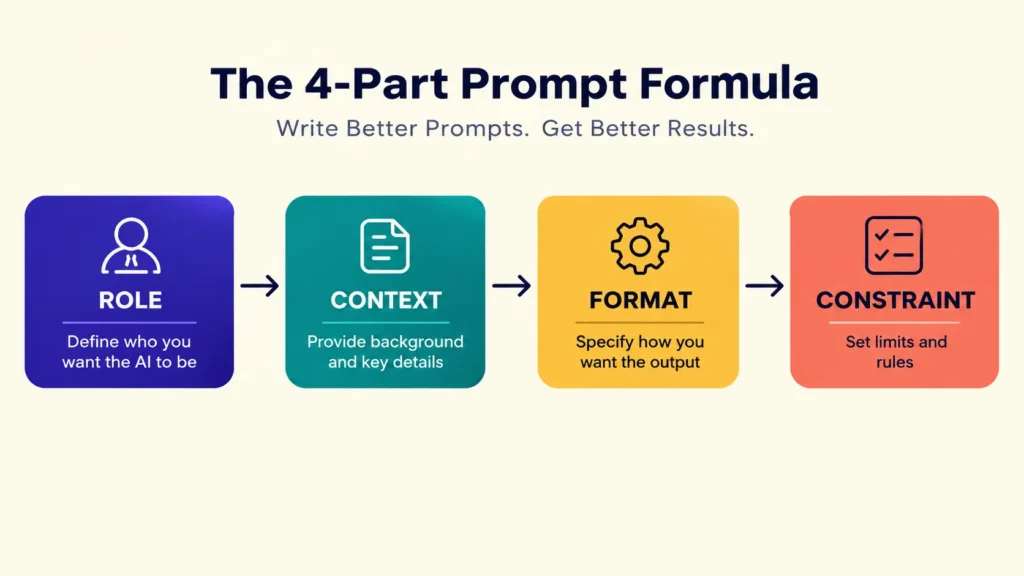
A prompt works when it supplies four things: a role for the model, the specific context of your assignment, the exact output format you want, and a constraint that limits length or scope. Prompts missing these tend to return encyclopedia entries. Prompts containing all four return something you can use immediately.
Compare the two versions below. The difference in output quality is not subtle, and it is the single reason the ChatGPT prompts for college students in this article are written the way they are.
Weak prompt: Help me write an essay about climate policy.
Strong prompt: You are a political science tutor. I am writing a 1,500 word argumentative essay for an undergraduate policy course arguing that carbon pricing is more politically durable than direct regulation. Give me three possible thesis statements, then for the strongest one, outline four body paragraphs with the specific type of evidence each would need. Do not write the essay.
The weak version gets a summary of climate policy. The strong version gets a working plan. Every one of the ChatGPT prompts for college students below follows that second pattern, which is also the pattern behind most effective prompting across disciplines. If you want the broader background on how these systems produce text in the first place, our explainer on what generative AI is and how it works covers the mechanics without the jargon.
The four part prompt formula
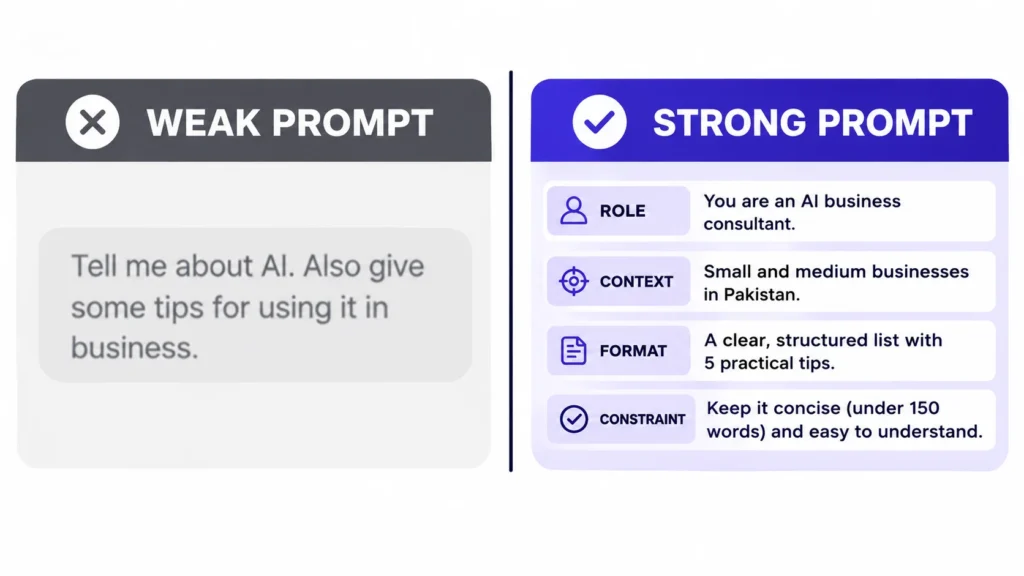
Role: tell the model who it should act as, such as a tutor, an examiner, or a peer reviewer.
Context: paste the assignment brief, the rubric, the word count, and your course level.
Format: specify a table, a bulleted outline, five questions, or a two paragraph summary.
Constraint: cap the length, ban the model from writing the final text, or force it to ask you questions first.
Every entry in the sections below already contains all four. When you adapt these ChatGPT prompts for college students to your own modules, keep the structure and swap only the bracketed details.
How Do You Turn On ChatGPT Study Mode?
Study mode is a built in setting that makes ChatGPT guide you through a problem step by step instead of handing over the answer. You activate it from the tools menu inside the prompt box by selecting the study and learn option. It is free, and it changes the behavior of whichever model you are already using.
OpenAI introduced the feature in July 2025, and its study mode announcement confirmed availability for logged in users on Free, Plus, Pro and Team from launch day, with education tiers following shortly after. Access has since widened across plans, so cost is not a barrier for most students using the ChatGPT prompts for college students in this guide.
Study mode matters for this collection because it changes what the ChatGPT prompts for college students in this article return. In normal mode, a prompt asking you to be quizzed produces a quiz plus the answer key. In study mode, the same prompt produces the quiz and then waits for your attempt before responding. For revision and problem sets, that difference is the entire point.
Google shipped a comparable feature called Guided Learning inside Gemini, described in its Guided Learning announcement as a mode that uses questions and step by step breakdowns rather than direct answers. If ChatGPT is unavailable to you, that is the closest free equivalent.
ChatGPT Prompts for College Students: Essay Writing and Drafting
These twelve ChatGPT prompts for college students handle the thinking work around an essay: narrowing a topic, testing a thesis, structuring an argument, and stress testing your reasoning. None of them ask the model to write your essay, which is deliberate and explained in the academic integrity section later on. Paste your actual brief into each one before you run it.
1. Narrow a broad topic
You are a writing tutor. Here is my assignment brief: [paste brief]. Ask me five questions that will help me narrow this into a specific, arguable essay topic. Ask them one at a time.
2. Generate thesis options
Give me six possible thesis statements for an essay arguing [position] in a [subject] course. Rank them from most to least arguable and explain the ranking in one sentence each.
3. Stress test your thesis
Here is my thesis: [paste thesis]. List the three strongest counterarguments a skeptical professor would raise, and for each, note what evidence I would need to answer it.
4. Build a paragraph outline
Turn this thesis into a five paragraph outline: [paste thesis]. For each body paragraph, state the claim, the type of evidence required, and how it connects back to the thesis.
5. Organize scattered notes
I have these disorganized notes for an essay: [paste notes]. Group them into three to four thematic clusters and suggest a logical order for the argument.
6. Check what your intro promises
Read my introduction and tell me, in plain language, what argument a reader would expect the rest of the essay to make: [paste introduction].
7. Cut an over length draft
My essay is [X] words over the limit. Here is the draft: [paste draft]. Identify the five weakest passages by argumentative value and explain why each is expendable.
8. Grade yourself against the rubric
Act as a rubric based grader. Here is the rubric: [paste rubric]. Here is my draft: [paste draft]. Score each criterion and give one concrete revision for each.
9. Tell summary from analysis
Explain the difference between summary and analysis using two short examples from my topic, [topic], so I can check whether my paragraphs are analytical.
10. Diagnose a clunky paragraph
Here is a paragraph I find clunky: [paste paragraph]. Do not rewrite it. Instead, tell me what specific problem it has: sentence rhythm, unclear referents, buried claim, or weak transition.
11. Find a better conclusion
I need to write a conclusion that does not just repeat my thesis. Here is my argument: [paste summary]. Suggest three different conclusion strategies and what each one signals to a reader.
12. Argue the opposite side
Play devil’s advocate. I will paste my argument, and I want you to argue the opposite position as forcefully as you can so I can find the weak joints: [paste argument].
ChatGPT Prompts for College Students: Exam Preparation and Revision
Revision is where ChatGPT prompts for college students deliver the clearest measurable benefit, because active recall beats rereading and the model is an infinitely patient quiz partner. Turn on study mode before using this set of ChatGPT prompts for college students so the model withholds answers until you attempt them.
13. Run an oral style quiz
You are an examiner for a [level] course in [subject]. Generate ten short answer questions on [topic]. Ask them one at a time and wait for my answer before giving feedback.
14. Turn notes into flashcards
Here are my lecture notes: [paste notes]. Create twenty flashcard pairs in a two column table, question on the left, answer on the right.
15. Escalate question difficulty
Quiz me on [topic] using increasing difficulty. Start with recall questions, move to application, then to analysis. Do not tell me the answers until I respond.
16. Separate two confusing concepts
I keep confusing [concept A] and [concept B]. Give me a comparison table, then three tricky questions designed to catch me if I still confuse them.
17. Decode a past exam paper
Here is a past exam paper: [paste questions]. Identify the underlying concepts each question is really testing and rank them by how often they appear.
18. Explain at three levels
Explain [difficult concept] at three levels: to a curious child, to a first year student, and to a final year student. I will tell you which level finally clicks.
19. Build a spaced repetition schedule
I have [X] days until my [subject] exam and these topics remain: [list]. Build a revision schedule that uses spaced repetition and tells me what to review on which day.
20. Practice essay style questions
Give me five exam style essay questions on [topic], then for each, a one line plan of what a first class answer would need to include.
21. Find your own mistake
I answered this practice question and got it wrong: [paste question and my answer]. Do not give me the correct answer yet. Ask me questions that lead me to spot my own error.
22. Make a one page cheat sheet
Create a one page cheat sheet for [topic] containing only the formulas, definitions and dates I am most likely to forget under pressure.
23. Apply the Feynman technique
Test my understanding of [topic] using the Feynman technique. Ask me to explain it in simple terms, then point out every place where my explanation was vague rather than wrong.
24. Learn the common misconceptions
List the ten most commonly misunderstood points about [topic] according to standard textbook treatments, and explain the correct version of each.
Lecture Notes, Readings and Summarizing Prompts
This set converts raw material into something you can revise from. The strongest ChatGPT prompts for college students in this category share one feature: they ask for structure, not compression. A summary that flattens everything into a paragraph is less useful than one that preserves the hierarchy of an argument, so most of these ChatGPT prompts for college students specify the shape of the output.
25. Extract structure from a lecture
Here is a lecture transcript: [paste transcript]. Extract the main argument, the supporting points, and any terms the lecturer defined. Keep the hierarchy visible.
26. Summarize in three layers
Summarize this reading in three layers: a one sentence takeaway, a five bullet summary, and a paragraph on the author’s method: [paste text].
27. Translate dense academic prose
Here is a dense academic paragraph: [paste paragraph]. Rewrite it in plain English without losing any technical precision, then list the terms you simplified.
28. Build a text based mind map
Turn these lecture notes into a mind map described in text, with the central concept, main branches and sub branches clearly labeled: [paste notes].
29. Compare three authors in a table
I have readings from three authors on [topic]. Here are my notes on each: [paste]. Build a table comparing their positions, their evidence, and where they directly disagree.
30. Pull out a glossary
Extract every definition, formula and named theory from this chapter and present them as a glossary in alphabetical order: [paste chapter].
31. Reorganize messy seminar notes
Here are my messy notes from a two hour seminar: [paste notes]. Reorganize them under the questions the seminar was actually trying to answer.
32. Find the assumed background
Identify what this reading assumes the reader already knows, and list the background concepts I should look up first: [paste text].
33. Identify the load bearing sentences
Give me the five sentences from this text that carry the most argumentative weight, and explain what each one is doing: [paste text].
34. Convert a summary to exam points
Convert this chapter summary into ten exam ready bullet points a marker would recognize as the key content: [paste summary].
ChatGPT Prompts for College Students: Research Papers and Sources
Research is the area where the model is least trustworthy and where careful prompting matters most. ChatGPT can invent citations that look completely plausible, so every prompt in this group is designed around material you supply rather than material the model retrieves from memory. Never accept a reference you have not personally located in a library database, no matter how confident the output sounds.
35. Turn an interest into a question
I am researching [topic]. Help me convert this broad interest into three specific, answerable research questions, each with a different scope.
36. Map the scholarly debates
Here is my research question: [paste question]. What are the main scholarly debates I should expect to encounter, and what search terms would surface each one?
37. Interrogate an abstract
Here is an abstract: [paste abstract]. Tell me what the study actually claims, what it does not claim, and what its likely limitations are.
38. Group your sources by approach
I have found these five sources: [paste titles and abstracts]. Group them by theoretical approach and identify which one is the outlier.
39. Decode a methods section
Here is a methods section: [paste text]. Explain the method in plain language and list three questions a reviewer would ask about it.
40. Structure a literature review
Build a literature review structure for [topic] based on these sources I have gathered: [paste list]. Organize by debate, not by author.
41. Test a claim against its evidence
Here is a claim from a source: [paste claim]. What kind of evidence would be needed to support it, and does the source appear to provide that kind?
42. Outline a research proposal
Help me write a research proposal outline for [topic] covering rationale, question, method, scope and expected contribution. Flag anything I have not specified.
43. Frame why your research matters
I need to justify why my research matters. Here is my question: [paste question]. Give me three different framings of its significance: theoretical, practical, and policy relevant.
44. Explain conflicting findings
Compare these two conflicting findings from my sources and suggest three plausible explanations for the disagreement: [paste both].
45. Review your data collection plan
Review my data collection plan for obvious flaws: [paste plan]. Focus on sampling, bias and whether the data can actually answer my question.
46. Spot summarizing versus synthesis
Here is my draft literature review: [paste text]. Identify where I am merely summarizing sources rather than synthesizing them into an argument.
Citations, Formatting and Proofreading Prompts
Formatting errors cost marks that have nothing to do with your thinking, which makes this the highest return set of ChatGPT prompts for college students per minute spent. Run them on a finished draft rather than a work in progress. Use these ChatGPT prompts for college students to check your work against a style guide, not to generate references from nothing.
47. Standardize a mixed reference list
Here is a reference list in mixed formats: [paste list]. Convert everything to [APA / MLA / Chicago / Harvard] and flag any entry missing required information.
48. Cross check citations and references
Check my in text citations against my reference list and tell me which sources appear in one but not the other: [paste both].
49. Check citation placement
Here is a paragraph with three citations: [paste paragraph]. Tell me whether each citation is placed correctly for the claim it supports.
50. Proofread without rewriting
Proofread this passage for grammar, punctuation and consistency only. Do not change my word choices or sentence structure: [paste passage].
51. Find informal constructions
My professor flagged my writing as too informal. Here is a sample: [paste text]. Identify the specific informal constructions without rewriting the passage for me.
52. Catch inconsistent terminology
Check this document for inconsistent terminology, spelling variants and heading formats: [paste document].
53. Learn when a citation is needed
Explain when I need a citation and when I do not, using three examples drawn from my topic, [topic].
54. Audit figures and appendices
Here is my appendix and figure list: [paste]. Check that every figure is referenced in the body text and numbered consecutively.
Presentations and Group Project Prompts
Presentations fail on structure and timing far more often than on content, so the ChatGPT prompts for college students below target shape before wording. This set of ChatGPT prompts for college students helps you build a narrative arc, cut to fit a time limit, and prepare for the part most students skip entirely, which is the question and answer session.
55. Build a timed slide outline
I have [X] minutes to present on [topic] to [audience]. Give me a slide by slide outline with a suggested time allocation for each slide.
56. Compress an essay into five minutes
Here is my full essay: [paste essay]. Extract the three points that would survive a five minute presentation and explain why the rest can be cut.
57. Design a visual for each point
Suggest one clear visual for each of these points, describing what the visual should show rather than just naming a chart type: [paste points].
58. Prepare for hostile questions
Act as a skeptical audience member. Here is my argument: [paste summary]. Ask me the five hardest questions I should prepare for.
59. Turn bullets into spoken language
Rewrite these dense bullet points as spoken language I can actually say out loud without sounding scripted: [paste bullets].
60. Divide a group presentation
Our group is presenting on [topic] with [number] members. Suggest a division of sections that avoids overlap and gives each person a distinct role.
61. Find a stronger opening
Give me three ways to open this presentation that are not a definition or a dictionary quote. Topic: [topic]. Audience: [audience].
62. Remove overlap between sections
Here is our group’s shared outline: [paste outline]. Identify where two sections say the same thing and suggest which one should drop it.
ChatGPT Prompts for College Students: Study Plans and Time Management
Planning prompts work best when you give the model real constraints: actual deadlines, actual contact hours, actual energy patterns. Vague inputs produce those generic study timetables nobody follows past Tuesday. Be specific about what your week genuinely looks like, because these ChatGPT prompts for college students are only as good as the constraints you feed them.
63. Prioritize by marks at stake
Here are my deadlines and their weightings: [paste list]. Build a priority order based on marks at stake and time required, and explain the reasoning.
64. Design a realistic weekly schedule
I have [X] hours of class, [X] hours of work, and these commitments: [list]. Design a realistic weekly study schedule with buffer time built in.
65. Break an assignment into daily tasks
Break this assignment into daily tasks between today and the deadline of [date]: [paste brief]. Each task should be finishable in one sitting.
66. Diagnose your procrastination
I procrastinate on [specific task]. Ask me diagnostic questions to work out whether the cause is unclear instructions, perfectionism, or something else.
67. Audit your current routine
Here is my current study routine: [describe]. Identify which parts are genuinely productive and which are passive activities that feel like work.
68. Structure a two hour study block
Design a two hour study block for [subject] using focused intervals, with specific tasks for each interval rather than just timing.
69. Sequence four deadlines
I have four assignments due in the same week: [list with details]. Build a plan that sequences them to minimize context switching.
70. Set up a weekly review
Help me set up a weekly review routine that takes thirty minutes and catches things falling behind before they become urgent.
71. Build a catch up plan
I am behind on [subject] by [amount]. Build a realistic catch up plan that does not assume I have unlimited free time.
72. Make study time measurable
Suggest three ways to make my study sessions measurable so I can tell whether an hour was actually productive.
Math, Coding and STEM Problem Solving Prompts
STEM work is where study mode earns its keep, and these ChatGPT prompts for college students are written to keep the model coaching rather than answering. These prompts are written so the model coaches you toward a solution rather than supplying one, which is both better learning and safer under most course policies. Verify every numerical result independently, since language models make arithmetic errors confidently. Study mode should stay on for the whole set.
73. Get unstuck without the answer
Here is a problem I am stuck on: [paste problem]. Do not solve it. Ask me what I have tried and point to the first place my reasoning breaks.
74. Understand intuition before notation
Explain the intuition behind [theorem or formula] before showing me any notation, then connect the intuition to the notation step by step.
75. Find the first error in your work
Here is my worked solution: [paste work]. Find the first error, explain why it is an error, and stop there so I can continue myself.
76. Practice with escalating problems
Give me three practice problems on [topic] at increasing difficulty. Wait for my answer to each before moving on.
77. Understand an error message
Here is my code and the error message: [paste both]. Explain what the error means in plain language before suggesting any fix.
78. Learn the general approach
Walk me through how to approach this type of problem generally, using [topic] as the example, so I can recognize the pattern next time.
79. Check a method against the data
Here is a dataset description and my analysis plan: [paste both]. Tell me whether the method suits the data type and what assumptions I am making.
80. Fix a broken mental model
I understand [concept] procedurally but not conceptually. Ask me questions until you find where my mental model is wrong.
Where ChatGPT Prompts for College Students Cross the Academic Integrity Line
The line sits at authorship. Using ChatGPT to quiz you, restructure your notes, or diagnose a flawed argument is study support. Submitting text the model produced as your own work is academic misconduct at essentially every institution, regardless of how much you edited it afterward.
This is why none of the ChatGPT prompts for college students in this article ask the model to write finished prose. That restriction is not squeamishness. It reflects how universities are actually writing their rules. Cornell’s guidance on AI and academic integrity advises instructors to require verification of references and methods and to expect students to explain their submitted work verbally, an expectation you cannot meet for text you did not write.
Three practical rules keep you safe when using ChatGPT prompts for college students on assessed work. First, read your course policy before your first assignment, because policies now vary by module rather than by institution. NYU Steinhardt’s academic integrity and syllabus guidance reflects how granular these statements have become. Second, disclose your AI use if your course asks for disclosure, and keep a record of what you used it for. Third, understand that detection tools are unreliable in both directions, which is precisely why oral defense of your work is becoming the preferred check. Our review of AI detectors and how accurate they really are covers the false positive problem in detail, and it is worth knowing about even if you never use AI at all.
OpenAI’s own usage policies prohibit uses that interfere with a person’s ability to get an education, and its guidance for educators acknowledges directly that presenting AI generated content as your own may violate both school honor codes and the platform’s terms.
Common Mistakes Students Make With ChatGPT Prompts
The most expensive mistake is trusting citations. ChatGPT can generate references with real author names, plausible titles and correct journal formatting for papers that do not exist. Students have failed assignments over this. Verify every source in your library catalogue before it enters your bibliography. No set of ChatGPT prompts for college students can protect you from a fabricated reference you did not check.
Four other patterns waste time repeatedly. Accepting the first output instead of pushing back, which is why these ChatGPT prompts for college students so often include a follow up instruction. Pasting an entire textbook chapter when a focused excerpt would produce a sharper answer. Asking for a summary when you needed a structure. And relying on the model for current facts, course specific requirements, or anything your professor said in week three, none of which it has access to.
There is also a quieter cost. If you outsource the struggle of organizing your own thoughts, you skip the part of the process where understanding is actually built. The prompts here are designed to add friction in the right places rather than remove it everywhere. For a fuller picture of what the tool does and does not do well, our ChatGPT review covers its current capabilities and limitations.
Frequently Asked Questions
Are these ChatGPT prompts for college students free to use?
Yes. Every one of the 80 ChatGPT prompts for college students in this article works on ChatGPT’s free tier, including study mode, which OpenAI made available to logged in free users at launch in July 2025. Some advanced models and higher usage limits require a paid plan, but none of these prompts depend on paid features to function.
Is it cheating to use ChatGPT prompts for college students on assessed work?
It depends entirely on what you use it for and what your course policy says. Using ChatGPT to quiz yourself, clarify a concept, or diagnose a weak argument is generally permitted study support. Submitting model generated text as your own writing is misconduct at nearly every institution. Read your module policy first, then choose which ChatGPT prompts for college students are appropriate for that specific assignment.
Can ChatGPT write my essay for me?
It can produce essay shaped text, but doing so risks academic misconduct, and the output typically lacks course specific context, assigned readings and genuine analysis. It is why the ChatGPT prompts for college students in this guide focus on outlining, critiquing and revising rather than drafting final prose.
Does ChatGPT make up sources and citations?
Yes, and frequently. The model can generate references with realistic authors, titles and formatting for papers that were never published. Always locate every source in your library database or a scholarly index before citing it, especially when using research focused ChatGPT prompts for college students. Never cite a reference solely because ChatGPT produced it.
What is ChatGPT study mode and should I use it?
Study mode is a free setting in the tools menu that makes ChatGPT guide you step by step instead of giving direct answers. For revision, problem sets and any task where you need to learn rather than finish, it is meaningfully better than standard mode. Toggle it on before you start.
How do I make a ChatGPT prompt better?
Add four elements: a role, your specific assignment context, the exact output format you want, and a constraint on length or scope. Then push back on the first response rather than accepting it. That single habit separates useful ChatGPT prompts for college students from the generic lists circulating online. Most weak outputs come from prompts that supplied a topic but no context, format or limit.
Final Takeaway
Used carelessly, ChatGPT produces generic work and hollow understanding. Used deliberately, it functions as a tutor who is available at two in the morning, never impatient, and happy to quiz you for the fortieth time. The 80 ChatGPT prompts for college students collected here are built for the second use.
Start with three rather than trying to use the whole set. Pick the essay planning prompt, one revision prompt, and one study plan prompt, and use them on work you already have due this week. Adapt the wording to your own course and rerun them until the output is genuinely useful. The best ChatGPT prompts for college students are the ones you have rewritten enough times that they fit exactly how you study.
More prompt libraries for specific fields are collected in our AI prompts library, including a set of ChatGPT prompts for accountants that suits business and finance students working on applied coursework. You can browse everything we publish on AI tools and workflows at the AI Insights Hub.

Ahmad Hussain
ACCAAhmad builds advanced Excel models, Power BI dashboards, and AI automation for businesses. He writes AI Foresight 360 himself, and every pricing figure and feature claim is verified against official documentation at the source.
Connect on LinkedIn