Most articles about the AI tools cost for small business quote a list of monthly prices and stop there. That is not a budget. A budget tells you the total, names the exact plans, and admits what you give up at each level.
This guide breaks the AI tools cost down for a five person team. Three complete scenarios, real plan names, verified prices, and two totals for each: what the AI itself costs, and what you pay all in once your productivity suite is counted.
One thing has changed the maths completely this year. AI is no longer a separate purchase. Google and Microsoft have both folded it into the base subscription you already pay for, which means the honest question is not what AI tools cost, but what your incremental AI spend is on top of the software you already own.
Written by Ahmad Hussain, ACCA. Every figure below was checked against the vendor’s own pricing page or help documentation in August 2026, not against third party roundups.
How Much Do AI Tools Cost for a Small Business in 2026?
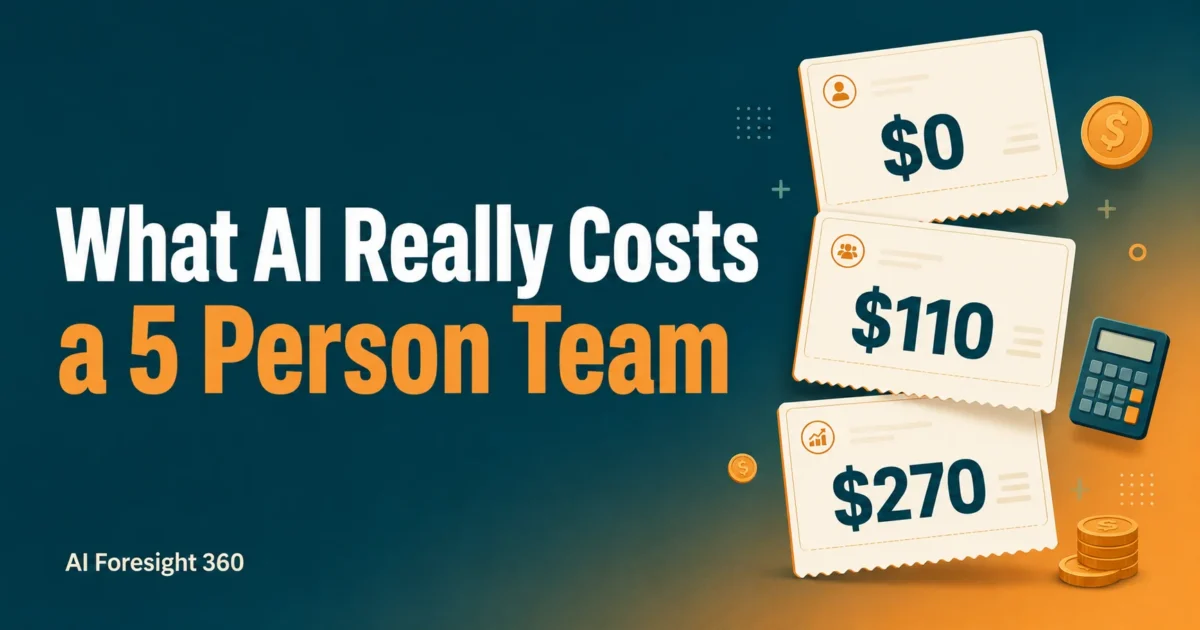
A five person small business can run a credible AI stack for anywhere between zero and roughly $200 per month in dedicated AI spend. All in, including the productivity suite that hosts it, that range runs from about $35 to $270 per month. The variable that moves the number most is how many people genuinely need a paid seat.
That range is wide because the AI tools cost depends on a decision most buyers never make consciously: whether to buy dedicated AI subscriptions, or simply upgrade the productivity suite you already run and use the AI bundled inside it.
Here is the summary before the detail.
| Scenario | Dedicated AI spend | All in with suite | Annual all in |
|---|---|---|---|
| Free stack | $0 per month | $35 per month | $420 |
| Lean stack | $40 per month | $110 per month | $1,320 |
| Full stack | $200 per month | $270 per month | $3,240 |
Those totals are the whole AI tools cost, not a starting point with add ons hidden underneath. All figures assume five people, annual billing, and US list prices. Annual billing is not a rounding detail here. It changes the full stack total by $600 a year on its own.
Why the $4.99 Headline Price Is Not Available to Your Business
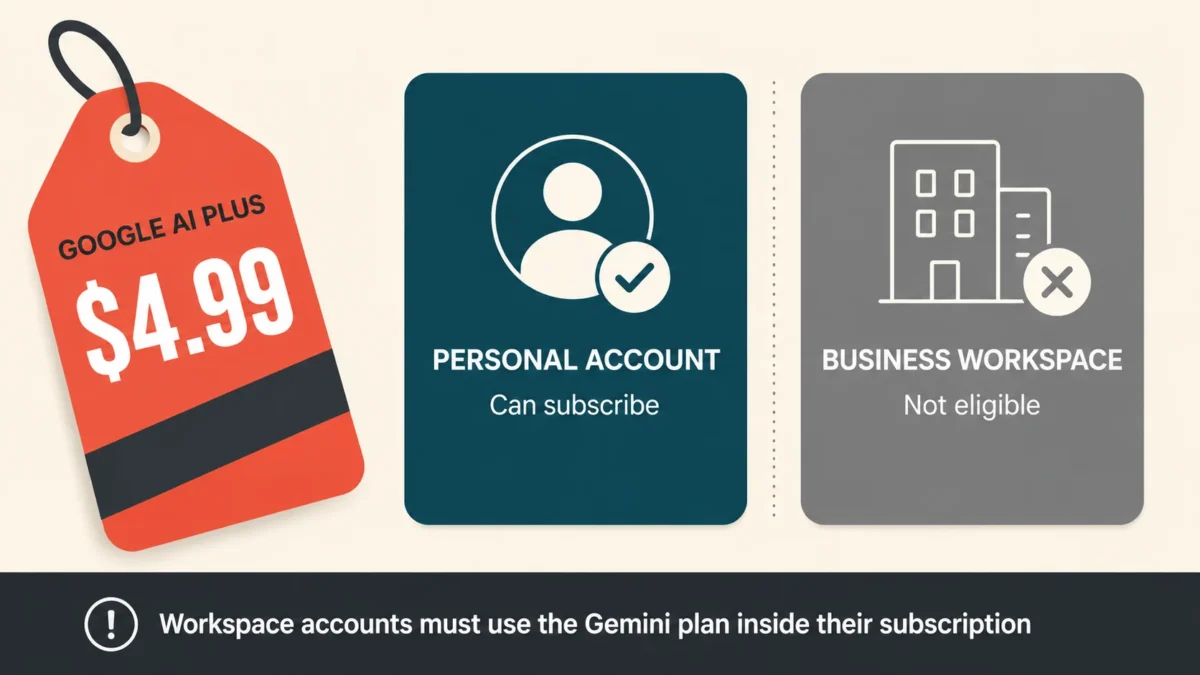
Google AI Plus costs $4.99 per month, and your business almost certainly cannot buy it. Google’s own documentation states that only personal Google Accounts can subscribe to Google AI plans, and that Workspace customers must use a Gemini offering attached to their existing subscription instead. The cheapest advertised AI price on the market is a consumer product.
This matters because it is the single most repeated error in AI tools cost content aimed at small business right now. Google cut AI Plus from $7.99 to $4.99 and doubled its storage to 400GB in June 2026, and dozens of roundups immediately recommended it as the budget option for teams. It is not one.
Google restructured its whole consumer AI ladder at I/O 2026, introducing a $100 Ultra tier and cutting the top tier from $250 to $200, but every one of those plans sits on the consumer side of the line. If your staff log in with an @yourcompany.com address on Google Workspace, that account is ineligible. The workaround people reach for, having staff use personal Gmail accounts for work, creates a genuine problem: your company data sits in accounts you do not control, cannot audit, and cannot recover when someone leaves.
Budgeting around a plan you cannot legally buy is the fastest way to get your AI tools cost wrong before you have spent anything. The same trap exists elsewhere. OpenAI’s pricing documentation states plainly that Free, Go, and Plus are designed for individuals, while Business and Enterprise are the plans intended for businesses. A team of five sharing personal Plus accounts is not saving money so much as deferring a data governance problem.
For a fuller view of the control side of this, our guide to AI agent security for small business covers what you lose when AI runs on unmanaged accounts.
Scenario One: The Free Stack at $0 AI Spend
The free stack brings the AI tools cost to zero in dedicated spend, and to about $35 per month all in, which is five Google Workspace Business Starter seats at $7 each. You get real capability, and in one respect the free tiers just got dramatically better, but three specific limits will find you quickly.
What you actually get:
- ChatGPT Free, which since the week of 10 August 2026 offers unlimited text chats after OpenAI removed the message cap on Free and Go accounts
- Claude Free for document work and longer reasoning tasks
- Gemini’s free tier, running Gemini 3.6 Flash
- Gemini inside Gmail, included even on Workspace Business Starter
The three limits, stated honestly:
Ads. OpenAI began showing ads to logged in adult users on the Free and Go tiers in the United States in February 2026. Paid tiers stay ad free. If you screen share with a client, ads appear.
Model access. Free ChatGPT accounts are restricted to GPT-5.6 Luna, the smallest model in the current family. Unlimited access to the lightest model is not the same as access to the best one. Image generation and file uploads also keep separate caps.
No Gemini in Docs or Sheets. This is the expensive one, and it is covered in its own section below.
The free stack is genuinely viable for a business where one or two people touch AI occasionally. It stops working the moment AI becomes part of how the work gets done, at which point the AI tools cost stops being zero and starts being a decision.
Scenario Two: The Lean Stack at $40 Per Month
The lean stack costs $40 per month in dedicated AI spend and $110 all in, or $1,320 a year. It buys two proper business seats for the people who use AI daily and leaves everyone else on free tiers. For most five person teams this is the correct answer, and it holds the AI tools cost under $50 a month.
| Line item | Plan | Seats | Monthly |
|---|---|---|---|
| AI | ChatGPT Business, annual billing | 2 | $40 |
| Suite | Google Workspace Business Standard | 5 | $70 |
| Total | $110 |
ChatGPT Business is $20 per user per month billed annually, or $25 billed monthly, with a two seat minimum. OpenAI cut this price by $5 per seat in April 2026, so any source quoting $25 and $30 is out of date.
The Workspace upgrade from Starter to Standard is doing quiet work here. It moves you from Gemini in Gmail only to Gemini across Docs, Sheets, Slides, Drive, Meet and Chat, plus expanded access in the Gemini app. For a finance team, Gemini in Sheets is the feature that justifies the line.
The logic behind this AI tools cost split is simple. Two people get admin controls, ad free access, the full model range, and a workspace where company data is not used for model training by default. The other three get free tiers that are now good enough for occasional use. You revisit the split in six months based on who actually hits limits.
If your team leans toward content and campaign work, our roundup of the best AI tools for marketing in 2026 covers which specialist tools are worth adding on top.
Scenario Three: The Full Stack at $200 Per Month
The full stack costs $200 per month in dedicated AI spend and $270 all in, which is $3,240 a year. Every person gets a paid seat on two different frontier models. At $200 a month the AI tools cost is real money for a small business, so this level is right only when AI is load bearing in daily work rather than an occasional assist.
| Line item | Plan | Seats | Monthly |
|---|---|---|---|
| AI | ChatGPT Business, annual billing | 5 | $100 |
| AI | Claude Team Standard, annual billing | 5 | $100 |
| Suite | Google Workspace Business Standard | 5 | $70 |
| Total | $270 |
Claude Team is $20 per seat per month billed annually, or $25 monthly, and supports teams of 2 to 150. Note that figure carefully, because a large number of comparison articles still claim a five seat minimum. Anthropic’s own pricing page says two. Team seats include Claude Code, Claude Cowork, single sign on, central billing, and no model training on your content by default.
Why run two models rather than doubling down on one? Because they fail differently. Teams that do this seriously tend to find one model handles long document analysis and structured reasoning better while the other is stronger at quick drafting and code. At $20 a seat each, running both keeps the AI tools cost flat against a single premium seat on either.
Speaking of which, the tempting upgrade here is Claude Team Premium at $100 per seat annually for five times the usage. For five people that is $500 a month on its own. Do not buy it until someone is demonstrably hitting limits weekly.
Google vs Microsoft: Which Suite Is Cheaper Once AI Is Included?
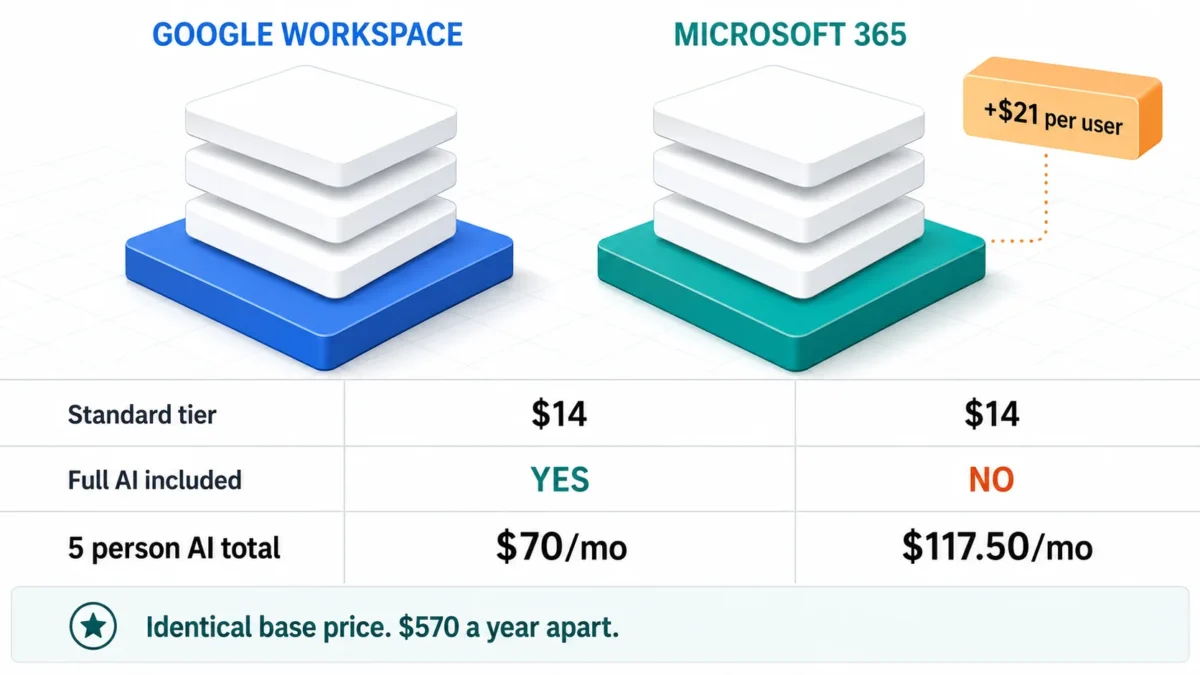
At list price the two suites are identical at the entry and standard tiers, both $7 and $14 per user per month on annual billing. The entire difference in AI tools cost appears at the AI layer. Google includes it. Microsoft charges for it. For a five person team that gap is about $570 a year.
| Google Workspace | Microsoft 365 | |
|---|---|---|
| Entry tier | Business Starter, $7 | Business Basic, $7 |
| AI at entry tier | Gemini in Gmail only | Copilot Chat only |
| Standard tier | Business Standard, $14 | Business Standard, $14 |
| Full AI at standard tier | Included | Not included |
| Cost to add full AI | $0 | $21 per user, or bundle |
| Bundled AI plan | n/a | Standard with Copilot, $23.50 |
| Five person AI capable total | $70 per month | $117.50 per month |
Microsoft raised list prices across most commercial plans on 1 July 2026, moving Business Standard from $12.50 to $14 while Business Premium held at $22. At the same time, Microsoft 365 Business Standard with Copilot at $23.50 and Business Premium with Copilot at $32 became permanent plans rather than promotions, available for 1 to 300 seats.
This is not an argument that Google is the better product. Copilot inside Excel and Outlook is excellent, and if your business runs on Excel models and Teams, the switching cost of leaving Microsoft dwarfs $570 a year. It is an argument that you should know exactly what the AI tools cost inside your suite bill, because most businesses do not.
The Business Starter Trap
Google’s own feature comparison shows Business Starter receiving Gemini in Gmail, and nothing else. Gemini in Docs, Sheets, Slides, Drive, Meet and Chat are all marked unavailable at that tier, and the Gemini app is limited to basic access rather than the expanded access Standard receives.
The practical effect is that the $7 plan is not an AI plan. Businesses pick it believing they have AI included, then conclude AI is overhated when nothing useful appears in their spreadsheets. The AI tools cost saved is $7 per seat per month. The capability lost is all of it. On Google’s published Workspace pricing, Standard at $14 is the real entry point for a team that intends to use AI.
What Can You Actually Cut?
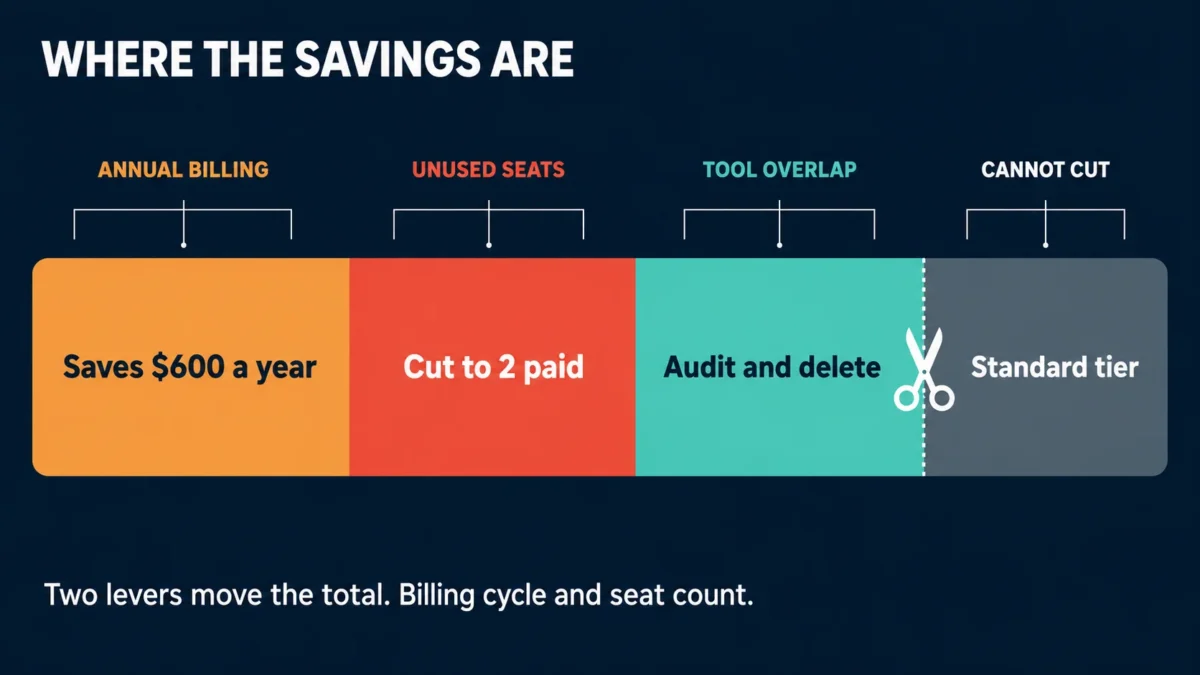
The three highest value cuts are switching to annual billing, reducing paid seats rather than downgrading plans, and deleting overlapping specialist tools. Together they typically remove 30 to 40 percent of an AI tools cost without reducing what the team can do.
Switch to annual billing. Every major vendor discounts it. ChatGPT Business drops from $25 to $20 per seat, Claude Team from $25 to $20, Claude Pro from $20 to $17, and Google Workspace saves 16 percent. On the full stack above, monthly billing costs $250 rather than $200 in AI spend. That is $600 a year for nothing. The trade off is real though: annual commitments lock your seat count, so you cannot shrink mid year if the team does.
Cut seats, not plans. A team of five rarely needs five paid seats. Two paid seats and three free accounts almost always outperforms five downgraded accounts, because the people doing AI heavy work get full capability while occasional users lose very little. Check your admin console for seats that have not been used in 30 days.
Delete the overlap. Most small businesses accumulate a separate writing tool, a separate summarising tool, and a separate research tool, all of which a single ChatGPT Business or Claude Team seat now does. Audit what each subscription does that your main assistant cannot. Every duplicate is pure AI tools cost with no added capability.
What you cannot cut: the Starter to Standard suite upgrade, and admin controls once more than two people use AI on company data.
What About API and Automation Costs?
If you build automations rather than just chat, you pay per token instead of per seat, and the budgeting logic changes entirely. For most five person businesses this adds under $20 a month to the AI tools cost. The one thing worth diarising is that Google’s cheapest current rates expire at the end of December.
Gemini 3.7 Flash and 3.6 Flash currently run at $0.75 per million input tokens and $3.75 per million output tokens. Those are introductory rates. On 1 January 2027 both double, to $1.50 and $7.50, and context caching doubles alongside them. If you are modelling automation costs for next year, build the forecast at the higher number now rather than being surprised in January.
Anthropic publishes comparable rates: Sonnet 5 at $2 and $10 per million input and output tokens, Haiku 4.5 at $1 and $5, and Opus 5 at $5 and $25. Batch processing halves those figures for work that does not need an immediate answer.
For a small business, the realistic automation use cases are invoice extraction, email triage, and report drafting, all of which run comfortably on the cheaper models. Our guide to AI agents for small business covers which workflows justify the build effort, and what AI agents actually are is worth reading first if the term is new.
Frontier model pricing moves faster than any budget cycle. The rates on GPT 6 Astra and what they mean for a small team show how quickly a per token bill can outrun a forecast.
Hidden Costs Most AI Budgets Miss
Four costs sit outside the headline per seat price and routinely push the real AI tools cost above forecast: per seat scaling with no volume discount, seat minimums, metered usage on top of subscriptions, and the price of staying on a legacy plan.
No volume discounts. Below enterprise scale, per seat pricing is linear. Ten seats costs exactly ten times one seat. There is no small business bulk rate at any major vendor, so growing from five to ten people doubles the AI tools cost with no efficiency gain.
Seat minimums. ChatGPT Business requires two seats. Claude Team requires two. Some design and marketing tools require three, which means a two person team pays for a seat nobody uses.
Metered usage above the subscription. Several vendors now sell credits or usage that sits on top of the monthly fee. Anthropic offers usage credits at standard API rates once plan limits are reached. Google sells AI Expanded Access as a separate Workspace add on for higher limits. Neither shows up in a per seat comparison table.
The cost of not moving. Microsoft does not migrate existing customers to new pricing until their next renewal, so a business that has not renewed since July 2026 is likely still on the old rate. That is worth knowing before you budget the increase, and worth checking before you renew.
One deliberate omission. This guide excludes design tool pricing, because current published figures for the major players contradict each other across every source we checked, ranging from $10 to $30 per seat with three different seat minimums. We would rather leave a line out than print a number we cannot verify against the vendor.
These are the numbers a small team actually pays, which is also the first thing an outside adviser should be checking before recommending anything new. If you are on the other side of that conversation and thinking about advising businesses yourself, our guide on how to become an AI consultant covers verified rate data and how the work is really scoped.
Frequently Asked Questions
How much do AI tools cost for a small business per month?
A five person small business typically spends between $0 and $200 per month on dedicated AI subscriptions, and between $35 and $270 all in once the productivity suite is included. The most common practical setup is two paid business seats at $40 per month, with remaining staff on free tiers.
Is the $4.99 Google AI Plus plan available for business accounts?
No. Google states that only personal Google Accounts can subscribe to Google AI plans. Businesses on Google Workspace must use the Gemini capability included in their Workspace subscription instead, which requires Business Standard at $14 per user per month for full access across Docs, Sheets and Meet.
What is the cheapest AI plan for a business team?
ChatGPT Business at $20 per user per month on annual billing and Claude Team Standard at the same price are the cheapest genuine business tiers, both with a two seat minimum. Cheaper consumer plans exist but are licensed for individual use and lack admin controls and data protections.
Does Google Workspace Business Starter include AI?
Only partially. Business Starter includes Gemini in Gmail and basic Gemini app access, but not Gemini in Docs, Sheets, Slides, Drive, Meet or Chat. Teams that want AI inside their documents and spreadsheets need Business Standard at $14 per user per month.
Should a small business pay monthly or annually for AI tools?
Annually, in almost every case. Annual billing reduces ChatGPT Business and Claude Team from $25 to $20 per seat and saves 16 percent on Google Workspace, worth around $600 a year on a five person full stack. The trade off is that annual commitments lock your seat count for the term.
The Bottom Line
The AI tools cost for small business in 2026 is lower than most owners expect and structured differently than most articles describe. AI is now a feature of the productivity suite you already buy, not a separate category, and the largest single saving available to most teams is simply moving to annual billing.
Start at the lean stack. Two paid seats, everyone else on free tiers, Workspace or Microsoft 365 at the standard rather than entry tier. Give it three months, look at who is hitting limits, and add seats only where the evidence says so. Buying five seats on day one is the most common and most expensive mistake in this category, and the easiest way to triple your AI tools cost for no measurable gain.
If you want the AI spend modelled properly against your actual headcount and workflows, or you need the reporting built to track it, get in touch and we can work through it. You can also browse more practical guidance in our Business and AI section, including our review of the best AI bookkeeping agents for small business.
All prices verified against vendor documentation in August 2026. AI pricing moves quickly, so confirm current figures before committing to an annual term.

Ahmad Hussain
ACCAAhmad builds advanced Excel models, Power BI dashboards, and AI automation for businesses. He writes AI Foresight 360 himself, and every pricing figure and feature claim is verified against official documentation at the source.
Connect on LinkedIn