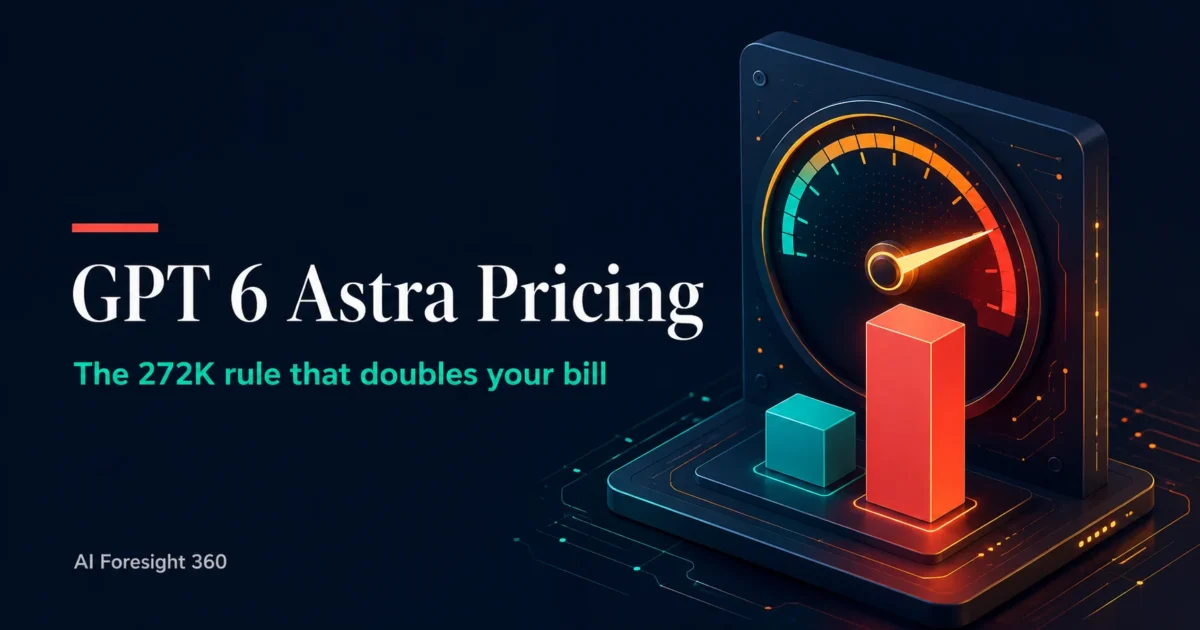
OpenAI released GPT 6 Astra on 3 September 2026, and within hours the pricing figures were everywhere: ten dollars per million input tokens, fifty dollars per million output tokens, a context window of roughly a million tokens. Those numbers are correct. They are also incomplete in a way that will surprise anyone who budgets from them. The published GPT 6 Astra pricing has a second rate card that activates automatically once a request crosses 272,000 input tokens, and at that point the same request costs double on input and half again as much on output.
This guide works through every rate in OpenAI’s published GPT 6 Astra pricing, verified directly against the company’s own API pricing page and model documentation rather than third party summaries. It covers the standard rates, the long context rates, Batch, Flex and Fast mode, which ChatGPT plans get access, what happens outside the United States, and where the real money goes in a production workload. It also states plainly what could not be verified, because a pricing guide that hides its gaps is not worth reading.
How Much Does GPT 6 Astra Cost?
GPT 6 Astra costs $10.00 per million input tokens and $50.00 per million output tokens on the standard OpenAI API tier, for requests under 272,000 input tokens. Cached input is $1.00 per million and cache writes are $12.50 per million. Requests above that input threshold move to a higher rate card. There is no monthly platform fee for API access.
The full standard rate card, taken from OpenAI’s API pricing page, looks like this.
| Rate type | Under 272K input tokens | Over 272K input tokens |
|---|---|---|
| Input | $10.00 / 1M | $20.00 / 1M |
| Cached input | $1.00 / 1M | $2.00 / 1M |
| Cache writes | $12.50 / 1M | $25.00 / 1M |
| Output | $50.00 / 1M | $75.00 / 1M |
Cache writes are billed at 1.25 times the uncached input rate, which is why the figure sits above the standard input price rather than below it. That is a one time cost per cached block, not a recurring one, and the section on reducing your bill below shows when it pays for itself.
Astra did not launch in isolation. Anthropic released Claude Fable 5.1 on 1 September and Google shipped Gemini 3.8 Flash on 2 September, the day before Astra. Our breakdown of how GPT-6 Astra pricing compares against the other September 2026 launches sets all three side by side, including the cache read rates where they differ most and the increase Google has already scheduled for January 2027.
Batch, Flex and Fast mode
OpenAI sells the same model at three other price points depending on how quickly you need the answer.
| Processing mode | Input | Output | When it applies |
|---|---|---|---|
| Standard | $10.00 | $50.00 | Default |
| Batch | $5.00 | $25.00 | Asynchronous jobs, 50% of standard |
| Flex | $5.00 | $25.00 | Lower priority, 50% of standard |
| Fast mode | $20.00 | $100.00 | Up to 2x speed, 2x standard |
Batch and Flex are both priced at half of standard rates. Fast mode delivers up to twice the speed of standard processing for twice the price, and it was previously called Priority processing before OpenAI renamed it on 30 July 2026. Both service_tier: "priority" and service_tier: "fast" still work in API requests.
These multipliers stack with the long context rates. A Fast mode request above 272,000 input tokens is billed at $40.00 per million input tokens and $150.00 per million output tokens, four times the $10.00 headline input rate and three times the $50.00 headline output rate.
The 272K Rule That Changes GPT 6 Astra Pricing
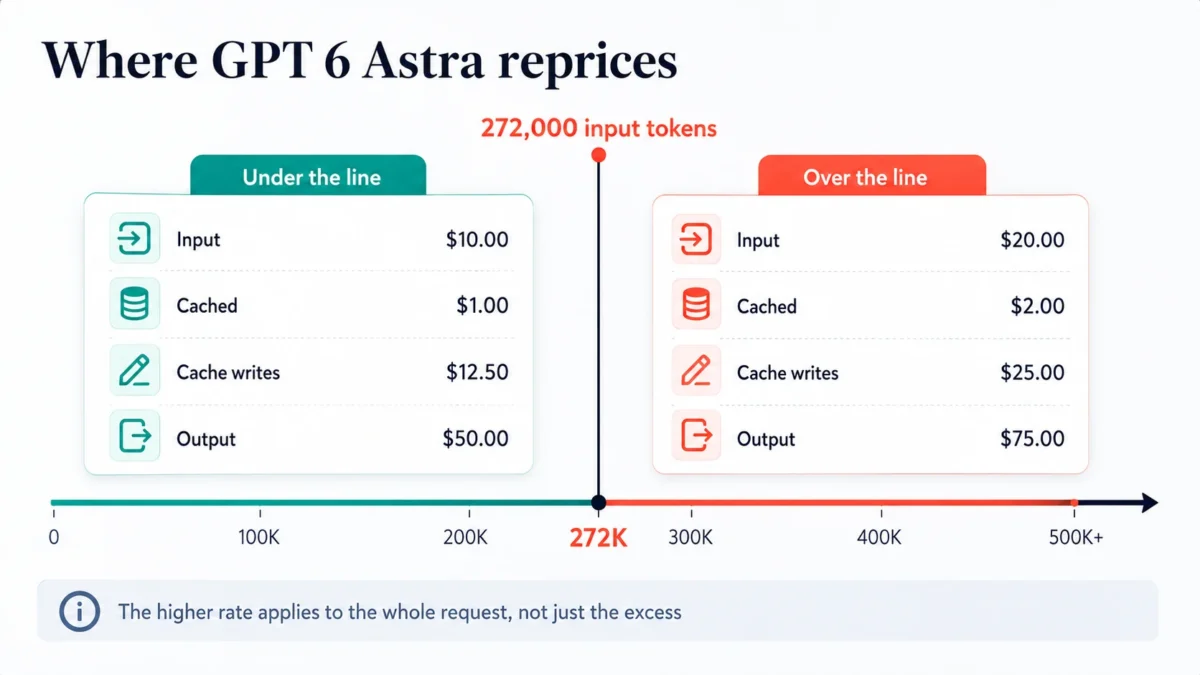
Prompts with more than 272,000 input tokens are billed at 2x the input and cache rates and 1.5x the output rate, and the higher rate applies to the entire request rather than just the tokens above the threshold. Since the model advertises a context window of 1,050,000 tokens, most of that window sits on the expensive side of the line.
This is the detail that separates a realistic budget from an optimistic one, and it is documented on the GPT 6 Astra model page rather than in the launch announcement, which is why almost no coverage has picked it up.
What crossing the threshold actually costs
Consider two requests that look almost identical.
| Request | Input tokens | Output tokens | Cost |
|---|---|---|---|
| A | 250,000 | 20,000 | $3.50 |
| B | 300,000 | 20,000 | $7.50 |
Request B sends twenty percent more input than request A. It costs one hundred and fourteen percent more. Nothing else changed. The full request tipped over the threshold, so every token in it repriced.
The effect gets larger as you use more of the window. A request that fills the context window with 1,000,000 input tokens and returns 50,000 output tokens costs $23.75. Estimated at the headline rates, the same request looks like $12.50. The real bill is 1.9 times the number a spreadsheet built from the launch coverage would produce.
For a team running a few hundred long context requests a month, that gap is the difference between a forecast that holds and one that does not. If you are already tracking what AI tools cost a small team, this is the line item most likely to break the model.
The practical rule
Treat 272,000 input tokens as the real price boundary, not 1,050,000 as the capability boundary. If a workload can be restructured to sit below it, through retrieval, chunking or summarisation, the saving is not marginal. It is roughly half the input cost of every affected request.
How Does Astra Compare to GPT 5.6 Sol on Cost?
GPT 6 Astra costs exactly 2.5 times GPT 5.6 Sol on both input and output at standard short context rates. Sol is $4.00 input and $20.00 output per million tokens against Astra’s $10.00 and $50.00. Against the cheaper models in the same family the gap widens sharply, and against the long context rate card Astra reaches five times Sol’s input price.
Here is OpenAI’s full current model ladder at standard short context rates.
| Model | Input | Cached input | Output |
|---|---|---|---|
| gpt-6-astra | $10.00 | $1.00 | $50.00 |
| gpt-5.6-sol | $4.00 | $0.40 | $20.00 |
| gpt-5.6-terra | $2.00 | $0.20 | $12.00 |
| gpt-5.6-luna | $0.20 | $0.02 | $1.20 |
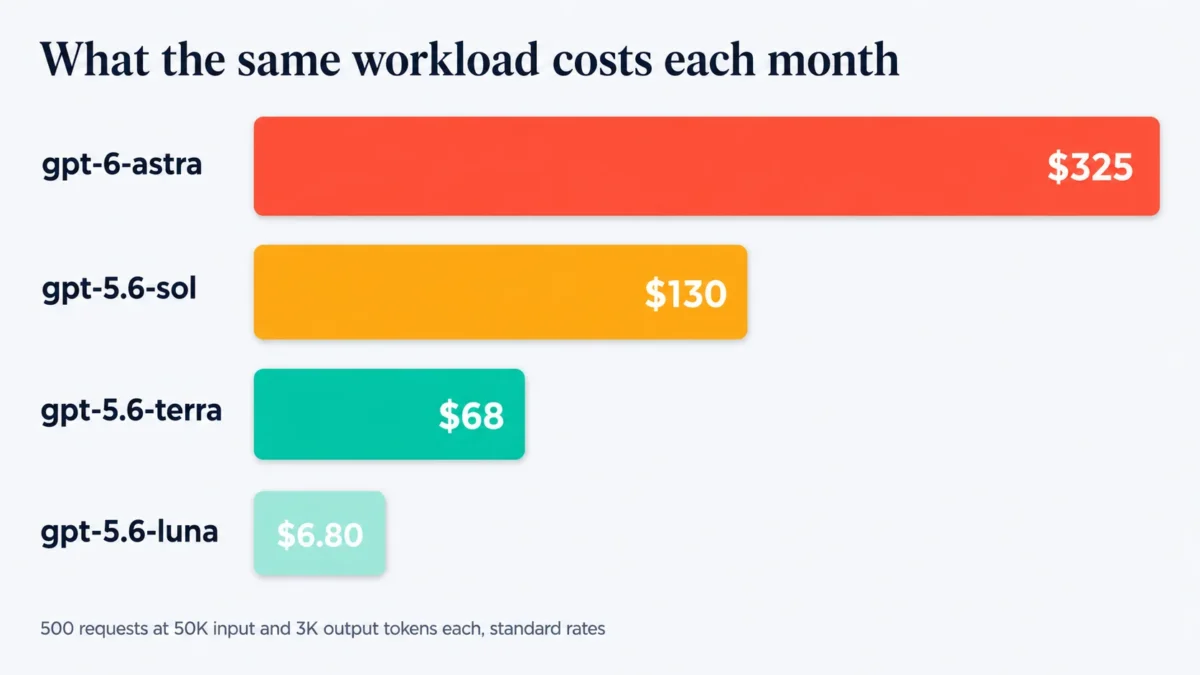
To put that in operational terms, take a small firm running 500 requests a month at 50,000 input and 3,000 output tokens each. On Astra that is $325 a month. The identical workload costs $130 on Sol, $68 on Terra, and $6.80 on Luna. Astra is roughly forty eight times the price of the cheapest model in the same lineup for the same token volume.
The Sol promotional pricing detail almost nobody is reporting
Every comparison currently circulating describes Astra as 2.5 times the price of Sol. That multiple is real, but it is measured against a promotional rate. OpenAI’s pricing page states that GPT 5.6 Sol’s promotional pricing is available at least through 21 November 2026.
OpenAI has not published what Sol costs after that date, so the honest conclusion is a conditional one. If Sol’s list price rises when the promotion ends, the gap between the two models narrows and the case for staying on Sol purely to save money weakens. If OpenAI extends the promotion, nothing changes. Either way, anyone building a twelve month cost model on the current 2.5x multiple is building on a rate with a published expiry date attached to it. Diary that date.
OpenAI’s own cost efficiency claims
OpenAI’s launch announcement makes several comparative cost claims: that Astra reaches higher scores than competing models at lower estimated API cost on Terminal-Bench Science, Terminal-Bench 4.0 and BenchCAD, and that it uses substantially fewer output tokens than rivals on some agentic benchmarks.
These are vendor figures, produced by OpenAI, in configurations OpenAI chose, and they compare estimated cost per task rather than list price. They are worth knowing and they are not independent evidence. We deliberately do not publish a cross vendor rate table in this guide, because the competitor list prices currently circulating on aggregator sites contradict each other on basic figures, and we could not confirm them against the vendors’ own published pages during verification. A table built on unverified numbers would be worse than no table.
The argument OpenAI is making is a defensible one in principle: a more capable model that finishes a task in fewer tokens can be cheaper in practice than a lower priced model that needs more attempts. Whether that holds for your workload is an empirical question you answer by running both, not one you settle from a price sheet.
Who Gets Access to GPT 6 Astra?
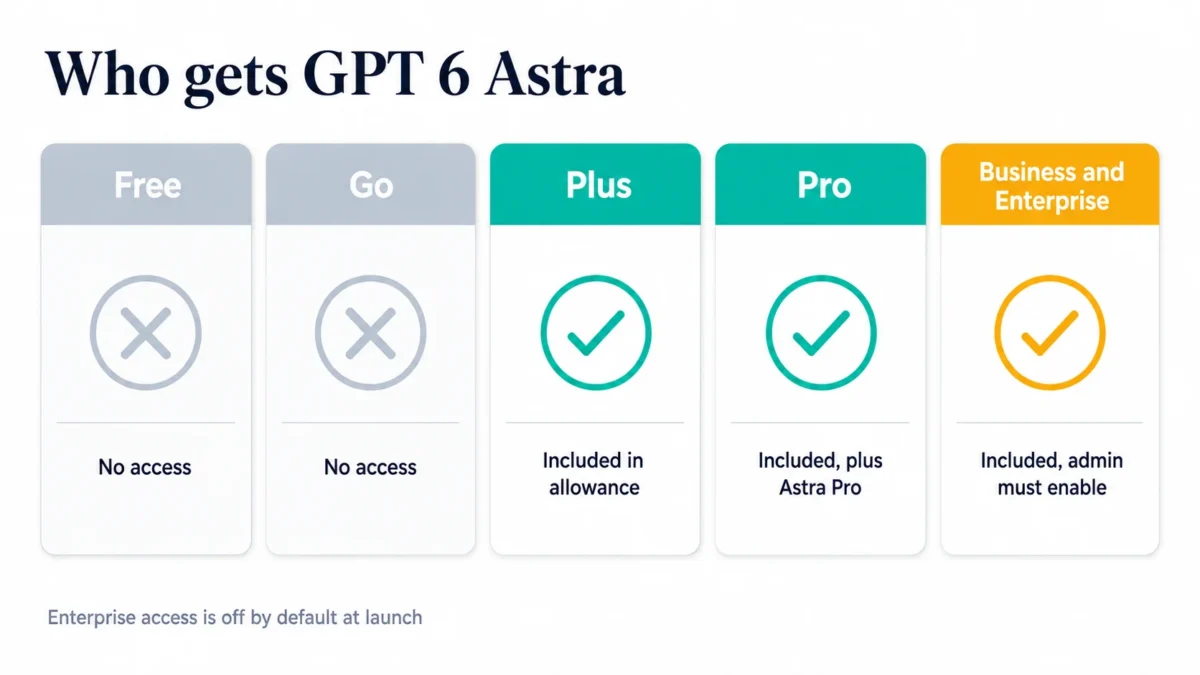
GPT 6 Astra began rolling out on 3 September 2026 to a limited set of organisations, with access for all ChatGPT Plus, Pro, Business and Enterprise users, plus the OpenAI API, Microsoft Azure and AWS Bedrock, arriving over the following days. Astra usage falls inside existing subscription allowances, and users and businesses can buy credits for more.
The model documentation describes that first wave as enterprises in OpenAI’s Trusted Access Program. This is worth distinguishing from Daybreak, which is OpenAI’s cybersecurity programme and has its own separate model lineup and pricing on the same price sheet. OpenAI says it plans to expand Astra access and roll out less restrictive safeguards through Daybreak in the coming weeks, but Daybreak is not where the general rollout started.
ChatGPT plans and Astra Pro
Users on the Pro, Business and Enterprise plans also get access to GPT 6 Astra Pro. OpenAI has published no separate pricing, specification or usage allowance for Astra Pro beyond confirming which tiers receive it.
For teams, the seat prices on OpenAI’s business pricing page are published directly and are as follows.
| Seat type | Annual billing | Monthly billing |
|---|---|---|
| Business standard | $20 per user per month | $25 per user per month |
| Business premium | $100 per user per month | $125 per user per month |
Premium seats carry five times the usage of standard seats with no five hour limit. Business workspaces start at two users. Enterprise pricing is custom, and OpenAI offers both credit based and token based pricing on Enterprise plans. Nonprofits can access up to a seventy five percent discount on Business or Enterprise.
Individual plan prices are a different matter. OpenAI renders the monthly figures for Free, Go, Plus and Pro dynamically on its consumer pricing page rather than serving them in the page source, which is consistent with regional pricing and means the numbers cannot be captured reliably by anything other than loading the page yourself in your own country. Rather than quote a figure from a third party aggregator, check the current price for your region on OpenAI’s ChatGPT pricing page directly. What that page does confirm without ambiguity is the structure: Pro is sold in two usage tiers offering five times and twenty times Plus usage respectively.
Enterprise administrators need to switch it on
Enterprise administrators can enable Astra for their workspace, and access is off by default at launch. If your organisation is on Enterprise and nobody can find the model, that is almost certainly why rather than a rollout delay.
Is GPT 6 Astra free?
No. GPT 6 Astra is not available on the ChatGPT Free tier. OpenAI’s rollout list names Plus, Pro, Business and Enterprise only, and the API rate limit table marks the Free usage tier as not supported for this model. The consumer plan comparison shows the same pattern with the previous flagship, where Free and Go do not receive GPT 5.6 Sol either.
There is also no free API allowance. API access is pay per token from the first request, with rate limits scaling by usage tier.
| API usage tier | Requests per minute | Tokens per minute |
|---|---|---|
| Free | Not supported | Not supported |
| Tier 1 | 500 | 500,000 |
| Tier 2 | 5,000 | 1,000,000 |
| Tier 3 | 5,000 | 2,000,000 |
| Tier 4 | 10,000 | 4,000,000 |
| Tier 5 | 15,000 | 40,000,000 |
What Does GPT 6 Astra Cost Outside the United States?
Token pricing is set in US dollars and is the same worldwide, but three things change the effective cost outside the US: data residency uplifts, a Fast mode restriction in the EU, and cloud reseller billing. None of these appear in the headline figures.
Data residency uplift. Regional processing endpoints carry a ten percent uplift for models released on or after 5 March 2026 that are eligible for data residency. Astra qualifies. If your compliance position requires processing in a specific region, budget $11.00 rather than $10.00 per million input tokens, and $22.00 rather than $20.00 on the long context tier. Enterprise plans support data residency in ten regions including the UK and the EU.
Fast mode is unavailable in the EU. OpenAI states that Fast mode does not work for GPT 6 Astra with EU data residency, and that those requests must use standard processing. European teams with a residency requirement cannot buy their way to lower latency on this model.
Cloud marketplace billing. Astra is available through Microsoft Azure and Amazon Bedrock. OpenAI notes that models served through Bedrock are billed by AWS and the rates may differ from direct OpenAI pricing. If you are buying through a cloud marketplace to use committed spend, confirm the rate on the marketplace listing rather than assuming parity.
Tax. API charges are quoted before local sales tax. UK customers should expect VAT at twenty percent on top, and EU customers their national rate. A £1,000 monthly API spend is £1,200 out the door in the UK. This is standard practice rather than anything specific to Astra, but it is routinely left out of budget models.
What You Actually Get for the Price
The published specification for GPT 6 Astra includes a 1,050,000 token context window, a maximum output of 128,000 tokens, and a knowledge cutoff of 30 April 2026. It accepts text and image input and returns text only, with no audio or video support.
| Specification | Value |
|---|---|
| Model ID | gpt-6-astra |
| Context window | 1,050,000 tokens |
| Maximum output | 128,000 tokens |
| Knowledge cutoff | 30 April 2026 |
| Input modalities | Text, image |
| Output modalities | Text |
| Reasoning effort levels | low, medium, high, xhigh, max |
The reasoning effort setting matters for cost in a way the rate card does not show. Higher effort settings produce more reasoning tokens, and reasoning tokens are billed as output at $50.00 per million. Two requests with identical prompts and identical visible answers can carry materially different bills depending on the effort level. OpenAI’s own benchmark footnotes acknowledge this, noting that scores reflect the maximum at any effort level and that lower cost settings reach lower scores.
The model supports web search, file search, image generation, code interpreter, hosted shell, apply patch, skills, computer use, MCP and tool search through the Responses API. Tokens consumed by built in tools bill at the model’s own per token rates, and several tools carry their own per call fees on top: web search at $10.00 per thousand calls, file search at $2.50 per thousand calls, plus $0.10 per gigabyte per day of storage after the first gigabyte free.
Astra also supports Zero Data Retention for eligible API customers, which is a meaningful consideration for anyone handling client financial data. Understanding how AI agents work in practice helps clarify why a computer use model with tool access raises different data questions than a chat model does.
Is GPT 6 Astra Worth the Price?
GPT 6 Astra is worth its premium for a narrow set of workloads: long horizon agentic tasks, computer use, complex software engineering, and work where a single failed attempt costs more than the token difference. For high volume routine work such as classification, summarisation, drafting or customer support, the cheaper models in the same family deliver most of the value at a fraction of the cost.
The honest test is not which model scores highest on a benchmark. It is whether the capability gap changes an outcome you can put a number on.
Astra makes sense when a task currently requires a person to supervise a cheaper model through multiple attempts, when a workflow spans many steps and tools where a mid task failure is expensive, when accuracy on a single high value document matters more than throughput, or when you need computer use and browser automation that earlier models handle poorly.
Astra is hard to justify when the work is high volume and low complexity, when a cheaper model already produces acceptable output, when your prompts routinely exceed 272,000 input tokens without a restructuring plan, or when cost predictability matters more than peak capability.
For small firms and finance teams specifically, the sensible pattern is routing rather than standardising. Run the bulk of the volume on Terra or Luna, escalate to Sol for anything ambiguous, and reserve Astra for the small number of tasks where its capability actually changes the result. That structure costs a fraction of putting everything on the flagship, and the arithmetic in the comparison section above shows why. If API costs are the binding constraint, it is also worth understanding the economics of running AI models locally before committing to a per token bill that scales with your growth.
How to Reduce Your GPT 6 Astra Bill
Five mechanisms cut cost without changing the model, and OpenAI documents all of them. Applied together on a suitable workload they can reduce a bill substantially.
Stay under 272,000 input tokens. This is the single largest lever. Every request that crosses the threshold reprices entirely, so restructuring a 300,000 token prompt down to 250,000 tokens cuts that request’s cost by more than half.
Cache repeated context. A 200,000 token system prompt costs $2.50 to write to cache once, then $0.20 per subsequent read against $2.00 uncached. The cache write pays for itself on the first reuse and saves $1.80 on every call after that.
Batch anything asynchronous. Batch and Flex both run at fifty percent of standard rates. A nightly job sending a million input tokens and returning a hundred thousand output tokens costs $27.50 on standard long context rates and $13.75 batched.
Use effort settings deliberately. Reasoning tokens bill as output. Defaulting every call to maximum effort is the most common avoidable overspend on reasoning models.
Route by task, not by habit. The price ladder in the comparison section exists so you can move work down it. Most production volume does not need the flagship.
What We Could Not Verify
Three things in this guide are stated with less confidence than the rest, and it is worth being explicit about which.
First, individual ChatGPT plan prices. OpenAI renders these client side and localises them, so they could not be captured from the page source. The Business seat prices are published in the page source and are stated above with confidence. Individual tier prices are not, and are not quoted here.
Second, the rollout status at time of writing. As of the verification date, OpenAI’s own consumer and business plan comparison tables still listed only the GPT 5.6 family and had not yet added Astra, consistent with a rollout described as arriving in the coming days rather than immediately.
Third, competitor list prices. As explained above, the aggregator figures currently circulating contradict each other and could not be confirmed against vendor pages, so no cross vendor rate table appears in this guide.
All OpenAI figures in this article were verified on 5 September 2026 against OpenAI’s API pricing page, the GPT 6 Astra model documentation, the launch announcement and the business pricing page. AI model pricing moves quickly and promotional rates expire. Confirm current rates on OpenAI’s own pages before committing budget.
Frequently Asked Questions
How much does GPT 6 Astra cost per million tokens?
GPT 6 Astra pricing is $10.00 per million input tokens and $50.00 per million output tokens on the standard API tier for requests under 272,000 input tokens. Cached input is $1.00 per million and cache writes are $12.50 per million. Requests above 272,000 input tokens are billed at $20.00 input and $75.00 output per million.
Why does my GPT 6 Astra bill double on long prompts?
Prompts with more than 272,000 input tokens are billed at twice the input and cache rates and 1.5 times the output rate, and the higher rate applies to the whole request rather than only the excess tokens. A request with 300,000 input tokens costs more than twice one with 250,000 input tokens for that reason.
Is GPT 6 Astra free on ChatGPT?
No. GPT 6 Astra is available on ChatGPT Plus, Pro, Business and Enterprise plans only. The Free tier does not receive it, and the API has no free usage tier for this model, with the Free API tier marked as not supported in OpenAI’s rate limit table.
How much more expensive is GPT 6 Astra than GPT 5.6 Sol?
GPT 6 Astra costs exactly 2.5 times GPT 5.6 Sol on both input and output at standard short context rates, at $10.00 and $50.00 against Sol’s $4.00 and $20.00. OpenAI states that Sol’s pricing is promotional and available at least through 21 November 2026, so this multiple may change after that date.
What is GPT 6 Astra Pro and does it cost extra?
GPT 6 Astra Pro is a higher capability version available to users on the ChatGPT Pro, Business and Enterprise plans. OpenAI has confirmed which tiers receive it but has published no separate pricing, specification or usage allowance for it beyond inclusion in those plans.
Does GPT 6 Astra cost more in the UK or the EU?
Token prices are set in US dollars and are identical worldwide, but regional data residency endpoints carry a ten percent uplift, and Fast mode is unavailable for GPT 6 Astra with EU data residency. Local sales tax applies on top, including UK VAT at twenty percent.
What is the cheapest way to run GPT 6 Astra?
Keep requests under 272,000 input tokens, cache repeated context, and send asynchronous work through Batch or Flex at fifty percent of standard rates. Use lower reasoning effort settings where the task allows, since reasoning tokens are billed at the output rate of $50.00 per million.
The Bottom Line
The published GPT 6 Astra pricing is straightforward on its face and considerably less so in practice. Ten dollars and fifty dollars per million tokens is the correct headline, but the 272,000 token threshold means most of the advertised context window is billed at double the input rate, the comparison against GPT 5.6 Sol rests on a promotional price with a stated expiry, and regional processing, tool calls and reasoning effort all add cost that the rate card alone does not show.
None of that makes the model a poor purchase. It makes it a purchase that needs a real model rather than a headline figure. Work out where your requests fall against the 272,000 token line, cache what repeats, batch what can wait, and reserve the flagship for the tasks where its capability actually changes the outcome. Then check the rates again before you commit, because this category reprices faster than any budget cycle.
For more analysis of AI tool costs and capabilities, browse our AI tools reviews, including our full ChatGPT review and our breakdown of Gemini Spark pricing.
If your team is trying to work out what AI tooling should actually cost inside a finance or reporting workflow, and which parts of it are worth automating at all, get in touch and we can look at it together.

Ahmad Hussain
ACCAAhmad builds advanced Excel models, Power BI dashboards, and AI automation for businesses. He writes AI Foresight 360 himself, and every pricing figure and feature claim is verified against official documentation at the source.
Connect on LinkedIn