

Month end close is where finance teams lose days to copying numbers, chasing explanations and arguing about whether a variance is real. These Claude prompts for month end close turn that work into 50 structured requests you can paste into Claude and run against a set of books, from the first checklist to the final review memo.
They are written for accountants, FP&A analysts, controllers and small business owners who close a services business every month. Each prompt names the data it needs, sets rules Claude must follow, and asks for output you can check line by line. To make that easy, the article comes with a free download: a fictional services firm workbook you can use to try every prompt before you point Claude at anything real.
The workbook was designed and reviewed by an ACCA qualified accountant, and the flux analysis prompt in Phase 2 was run on Claude Sonnet 5.5 with every figure in the answer rechecked, so you can see what a strong result looks like.
What Is the Close Lab Workbook and How Do You Download It?
The Close Lab workbook is a free Excel file for a fictional services firm called Harbor and Pine Advisory. It has 11 sheets, including a trial balance, a 12 month P&L, budget vs actual, AR aging, an AP register, accruals, payroll and a bank reconciliation, all built for a September 2026 close in US dollars.
Download the Close Lab workbook (XLSX, free, no signup)
What is inside the workbook?
The firm has 21 delivery staff and four service lines: Advisory, Implementation, Managed services and Training. The subledger sheets tie back to the trial balance, so totals agree across the file.
| Sheet | What it holds | Used in phases |
|---|---|---|
| Guide | Firm profile, sheet map and nine integrity checks | 1 |
| Chart of Accounts | 31 accounts in 7 groups with normal balances | 1, 2 |
| Trial Balance | Sep 2026, Aug 2026 and Sep 2025 with an adjustable flux flag | 2, 10 |
| 12 Month P&L | October 2025 to September 2026 by account | 2, 9 |
| Budget vs Actual | Month and year to date variances with status | 8 |
| AR Aging and WIP | 14 open invoices, age buckets and unbilled work | 4 |
| AP and Vendor Invoices | A raw invoice register with no review columns | 3, 5 |
| Accruals and Prepaids | Recurring accruals and a prepaid schedule against the ledger | 3 |
| Payroll and Utilization | Utilization, cost per billable hour and realization by team | 7 |
| Bank Rec Items | Bank side and book side with open reconciling items | 6 |
| Answer Key | The planted issues and a scorecard | 10 |
Why does the workbook contain planted errors?
A demo file with perfect books teaches nothing about review. The workbook contains seven deliberate issues of the kind that appear in real closes, such as a repeated vendor bill, a missing accrual and a receivable that has gone stale. One of them is a large movement that looks suspicious but has a genuine cause, because good review also means not calling normal things errors.
The answers sit on the last sheet with the rows collapsed, so you can attempt each task first and check yourself afterward. Delete that sheet from the copy you upload to Claude, otherwise the answers are visible to the assistant you are testing.
How Do You Use These Claude Prompts for Month End Close?
You use them by attaching the data a prompt names, pasting the prompt unchanged, and then checking Claude’s answer against your own calculations. Each prompt is built the same way, so once you know the pattern you can adapt any of them to your own chart of accounts, thresholds and month.
How do you set up Claude to read Excel files?
- Open Settings, then Capabilities, and make sure Code execution and file creation is switched on. According to the Claude Help Center, it is enabled by default on Free, Pro and Max plans, and on Team and Enterprise plans an organization owner controls it.
- Start a new chat. If you work inside a Claude project, remember that project instructions and files will also shape the answer.
- Attach your file. The Claude file upload guide says XLSX files cannot be uploaded unless code execution and file creation is enabled, and that chat uploads allow up to 20 files of 500MB each.
- Save a working copy first. Delete the Answer Key sheet and any sheet the prompt does not need.
- Paste the prompt, send it once, and read the whole answer before you reply.
File creation draws on the same usage limits as your plan and uses more of them than a normal chat, so long sessions with large workbooks can run into limits sooner.
What makes a close prompt work?
Every prompt in this article uses five parts. You can rebuild any prompt from your own situation by filling in the same five.
| Part | What it does | Example |
|---|---|---|
| Role | Sets the standard of work | Act as a senior financial controller |
| Data | Names the sheets and the period | The Trial Balance and AP register for September 2026 |
| Steps | Defines the method in order | Calculate, rank, search for evidence, classify |
| Rules | Blocks guessing | Use only the attached files and say when evidence is missing |
| Output | Fixes the format | A ranked table, then entries, then questions |
How do you adapt the prompts to your own books?
Change the month and year, replace sheet names with your own, and set the materiality thresholds to match your policy. Keep the rules and the output instructions, because they are what stop Claude from inventing explanations. If you are using real client data, read the next section before you upload anything.
If you want a broader set of everyday accounting requests, the ChatGPT prompts for accountants library covers general tasks, while this article stays focused on the close.
How Do You Protect Client Data When Using AI for Month End Close?
Treat every upload as a disclosure. Use fictional or masked data unless your firm has approved the tool, the plan and the client consent. ACCA and the AICPA both warn that confidential client information entered into AI tools can be reused or exposed, and that professional judgment cannot be delegated to the tool.
ACCA’s guidance on key areas of risk when adopting AI tells firms to think carefully about how confidential data is used when framing prompts, how models are trained, and how anything entered can later be disseminated. It also says members cannot outsource professional skepticism and judgment to technology.
The AICPA’s ethics article in the Journal of Accountancy, Accounting ethics in the age of AI, adds that some publicly available generative AI tools use inputs to train future models. It suggests testing a tool on non sensitive data first and asking whether client consent is required before pasting client data into any AI system.
For Claude specifically, Anthropic’s privacy policy says it may use inputs and outputs to train and improve its models unless you opt out in your account settings. It also says content may still be used, even after you opt out, if a conversation is flagged for safety review or you report it. The same policy states that it does not apply to content processed for customers of business offerings such as Enterprise accounts, which are governed by their customer agreements.
Practical rules that follow from these sources:
- Practice on the fictional workbook, not on a live client file.
- Mask client and vendor names, account numbers and personal data before you upload real files.
- Check the plan, the account settings and your engagement terms, and get consent where it is required.
- Keep a human reviewer in the loop for every figure and every entry.
- For a deeper look at risks when AI tools touch business data, see AI agent security for small business.
What Should You Prepare Before the Books Close?
Before the first entry is posted, confirm the calendar, the owners and the data. A close that starts with a clear timeline, a complete set of reports and an agreed chart of accounts avoids most of the rework that appears on day three. These four prompts build that foundation.
Prompt 1: Build the close calendar and owner matrix
Use with: Guide and Chart of Accounts. Check: every task has one owner and one due day.
Act as a financial controller who runs the monthly close for a professional services firm with 21 delivery staff and four service lines: Advisory, Implementation, Managed services and Training. The close period is September 2026.

Using the attached Guide and Chart of Accounts, build a close calendar from working day minus 2 to working day plus 5.

Steps:
1. List every close task by account group: cash, receivables and unbilled work, prepaids, payables, accruals, payroll, revenue, equity and reporting.
2. Assign each task a role as owner, a reviewer and a due day. Use roles, not names.
3. Mark the tasks that depend on another task and show the dependency.
4. Flag the three tasks most likely to delay the close and explain why.

Rules: do not invent software or systems the firm does not use, and say which assumptions you made about team size.

Output: a table with columns task, account group, owner role, reviewer role, due day, dependency and risk level, followed by a short paragraph on the critical path.
Prompt 2: Check data readiness before analysis
Use with: Trial Balance, Chart of Accounts and the other sheets you plan to use. Check: the arithmetic behind every tie out.
Act as an internal auditor checking whether a close file is ready for analysis. I have attached the workbook sheets for the September 2026 close.

Task: test completeness and consistency before anyone starts the analysis.

Steps:
1. Confirm the trial balance totals to zero for each period shown, and show the totals you calculated.
2. Check that every account on the trial balance exists on the chart of accounts and that no account is missing a normal balance.
3. Identify any subledger total in the other sheets that should agree to a trial balance account, and test whether it does.
4. List missing inputs, blank cells, unusual dates and formulas that return errors.
5. State plainly which analyses are safe to run now and which should wait.

Rules: show your arithmetic, never change any input, and separate confirmed problems from things that only look unusual.

Output: a checklist table with test, result, evidence and next action, then a one paragraph readiness verdict.
Prompt 3: Draft the cutoff and deadline message to the team
Use with: Guide. Check: dates, owners and the single clear ask in each paragraph.
Act as a controller writing to a small finance and operations team before the September 2026 close.

Write a message that does five things: states the close deadline, lists the three inputs each person must deliver, explains the cutoff rule for invoices and expenses dated in September, tells people where to send questions, and says what happens to items that arrive late.

Tone: calm, direct and respectful, with no jargon. Use short paragraphs and one numbered list for the deliverables. Keep it under 250 words.

Rules: use roles instead of names, do not promise anything about overtime or approvals, and do not invent policies. If a detail is missing, add it to a short list of questions at the end for me to answer before sending.

Output: the message, then the list of questions.
Prompt 4: Review the chart of accounts for coding risks
Use with: Chart of Accounts and Trial Balance. Check: that every suggestion is tied to specific account numbers.
Act as a technical accountant reviewing a chart of accounts for coding risk. I have attached the Chart of Accounts and the Trial Balance for a professional services firm.

Task: find places where transactions are likely to be coded to the wrong account.

Steps:
1. Group the accounts by their natural confusion risk, for example costs that could sit in cost of services or in operating expenses.
2. For each risk group, explain the difference in plain language and give a one line rule for choosing between the accounts.
3. Identify any account that looks unused, overused or too broad, using the balances on the trial balance.
4. Suggest at most five changes or clarifications, ranked by impact, and say what each would prevent.

Rules: do not recommend adding accounts unless a risk cannot be solved with a coding rule, and never assume how a transaction was coded.

Output: a table of risk group, accounts involved, coding rule and example, then the ranked list of suggestions.
How Do You Run a Flux Analysis With Claude?
Give Claude the trial balance for two periods, set a materiality rule, and ask it to rank movements and classify each as genuine, a possible error or undeterminable. The classification step is what turns a list of changes into a review, because it forces Claude to cite evidence instead of guessing.
Prompt 5: Rank material movements and classify each one
Use with: Trial Balance and AP and Vendor Invoices. Check: the thresholds, the ranking and every cited invoice.
Act as a senior financial controller preparing the September 2026 close for a professional services firm. I have attached two sheets: Trial Balance (Sep 2026, Aug 2026, Sep 2025) and AP and Vendor Invoices.

Task: perform a flux analysis of Sep 2026 against Aug 2026, and against Sep 2025 where it adds insight.

Steps:
1. Calculate the dollar and percent change for every account. Debits are positive and credits are negative, so state the direction of each movement clearly.
2. Treat a movement as material only when it exceeds both 10 percent and 10,000 dollars. List every material movement, ranked by absolute dollar change.
3. For each material movement, search the attached invoice register for evidence that explains it. Quote the vendor, invoice number, description and amount you relied on.
4. Classify each movement as one of: Genuine business cause supported by the data, Possible error needing investigation, or Cannot be determined from the files.
5. Do not label a movement an error unless you can point to specific evidence. A large movement with a clear business explanation is not an error.

Rules: use only the attached files, never invent a cause, and say plainly when evidence is missing. Round only at the final step.

Output: a ranked table (account, Aug, Sep, change in dollars, change in percent, classification, evidence), then a short paragraph for each item classified as a possible error, then a list of questions I should ask the budget owners. Finish with a one paragraph summary that a CFO could read in 30 seconds.
What did Claude Sonnet 5.5 find when this prompt was run?
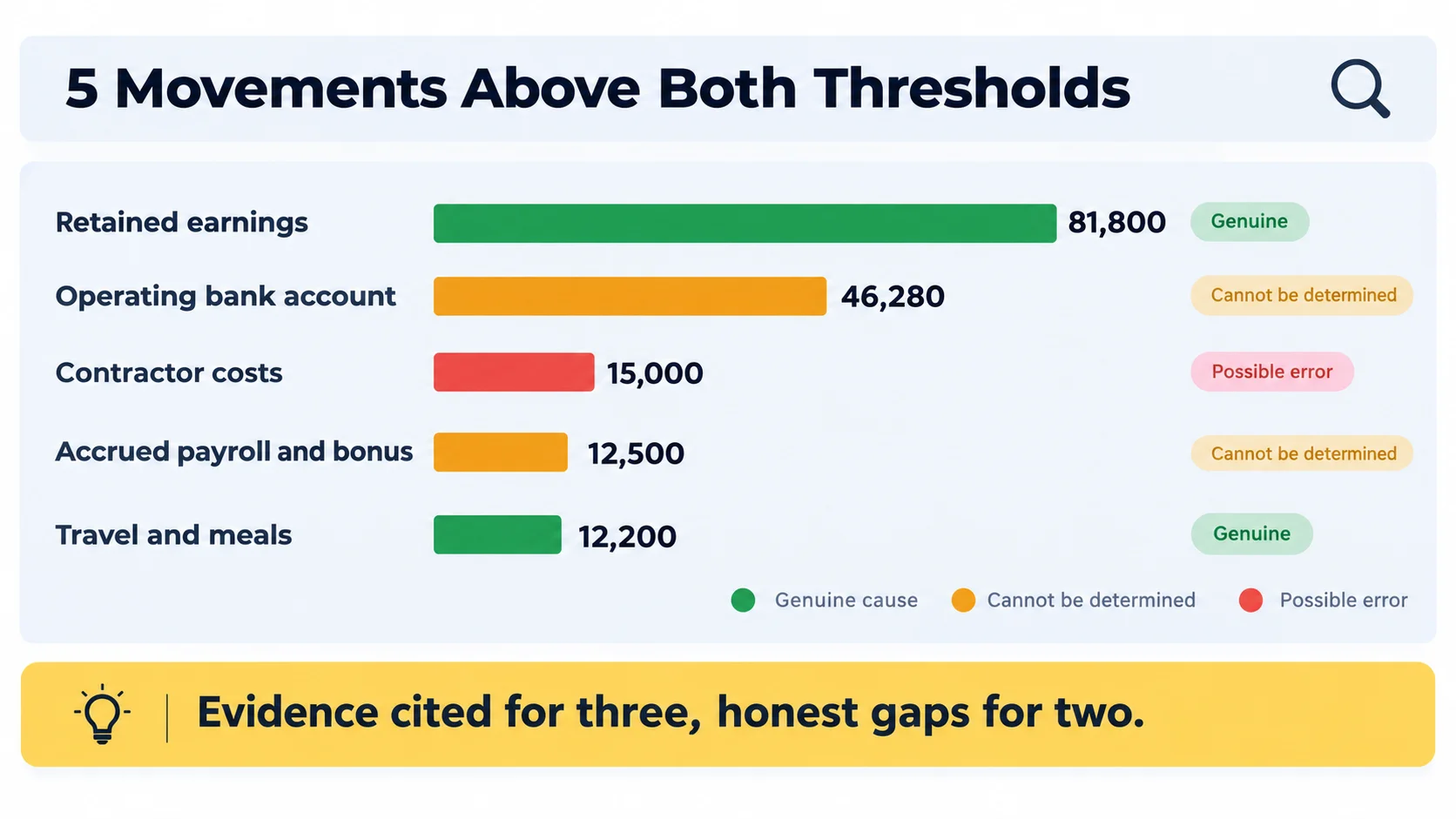
We ran Prompt 5 in a new chat in October 2026 on Claude Sonnet 5.5, attaching only the Trial Balance and AP sheets from the workbook, and then recalculated every figure in the answer ourselves. The dataset is fictional, so this is an illustration of what a careful answer looks like, and a single run should not be read as a benchmark.
Claude found five movements above both thresholds and classified them as follows:
| Account | Movement | Claude’s classification | What we found when we checked |
|---|---|---|---|
| 3100 Retained earnings | 81,800 credit increase | Genuine business cause | Matches August profit exactly, as the workbook notes explain |
| 1000 Operating bank account | 46,280 increase | Cannot be determined | Correct, because the files hold payments but no receipts |
| 5100 Contractor costs | 15,000 increase | Possible error | Two Northgate invoices of 18,000 with the same description, date and approver |
| 2150 Accrued payroll and bonus | 12,500 increase | Cannot be determined | Correct, because no file posts to this account |
| 6400 Travel and meals | 12,200 increase | Genuine business cause | Two annual client summit invoices of 9,000 and 3,200 explain it exactly |
Three details made the answer useful and not just plausible.
First, Claude did not call the travel and meals jump an error. It tied the movement to the two summit invoices, showed that the total equals the change to the dollar, and noted that September without the summit matched August at 9,600.
Second, it found the repeated vendor bill without being told to look for duplicates. The two Northgate invoices differed only in invoice number format and posting date. It also pointed out that the AP subledger and the general ledger tie out at 129,900 whether or not the second invoice is a duplicate, because both ledgers contain both invoices. A reconciliation that agrees is not proof that the underlying data is right.
Third, it found a coding problem nearby. A Keystone Analytics invoice of 9,000 for subcontract delivery support sat in marketing, not contractor costs, and Claude showed that marketing’s 22,000 ties exactly to three invoices. If both findings are confirmed, the contractor cost movement drops to 6,000, below the materiality threshold.
It was also honest about the limits. It treated accounts receivable as sitting exactly on the 10 percent line, explained that the workbook’s own flag uses “at or above”, and classified cash and the payroll accrual as undeterminable from the files it had. Our recalculation of its percentages, year over year changes, payment totals and what if scenarios found no errors.
Prompt 6: Compare against last year and separate timing from trend
Use with: Trial Balance and 12 Month P&L. Check: that seasonal reasoning rests on the monthly data.
Act as an FP&A manager reviewing whether September 2026 results are unusual or normal for this time of year. I have attached the Trial Balance and the 12 Month P&L for a professional services firm.

Task: compare September 2026 with September 2025 and with the trend over the last 12 months.

Steps:
1. For each revenue and expense line, calculate the change against September 2025 and against the average of the previous six months.
2. Mark each line as in line with trend, above trend or below trend, and say how you defined the trend.
3. Identify lines where the year over year change is large but the month over month change is small, and the reverse, and explain what each pattern suggests.
4. Flag any line where a one off item could be distorting the comparison.

Rules: use only the attached data, never assume seasonality that the monthly figures do not show, and say how many months of history support each conclusion.

Output: a table of line, Sep 2026, Sep 2025, six month average, change versus each, and trend label, then five bullet points a manager could use in a review meeting.
Prompt 7: Test the equity roll forward
Use with: Trial Balance and 12 Month P&L. Check: the roll forward arithmetic on a calculator.
Act as an auditor testing an equity roll forward. I have attached the Trial Balance and the 12 Month P&L for September 2026.

Task: test whether retained earnings on the trial balance moved by the amount the P&L explains.

Steps:
1. State the retained earnings balance for each period shown and the movement between them.
2. Calculate net income for August 2026 from the P&L and from the trial balance accounts separately, and confirm the two agree.
3. Explain whether the movement in retained earnings equals prior month profit, and state any difference.
4. Describe in plain English why a trial balance that shows profit and loss accounts for the month only can still balance.
5. List any other equity or balance sheet movement that does not have an obvious explanation.

Rules: show every number you use, do not adjust any balance, and say clearly if a conclusion depends on an assumption about how the file was built.

Output: a short reconciliation table, a plain English explanation of two to three sentences, and a list of open questions.
Prompt 8: Check for balances on the wrong side
Use with: Chart of Accounts and Trial Balance. Check: that every flagged account has a stated normal balance.
Act as an accountant doing a sign and balance review. I have attached the Chart of Accounts, which shows the normal balance of each account, and the Trial Balance for three periods.

Task: find accounts whose balance sits on the opposite side of their normal balance, or that changed side between periods.

Steps:
1. For every account, compare the sign of the balance with its normal balance.
2. List every account that is on the opposite side in any period and show the amounts.
3. For contra accounts such as allowances and accumulated depreciation, confirm the sign is expected and say so.
4. For each exception, say whether it is plausibly correct and what evidence would confirm it.

Rules: do not treat contra accounts as errors, do not assume intent, and report accounts you checked and found normal in a single summary line.

Output: an exceptions table with account, normal balance, balance by period, assessment and evidence needed, followed by the summary line.
Prompt 9: Turn the flux results into management commentary
Use with: the classified flux table from Prompt 5. Check: that no cause appears in the text that is not in the table.
Act as an FP&A manager writing flux commentary for a management pack. Below I have pasted the classified flux table from the September 2026 close. Use only that table and the sheets I have attached.

Task: write commentary that a finance director can read in two minutes.

Steps:
1. Open with two sentences that state how many movements were material and how many are explained.
2. Write one short paragraph for each explained movement, starting with the dollar amount and the cause.
3. Write one short paragraph for each unexplained movement, saying what is being investigated and who owns the answer.
4. End with the single most important decision or action that the commentary points to.

Style: plain English, no filler, no hedging words without a reason, and no causes that are not supported by the table.

Output: the commentary, then a separate list of three questions the finance director is likely to ask and a one line answer to each based only on the data.
Prompt 10: Propose reclassification entries
Use with: AP and Vendor Invoices and Trial Balance. Check: that each entry balances and each account exists.
Act as a technical accountant reviewing expense coding before the books close. I have attached the AP and Vendor Invoices register and the Trial Balance for September 2026.

Task: find invoices where the account coded does not match what the description says the vendor supplied, and propose reclassification entries.

Steps:
1. Compare each invoice description with the account it is coded to and with the chart of account names on the trial balance.
2. List every invoice where the match is weak, with the vendor, invoice number, description, amount and the account you think is better.
3. Explain your reasoning in one sentence and rate your confidence as high, medium or low.
4. Draft a journal entry for each item with account numbers and amounts, and show the effect on the trial balance lines affected.

Rules: do not reclassify anything you cannot support from the description, show items you reviewed and left alone in a count, and flag items that need a question to the approver.

Output: a findings table, the journal entries in the form Dr account, Cr account, amount, and a list of questions for approvers.
Prompt 11: Spot outliers in the monthly P&L
Use with: 12 Month P&L. Check: the statistical method Claude states.
Act as a financial analyst looking for unusual months in a profit and loss history. I have attached the 12 Month P&L for a professional services firm.

Task: identify revenue and cost lines where any month departs from its own pattern.

Steps:
1. For each line, describe the pattern across the 12 months in one sentence: rising, falling, flat or seasonal.
2. Calculate each month's difference from a simple trend and from the line's average, and say which method you used and why.
3. List the months that stand out, with the amount and the size of the departure.
4. Separate departures that look like timing from those that look like a change in the business, and say what you would check to confirm.

Rules: use only the attached data, do not infer causes without evidence, and report how confident you are given only 12 data points.

Output: a heat map style table with lines as rows and months as columns showing normal, high or low, followed by the three most important items to investigate.
Prompt 12: Build a gross margin bridge
Use with: Trial Balance and 12 Month P&L. Check: that the bridge items add up to the total movement.
Act as an FP&A analyst building a bridge for a management meeting. I have attached the Trial Balance and the 12 Month P&L.

Task: explain the change in gross profit between August 2026 and September 2026.

Steps:
1. Calculate gross profit and gross margin for each month.
2. Break the change into contributions from each revenue line and each cost of services line, in dollars.
3. Confirm that the contributions add up to the total change and show the check.
4. Rank the drivers by size and describe in one sentence what each one tells us.
5. Say which drivers are likely to repeat next month and which are likely to be one off, based only on the data.

Rules: show the arithmetic, do not round until the end, and never explain a driver with a cause that the files do not support.

Output: a bridge table with a running total, a one paragraph narrative for a non finance reader, and a list of two follow up questions.
How Do You Review Accruals and Prepaids With Claude?
Ask Claude to recompute each schedule independently and compare it with the ledger, instead of asking whether the numbers look right. Independent recalculation exposes missing monthly entries and amortization drift, and it gives you an exact amount for each adjusting entry rather than a vague warning.
Prompt 13: Check recurring accruals for completeness
Use with: Accruals and Prepaids. Check: that each comparison cites both months.
Act as a technical accountant responsible for accruals at month end. I have attached the Accruals and Prepaids sheet for the September 2026 close. It shows recurring accruals with the expected monthly amount and what was booked in August and September.

Task: test whether the recurring accruals are complete and consistent.

Steps:
1. For every item, compare expected monthly amount, August booked and September booked.
2. Flag any item that behaves differently between the two months, and state the dollar effect on September expense.
3. Explain which differences could be legitimate, for example an item that varies with activity, and which look like an omission.
4. For each possible omission, state what document or information would confirm it.

Rules: do not assume an accrual should stop without evidence, do not change any inputs, and show items you tested and found consistent as a single summary line.

Output: an exceptions table with item, account, expected, August, September, difference and assessment, followed by the summary line.
Prompt 14: Recompute prepaid amortization from scratch
Use with: Accruals and Prepaids. Check: the months elapsed for each item.
Act as a technical accountant testing prepaid expenses. I have attached the Accruals and Prepaids sheet with a prepaid schedule showing start date, term, total paid and the balance per ledger.

Task: recompute each balance independently and compare it with the ledger.

Steps:
1. For each prepaid item, calculate the monthly charge, the number of full months elapsed at 30 September 2026 and the expected remaining balance. Show every step.
2. Compare your balance with the per ledger balance and quantify any difference.
3. For each difference, state the most likely cause, for example a month where amortization was not posted, and what evidence would confirm it.
4. State whether the prepaid total on the sheet agrees to the trial balance account for prepaid expenses.

Rules: use calendar month counting and say so, never change inputs, and tell me if the first month of an item is ambiguous.

Output: a calculation table with item, start, term, monthly charge, months elapsed, expected balance, ledger balance and difference, then a short conclusion.
Prompt 15: Draft the accrual and prepaid journal entries
Use with: Accruals and Prepaids. Check: that each entry balances and has a reversal decision.
Act as a technical accountant drafting adjusting entries for the September 2026 close. I have attached the Accruals and Prepaids sheet.

Task: draft the entries needed to correct any accrual or prepaid problem you can support from the data.

Steps:
1. List the issues you are confident about and the issues you are not, and explain the difference.
2. For each confident issue, draft a journal entry with account numbers, account names, debit, credit and amount.
3. State whether each entry should reverse in October and why.
4. Give a one line explanation suitable for the journal entry description field.
5. Show the effect of all entries on net income for September.

Rules: do not draft an entry for an issue you are not confident about, show the arithmetic behind each amount, and mention any judgment involved.

Output: a table of entries, a net income effect line, and a list of items that need confirmation before posting.
Prompt 16: Test whether accruals are reasonable against activity
Use with: Accruals and Prepaids, Payroll and Utilization and 12 Month P&L. Check: each ratio against the source cells.
Act as a controller reviewing whether accrual amounts make sense for the level of activity in September 2026. I have attached the Accruals and Prepaids sheet, the Payroll and Utilization sheet and the 12 Month P&L.

Task: judge whether the largest accruals are reasonable.

Steps:
1. For the largest variable accrual, compare it with billable hours, activity levels and the movement in the related expense line.
2. For the bonus accrual, compare the monthly charge with the salary cost and describe the implied annual pool.
3. Calculate each accrual as a percent of the related expense line for September and for August.
4. Say which accruals look reasonable, which look high or low, and what information would settle the question.

Rules: use only the attached data, avoid invented benchmarks, and clearly label every statement as fact, calculation or judgment.

Output: a table of accrual, amount, related expense, ratio and assessment, then three sentences of conclusion.
Prompt 17: Run a cutoff test on invoice and posting dates
Use with: AP and Vendor Invoices. Check: the date logic against the sheet.
Act as an internal auditor running a cutoff test on the AP register for the period ending 30 September 2026. I have attached the AP and Vendor Invoices sheet, which shows invoice dates, posted dates, due dates, amounts and status.

Task: find invoices that may sit in the wrong period or were posted with unusual delay.

Steps:
1. Calculate the number of days between invoice date and posted date for every invoice.
2. List invoices dated in September but posted in October, invoices dated in August but posted in September, and any with unusually long delays compared with the rest.
3. Estimate the effect of each item on September expense and accounts payable.
4. State what document would confirm whether the service was received in the period.

Rules: do not assume an item is wrong because of a long delay alone, say when the register shows no cutoff problem, and show every date calculation.

Output: a table of invoice, vendor, invoice date, posted date, days delay and assessment, then a one paragraph conclusion on cutoff risk.
Prompt 18: Create next month’s reversal and follow up checklist
Use with: Accruals and Prepaids. Check: that every open item has an owner and a date.
Act as a controller preparing the handover from the September 2026 close to the October close. I have attached the Accruals and Prepaids sheet.

Task: build a checklist that prevents accrual and prepaid errors next month.

Steps:
1. List every accrual that should reverse in October and every one that should be rebooked at a new amount.
2. List every prepaid that needs an amortization posting and give the expected monthly charge.
3. Add recurring items that are easy to forget, based on the accrual list.
4. Assign each item a role as owner and a due working day.
5. Add a final check that confirms the accrued expense account agrees to the schedule.

Rules: use only items that appear in the file, do not create new accounts, and flag anything where the October amount is uncertain.

Output: a checklist table with item, action, account, amount or basis, owner role and due day.
How Do You Review Receivables, WIP and Revenue With Claude?
Ask Claude to rank open invoices by collection risk using several signals at once, then to compare timesheet value with the unbilled revenue booked in the ledger. Receivables and work in progress are where estimates and judgment sit, so the best prompts ask for reasoning and a range, not a single number.
Prompt 19: Rank open invoices by collection risk
Use with: AR Aging and WIP. Check: that the ranking weights are stated and reasonable.
Act as a credit controller reviewing receivables for a professional services firm. I have attached the AR Aging and WIP sheet, aged as of 30 September 2026. It lists open invoices with client, service line, due date, last client payment date, amount, days past due and age bucket.

Task: rank the open invoices by collection risk.

Steps:
1. Describe the signals you will use, for example days past due, amount, the gap since the client's last payment, and whether the client has other invoices that are current.
2. Score every invoice as high, medium or low risk and explain the main reason in one sentence.
3. Group the invoices by client and show total exposure and the oldest item for each client.
4. Identify the three actions that would reduce risk most, in order of impact.

Rules: use only the attached data, do not assume any dispute or insolvency, and state which signals were most important to your ranking.

Output: a ranked table with invoice, client, amount, days past due, last client payment, risk level and reason, then a client exposure table and the three actions.
Prompt 20: Test whether the allowance for doubtful accounts is adequate
Use with: AR Aging and WIP and Trial Balance. Check: that the range is reasoned and labeled as judgment.
Act as an accountant assessing the allowance for doubtful accounts at 30 September 2026. I have attached the AR Aging and WIP sheet and the Trial Balance. The trial balance shows the current allowance and the bad debt expense for the month.

Task: judge whether the allowance looks adequate and suggest a range.

Steps:
1. Summarize the receivables by age bucket and show the total of items over 60 days.
2. Compare the allowance with the total over 60 days and with the largest individual past due balance.
3. Describe two methods that could be used to set the allowance, for example specific identification and an aging matrix, and apply each one to the data with assumptions stated clearly.
4. Give a low, middle and high estimate of the required allowance and the journal entry for each.
5. List the evidence a reviewer would want before finalizing the amount.

Rules: label the final provision as a management judgment, state every assumption, and do not invent loss percentages without saying they are illustrative.

Output: an aging summary, the two method calculations, the three estimates with entries, and a list of evidence to collect.
Prompt 21: Draft a collections email for the highest risk client
Use with: AR Aging and WIP. Check: that no fact is stated that the sheet does not contain.
Act as an accounts receivable specialist writing to a client contact about overdue invoices. I have attached the AR Aging and WIP sheet.

Task: draft a firm and courteous email to the client with the highest collection risk, and a shorter follow up for use ten days later.

Steps:
1. Identify the client and list their open invoices with invoice number, date, due date, amount and days past due.
2. Write the first email: a clear subject line, a short factual summary, a specific request for payment or a payment date, and an offer to resolve any query.
3. Write the follow up: shorter, more direct, referencing the first message and stating the next step if payment is not received.
4. List two facts I should confirm internally before sending.

Rules: do not invent reasons for non payment, do not threaten legal action, and do not mention anything that is not in the file.

Output: the two emails and the list of internal checks.
Prompt 22: Compare timesheet value with unbilled revenue in the ledger
Use with: AR Aging and WIP. Check: hours multiplied by rate for every row.
Act as a revenue accountant testing the completeness of unbilled revenue at 30 September 2026. I have attached the AR Aging and WIP sheet, which lists projects with unbilled hours, a rate per hour, the value at rates and the amount booked in the unbilled revenue account.

Task: test whether the ledger carries the right amount of unbilled revenue.

Steps:
1. Recalculate hours multiplied by rate for each project and compare it with the amount booked.
2. Quantify any gap for each project and in total.
3. Explain what could legitimately cause a gap, for example a cap on fees, a rate that differs from the sheet or work not yet approved, and what evidence would confirm each.
4. Draft the adjusting entry for any gap you can support, naming the revenue account and the effect on September revenue.
5. State what you would ask the project manager before posting the entry.

Rules: show your arithmetic, do not assume a rate you cannot see, and keep confirmed gaps separate from possible ones.

Output: a recalculation table, an explanation of each gap, the entry and the questions for the project manager.
Prompt 23: Check revenue against hours and realization
Use with: Payroll and Utilization and Trial Balance. Check: each realization figure against the standard rate.
Act as a business analyst testing whether September 2026 revenue is plausible for the hours worked. I have attached the Payroll and Utilization sheet, which shows billable hours, standard rates and revenue by service line, and the Trial Balance.

Task: test the relationship between hours, rates and revenue for each service line.

Steps:
1. Calculate revenue per billable hour and realization, meaning revenue divided by billable hours at standard rates, for each team.
2. Compare each team with the others and say which realization figures look high or low.
3. Identify which service lines could be understating or overstating revenue, and the evidence for that view.
4. Say how unbilled work in the ledger could affect your conclusions.
5. Suggest two questions that would explain the differences.

Rules: use only the attached data, do not assume discounts or write offs, and separate calculation from interpretation.

Output: a table by team and a plain English summary of four sentences.
Prompt 24: Explain days sales outstanding and aging trend
Use with: AR Aging and WIP, Trial Balance and 12 Month P&L. Check: the DSO formula that Claude states.
Act as a finance analyst explaining receivables performance to a managing director. I have attached the AR Aging and WIP sheet, the Trial Balance and the 12 Month P&L.

Task: assess collection performance for September 2026 against August 2026 and September 2025.

Steps:
1. Calculate days sales outstanding for each period using receivables and revenue for the month, and state the formula you used.
2. Calculate the share of receivables that is past due in September.
3. Explain whether collection performance improved or worsened, and what the numbers can and cannot tell us.
4. Identify the clients or service lines that most affect the result.
5. Suggest two collection actions that fit the pattern you see.

Rules: use only the attached data, say when a comparison depends on a rough method, and avoid benchmarks you cannot source.

Output: a small table of the three periods, a four sentence explanation for a non finance reader, and the two actions.
How Do You Review Payables and Expenses With Claude?
Give Claude the raw invoice register and tell it which review areas to cover, such as repeated billing, coding, cutoff and unusual amounts. Requiring evidence from specific rows and a list of the rows checked and found clean makes the review auditable, instead of a loose list of suspicions.
Prompt 25: Review the invoice register before closing
Use with: AP and Vendor Invoices. Check: each finding against the quoted row.
Act as an experienced accounts payable reviewer and internal auditor. I have attached the vendor invoice register for the September 2026 close of a professional services firm. Account numbers follow a standard chart: 5100 contractor costs, 5200 billable travel, 6000 rent, 6100 software subscriptions, 6200 marketing, 6300 professional fees, 6400 travel and meals, 6500 insurance.

Task: review every row before we close the books and tell me what needs correcting or investigating.

Cover these review areas, and report on each one even if you find nothing:
1. Duplicate or repeated billing, including near matches where the invoice number differs slightly.
2. Coding: whether the GL account fits the vendor and the description.
3. Cutoff: whether the invoice date, posted date and period make sense for a September close.
4. Unusual amounts, vendors or patterns compared with the rest of the register.
5. Status and payment consistency, for example open items that look overdue or paid items with odd dates.

Rules: base every finding on specific rows and quote the vendor, invoice number, amounts and dates. Separate confirmed issues from items that only look unusual. If you are unsure, say what extra information would settle it. Do not invent facts about the vendors.

Output: a findings table (priority, row reference, issue, evidence, financial effect in dollars, confidence of high, medium or low), then a proposed journal entry for each confirmed issue in the format Dr account, Cr account, amount, one line of reasoning. Finish with a list of rows you checked and considered clean, so I can see the scope of the review.
Prompt 26: Analyze vendor concentration and approver patterns
Use with: AP and Vendor Invoices. Check: totals by vendor and by approver.
Act as an internal auditor reviewing purchasing controls. I have attached the AP and Vendor Invoices register for September 2026.

Task: analyze who we pay and who approves.

Steps:
1. Total the invoices by vendor and by approver, and show the share of the register for each.
2. Identify vendors that appear more than once with similar amounts or descriptions, and explain why that matters.
3. Identify any approver who approves a very large share of the total, or who approved items in an account that does not match their usual area.
4. Check whether any single invoice is large relative to the rest of the register.
5. Suggest three control improvements that fit the pattern, in order of benefit.

Rules: do not accuse anyone, describe patterns as observations and not conclusions, and say what you cannot tell from a register alone.

Output: two summary tables, a short list of observations and the three control suggestions.
Prompt 27: Map invoice descriptions to the right accounts
Use with: AP and Vendor Invoices and Chart of Accounts. Check: that each mapping uses the chart provided.
Act as a bookkeeper preparing a coding guide for new team members. I have attached the AP and Vendor Invoices register and the Chart of Accounts.

Task: create a vendor and description to account guide based on how this register is coded.

Steps:
1. List each vendor with the typical description and the account used.
2. Where one vendor appears under different accounts, or a description does not match the account, mark it for review and say why.
3. Write a one line coding rule for each expense account that a new team member could follow.
4. Add three common mistakes to avoid for the accounts where confusion is most likely.

Rules: use only the accounts on the chart provided, do not recommend new accounts, and mark any coding you cannot judge as unclear.

Output: a vendor guide table, the coding rules and the three mistakes.
Prompt 28: Review due dates and plan payments
Use with: AP and Vendor Invoices and Bank Rec Items. Check: the sum of each payment week.
Act as a treasury analyst planning supplier payments for October 2026. I have attached the AP and Vendor Invoices register and the Bank Rec Items sheet.

Task: build a payment plan that respects due dates and cash.

Steps:
1. List all open invoices by due date and group them into weeks.
2. Total each week and show the cumulative cash need.
3. Compare the cumulative need with the book bank balance and say which weeks are tight.
4. Identify invoices that are overdue or due within seven days.
5. Recommend a payment order and say which invoices could be held for review without a penalty, based only on the dates.

Rules: do not assume credit terms that are not shown, do not propose paying an item that looks questionable without a note, and state assumptions clearly.

Output: a week by week table, a recommended payment order and a short list of risks.
Prompt 29: Write explanation requests to budget owners
Use with: the findings from Prompt 5 or Prompt 25. Check: that each message asks one clear question.
Act as a finance business partner writing to budget owners after reviewing the September 2026 results. Below I have pasted the findings I want to raise.

Task: write one short message for each budget owner that asks for the explanation I need.

Steps:
1. Group the findings by owner role.
2. For each owner, write a message that states the item, the amount and the date, explains why I am asking, and asks one specific question.
3. Offer two ways the owner can respond, for example by confirming the invoice or sending a document.
4. Set a response date three working days from the send date.

Style: friendly and respectful, no accusations, no jargon, and under 120 words per message.

Rules: use only the facts I have provided, do not guess at causes, and do not name individuals unless I do.

Output: one message per owner and a one line subject for each.
How Do You Prepare a Bank Reconciliation With Claude?
Provide the statement balance, the ledger balance and the list of reconciling items, and ask Claude to build both sides of the reconciliation and say whether it agrees. Claude is most useful here for catching items that have been open too long and for drafting the entries that book what the bank already knows.
Prompt 30: Prepare the reconciliation
Use with: Bank Rec Items. Check: both adjusted balances by hand.
Act as an accountant preparing a bank reconciliation for the operating account as of 30 September 2026. I have attached the sheet Bank Rec Items. It contains the statement balance, the ledger balance for account 1000, and a list of reconciling items with a type, a date, an amount and an open flag.

Task:
1. Using only the items marked as open, prepare the reconciliation in the standard two sided format: bank side and book side.
2. Work out the adjusted bank balance and the adjusted book balance, showing each step.
3. State whether the two adjusted balances agree. If they do not, calculate the difference and suggest the most likely explanations without changing any input.
4. Draft the journal entries needed on the book side only for items that require booking, for example fees or receipts that are not yet recorded.
5. Identify any item that has been open long enough to deserve follow up and say why.

Rules: show all arithmetic, do not move items between sides unless the item type clearly requires it, and flag any assumption you make.

Output: the reconciliation table, the book side journal entries, a one paragraph conclusion on whether the account reconciles, and a short list of follow ups.
Prompt 31: Age the reconciling items and plan follow up
Use with: Bank Rec Items. Check: days open against the as of date.
Act as an accountant managing unreconciled items. I have attached the Bank Rec Items sheet with an as of date of 30 September 2026.

Task: decide which reconciling items need attention and what to do.

Steps:
1. Calculate how many days each item has been open.
2. For each item type, say how long is normal before follow up is needed, and mark that as general practice and not a rule.
3. Rank the items by urgency using age and amount.
4. For each item, write the follow up action, the person or team responsible and the evidence that will close it.
5. Say what would make you escalate an item to the controller.

Rules: use only the attached data, do not change the open flag, and keep general practice separate from facts in the file.

Output: a ranked table with item, type, days open, amount, urgency, action and owner role, then a three sentence summary.
Prompt 32: Write the reconciliation review memo
Use with: Bank Rec Items. Check: that the memo contains only what is in the sheet.
Act as a preparer writing a reconciliation memo for a reviewer to sign. I have attached the Bank Rec Items sheet.

Task: write a one page memo that lets a reviewer approve or challenge the reconciliation.

Include these sections: purpose and scope, balances used, the reconciliation in summary, a list of reconciling items with age and status, entries required, open questions, and a sign off block with preparer and reviewer lines.

Rules: write in plain, factual sentences, include every figure the reviewer needs and nothing else, and do not describe procedures that I have not told you were performed. Mark any statement you could not support from the sheet as to be confirmed.

Output: the memo in clean text that I can paste into a document.
How Do You Analyze Payroll and Utilization With Claude?
Ask Claude to compare billable hours with available hours and a target, then link the result to salary cost and revenue. For a services firm, utilization and cost per billable hour explain profit more directly than most ledger accounts, and they give you a clear way to discuss performance with team leads.
Prompt 33: Diagnose utilization against target
Use with: Payroll and Utilization. Check: utilization for each team on a calculator.
Act as a services firm finance partner reviewing utilization for September 2026. I have attached the Payroll and Utilization sheet, which shows headcount, available hours, billable hours, utilization, target and salary cost for each team.

Task: explain how each team performed against its target.

Steps:
1. Recalculate utilization for each team and for the firm, using billable hours divided by available hours.
2. Compare each result with its target in percentage points and classify it as above, within or below target, using a tolerance of two points.
3. Estimate the hours and the revenue at standard rates that the gap represents for each team below target.
4. Describe two plausible operational causes for each gap and say what data would confirm them.
5. Recommend one action per team.

Rules: use only the attached data, label causes as hypotheses, and show the arithmetic behind each estimate.

Output: a team table with utilization, target, gap in points, hours gap and revenue effect, followed by the five recommendations.
Prompt 34: Compare cost per billable hour and profitability by team
Use with: Payroll and Utilization. Check: each ratio and the ranking.
Act as a management accountant analyzing team profitability. I have attached the Payroll and Utilization sheet with salary cost, billable hours, revenue and standard rates for each team.

Task: rank the teams by profitability per billable hour.

Steps:
1. Calculate cost per billable hour, revenue per billable hour and the margin per hour for each team.
2. Rank the teams on margin per hour and on total margin dollars, and explain why the two rankings differ if they do.
3. Describe what would change each team's margin per hour by ten percent, for example utilization, rate or salary cost, and calculate the effect.
4. Say what the analysis ignores, such as contractor costs and overhead, and how that might change the picture.

Rules: show formulas, use only attached data, and do not present margin as full profitability.

Output: a team table, a sensitivity table and a three sentence conclusion for a managing director.
Prompt 35: Check payroll liabilities for reasonableness
Use with: Payroll and Utilization, Accruals and Prepaids and Trial Balance. Check: each ratio against the sources.
Act as a payroll accountant reviewing payroll liabilities at 30 September 2026. I have attached the Payroll and Utilization sheet, the Accruals and Prepaids sheet and the Trial Balance.

Task: test whether payroll taxes payable and the bonus accrual look reasonable.

Steps:
1. Calculate payroll taxes payable as a percent of monthly salary cost for September and August.
2. Compare the bonus accrual balance with nine months of monthly charges and say whether it agrees.
3. Compare each liability's movement with salary cost and say whether the movement is consistent.
4. List the documents you would need to verify each balance, for example payroll registers and tax filings.
5. State any assumption you made about how often taxes are remitted.

Rules: do not assume tax rates or filing dates, show the arithmetic, and mark conclusions that depend on assumptions.

Output: a table of liability, balance, comparison base, ratio and assessment, then a list of documents to request.
How Do You Write Budget vs Actual Commentary With Claude?
Tell Claude how to judge favorable and unfavorable variances, set a materiality rule, and forbid invented causes. When the data cannot explain a variance, the best commentary says so and turns it into a question for the owner, which keeps the report honest and speeds up the review meeting.
Prompt 36: Write variance commentary for the CFO
Use with: Budget vs Actual. Check: the favorable or unfavorable label on every line.
Act as an FP&A manager writing the monthly variance commentary for a CFO. I have attached the sheet Budget vs Actual for September 2026 and year to date, January to September 2026.

Task: write commentary on the variances that matter.

Steps:
1. Decide for every line whether the variance is favorable or unfavorable. Remember that revenue above budget is favorable and costs above budget are unfavorable, and state your reasoning for any total row.
2. Treat a variance as material when it exceeds 10 percent and 5,000 dollars. Comment only on material variances, plus one sentence confirming that the rest are within tolerance.
3. For each material variance, give the size in dollars and percent, whether it is a one month issue or a year to date trend, and what it means for full year performance.
4. Do not invent causes. If the data cannot explain a variance, write it as a question for the budget owner and name the person or function who should answer it.
5. Add a short section of recommended actions, each with a suggested owner.

Style: plain English, short paragraphs, numbers in the first sentence of each point, no jargon, and no filler.

Output: first a three sentence executive summary, then the variance table, then the commentary by line, then questions for budget owners, then recommended actions.
Prompt 37: Audit the favorable and unfavorable logic
Use with: Budget vs Actual. Check: your own view of each line before you read Claude’s.
Act as a reviewer checking a budget vs actual report for logic errors before it goes to the CFO. I have attached the Budget vs Actual sheet.

Task: test whether the status labels and variance figures are right.

Steps:
1. Recalculate the variance in dollars and percent for every line, for the month and for year to date.
2. For each line, decide whether the status should be favorable, unfavorable or on budget, using the rule that revenue above budget is favorable and costs above budget are unfavorable, with a two percent tolerance for on budget.
3. Compare your result with the status shown on the sheet and list every difference.
4. Check that each total row equals the sum of the lines above it.
5. Explain in one sentence any place where a reader could misread the sign.

Rules: show the calculations, do not assume the sheet is right, and report lines that you confirmed as correct in a single count.

Output: a table of line, recalculated variance, expected status, status on sheet and match, followed by a conclusion on whether the report is safe to circulate.
Prompt 38: Separate one off variances from trends
Use with: Budget vs Actual and 12 Month P&L. Check: that each trend claim cites the monthly figures.
Act as an FP&A analyst assessing whether variances are likely to continue. I have attached the Budget vs Actual sheet and the 12 Month P&L for a professional services firm.

Task: for each material variance in September 2026, judge whether it looks like a one off or a trend.

Steps:
1. For every material variance, compare the September variance with the year to date variance, and describe how much of the year to date gap came from September.
2. Use the monthly P&L figures to show whether the line has been drifting away from budget or whether September stands out.
3. Classify each variance as one off, emerging trend or established trend, and explain the evidence.
4. Estimate the full year effect for each if the pattern continues, stating the method.
5. Say which variances would justify revising the forecast.

Rules: do not assume monthly budget phasing that the file does not show, label estimates clearly, and keep facts separate from judgment.

Output: a classification table with evidence, a full year effect column and a short list of forecast changes.
Prompt 39: Summarize results for a board member who is not an accountant
Use with: Budget vs Actual and 12 Month P&L. Check: that every number in the summary exists in the sheets.
Act as a finance director writing a one page summary for a board member who is not an accountant. I have attached the Budget vs Actual sheet and the 12 Month P&L for September 2026.

Task: explain how the business performed this month and year to date.

Steps:
1. Start with a plain English headline about revenue and profit.
2. Explain the three biggest differences from budget in words a non accountant would use, with the dollar amount and one sentence on why it matters.
3. Compare this month with the same month last year in two sentences.
4. State the biggest risk and the biggest opportunity that the numbers point to.
5. End with the one decision the board may need to make.

Style: short sentences, no accounting jargon, no abbreviations without explanation, and no more than 300 words.

Rules: use only numbers from the files, do not guess at causes, and say plainly where more information is needed.

Output: the one page summary, then a list of three terms in it that I should be ready to explain.
Prompt 40: Turn the variances into an action list with owners
Use with: Budget vs Actual. Check: that each action is specific and has a date.
Act as a business partner turning variance analysis into actions. I have attached the Budget vs Actual sheet for September 2026.

Task: produce an action list that managers can act on.

Steps:
1. List each material variance and the question it raises.
2. For each one, propose one action that either explains it, fixes it or protects the full year result.
3. Assign an owner role, a due date within the next ten working days and a measure of success.
4. Rank the actions by effect on the full year result and by effort.
5. Identify the two actions that should be done first, and explain why.

Rules: do not invent causes, keep every action specific enough to be checked, and mark actions that depend on information I have not provided.

Output: an action table with variance, action, owner role, due date, measure, effect and effort, then the two priority actions.
Prompt 41: Prepare talking points for the variance review meeting
Use with: Budget vs Actual. Check: that the questions are answerable from the data or the owners.
Act as a finance lead preparing to run a 30 minute variance review meeting. I have attached the Budget vs Actual sheet for September 2026.

Task: prepare an agenda and talking points.

Steps:
1. Propose a 30 minute agenda with timings, putting the largest variances first.
2. For each agenda item, write the headline number, the question to ask the owner and the follow up if the answer is vague.
3. Write a two sentence opening that sets the tone and a two sentence close that confirms the actions and dates.
4. Add three questions that would reveal whether a variance is a one off or a trend.

Rules: use only the attached data, do not assume what the owners will say, and keep the tone constructive and curious.

Output: the agenda table, the opening and closing, and the three questions.
How Do You Build a Forecast With Claude From Close Data?
Start from the monthly P&L and ask Claude to state its method before it produces numbers. A transparent method, simple drivers such as utilization and rates, and a short list of assumptions you can challenge are worth more than a precise looking forecast that nobody can reproduce.
Prompt 42: Build a three month rolling forecast
Use with: 12 Month P&L and Payroll and Utilization. Check: the method statement before the numbers.
Act as an FP&A manager building a three month rolling forecast for October to December 2026. I have attached the 12 Month P&L and the Payroll and Utilization sheet.

Task: forecast revenue by service line, cost of services, operating expenses and net income.

Steps:
1. State your method for each line before you give numbers, for example trend, average of recent months or driver based on hours and rates, and explain why it fits that line.
2. Produce the forecast for each month and the quarter in total.
3. List the five assumptions that matter most and the effect of each if it is wrong by ten percent.
4. Identify lines where the forecast is weak because history is short or volatile.
5. Compare the quarter total with the same quarter implied by the last 12 months and explain the main differences.

Rules: use only the attached data, do not assume price rises or hiring that the files do not show, and label every assumption.

Output: a forecast table, the assumption list with sensitivities and a three sentence summary.
Prompt 43: Model utilization scenarios
Use with: Payroll and Utilization. Check: the arithmetic for one scenario by hand.
Act as an FP&A analyst modeling how utilization affects profit. I have attached the Payroll and Utilization sheet for September 2026.

Task: show how revenue and margin change if utilization moves.

Steps:
1. Using September data as a base, calculate revenue and salary cost for each team.
2. Model three scenarios for the firm: utilization two points lower, as is, and two points higher, holding rates and salary cost constant.
3. Show the effect on billable hours, revenue and margin for each team and in total.
4. Identify the team where a one point change matters most and explain why.
5. State what has to be true for the higher scenario to be achievable.

Rules: show formulas, state every assumption, and note that holding salary cost constant is a simplification.

Output: a scenario table by team and in total, followed by a short explanation for a managing director.
Prompt 44: Outline a 13 week cash outlook
Use with: AR Aging and WIP, AP and Vendor Invoices and Bank Rec Items. Check: weekly opening and closing balances.
Act as a treasury analyst building a simple 13 week cash outlook from the books. I have attached the AR Aging and WIP sheet, the AP and Vendor Invoices sheet and the Bank Rec Items sheet, with an as of date of 30 September 2026.

Task: outline expected cash movements for the next 13 weeks.

Steps:
1. Start from the adjusted book balance of the operating account.
2. Place expected customer receipts by week using due dates, and say how you treated invoices that are already past due.
3. Place supplier payments by week using due dates.
4. Show the weekly opening balance, receipts, payments and closing balance.
5. Identify the weeks with the lowest balance and the assumptions that matter most.

Rules: do not assume receipts or payments beyond what the files show, describe known gaps such as payroll and tax, and label the result as an outline and not a forecast.

Output: a week by week table, a list of assumptions and gaps, and three actions that would improve the weakest week.
Prompt 45: Propose a budget reforecast
Use with: Budget vs Actual and 12 Month P&L. Check: that each change is tied to evidence.
Act as an FP&A manager proposing a reforecast of the full year 2026 budget. I have attached the Budget vs Actual sheet and the 12 Month P&L.

Task: suggest which budget lines to change and by how much.

Steps:
1. Calculate the year to date variance for each budgeted line and the share of the annual budget it represents, assuming a straight line spread and saying so.
2. Identify lines where the variance is large enough and persistent enough to justify a change.
3. Propose a revised full year number for each such line, show how you calculated it and give a range.
4. Show the combined effect on revenue and costs.
5. List the approvals and information needed before the change is final.

Rules: do not assume phasing the file does not show, separate evidence from judgment, and keep the number of changes to the few that matter.

Output: a table of line, current budget, year to date actual, proposed forecast, range and reason, then a one paragraph summary of the overall effect.
Prompt 46: Run a sensitivity table on the key drivers
Use with: 12 Month P&L and Payroll and Utilization. Check: one row of the table by hand.
Act as a financial modeler preparing a sensitivity analysis. I have attached the 12 Month P&L and the Payroll and Utilization sheet.

Task: show how net income responds to changes in the main drivers.

Steps:
1. Identify the four drivers that move profit most, such as utilization, average rate, contractor costs and salary cost, and explain how you chose them.
2. For each driver, calculate the monthly effect on net income of a five percent and a ten percent change in each direction.
3. Present the results in a table and rank the drivers by effect.
4. Explain which drivers management controls and which it does not.
5. Suggest two early warning measures to track.

Rules: show formulas, use only attached data, and say clearly when a driver is a simplification.

Output: the sensitivity table, the ranking and a four sentence explanation for a non finance reader.
How Do You Review and Document the Close With Claude?
Use Claude to build the reviewer’s checklist, to challenge its own earlier answer, and to turn findings into a clean memo. The final phase matters because a close is only finished when someone other than the preparer can see what was checked, what changed and what is still open.
Prompt 47: Build a reviewer sign off pack
Use with: all sheets you used in the close. Check: that each item has evidence a reviewer can open.
Act as a controller preparing a review pack for the September 2026 close. I have attached the sheets used in the close.

Task: create a checklist a reviewer can use to sign off.

Steps:
1. For each area, namely cash, receivables, unbilled work, prepaids, payables, accruals, payroll, revenue, equity and reporting, list the checks that should be completed.
2. For each check, state the evidence a reviewer should see, for example a tie out or a schedule, and where in the files it is.
3. Mark checks that the files show as complete, partly complete or not evidenced.
4. List the five items with the highest risk if they are wrong.
5. Add a sign off block with preparer, reviewer and date.

Rules: use only the attached files, do not mark a check complete without evidence, and keep the checklist under two pages.

Output: a checklist table by area with check, evidence, status and comment, then the five highest risk items.
Prompt 48: Challenge Claude’s own answer
Use with: any earlier answer, pasted back into the chat. Check: every point that Claude changes its mind about.
Act as a skeptical reviewer whose job is to find mistakes in the analysis above. Treat the answer as if a junior colleague wrote it and you are about to sign it off.

Task: test the analysis before I rely on it.

Steps:
1. Recalculate every figure that appears in the answer from the attached files and list any that do not match.
2. Identify every statement that relies on an assumption and say whether the assumption is stated.
3. Look for conclusions that go beyond the evidence, and rewrite each one so it is supported.
4. Look for something the analysis missed that a careful reviewer would expect to see.
5. Rate your confidence in the original answer as high, medium or low and explain why.

Rules: be specific, quote the line you are challenging, and do not defend the original answer for its own sake.

Output: a table of statement, problem, correction and severity, then a revised conclusion and the confidence rating.
Prompt 49: Write the close memo with findings and adjustments
Use with: the findings and entries from earlier prompts. Check: that every amount appears in a source sheet.
Act as a controller writing a close memo for the file and for the managing director. Below I have pasted the findings and proposed adjustments from the September 2026 close.

Task: write a memo that documents what we found and what we did.

Sections: summary of the close, key findings with amounts, adjusting entries proposed with accounts and reasons, items awaiting confirmation, effect of adjustments on net income, and recommended control changes.

Rules: use only the facts I have pasted, mark each adjustment as confirmed or pending, and do not present a pending adjustment as posted. Write in short, factual sentences and keep the memo under 600 words.

Output: the memo, then a list of the three facts I should verify before sending it.
Prompt 50: Capture lessons learned and improve next month’s calendar
Use with: Guide and the close memo. Check: that each improvement is specific.
Act as a controller leading a short retrospective after the September 2026 close. I will paste the close memo and the list of problems found.

Task: turn the problems into improvements for October.

Steps:
1. Group the problems by root cause, for example missing information, unclear ownership, weak review or system limits.
2. For each root cause, propose one change that would prevent it, and say how we will know it worked.
3. Update the close calendar with any new task, owner or deadline.
4. Identify two tasks that could be automated or simplified, and the risk of doing so.
5. Write a three sentence summary for the team.

Rules: keep each improvement small enough to do within a month, do not blame individuals, and do not add tasks without removing or merging another.

Output: a table of root cause, change, owner role, success measure and date, then the revised calendar changes and the team summary.
What Can Claude Not Do in a Month End Close?
Claude cannot post entries, confirm facts that are not in the files, or take responsibility for a conclusion. It reads the data you give it and reasons over it, so missing information, ambiguous rules and unreviewed output remain your risk. Treat it as a fast, careful assistant that always needs a reviewer.
Four limits matter most in practice:
- It only knows what the files contain. In the flux run above, Claude correctly said that cash and the payroll accrual could not be explained, because the files held no receipts and no payroll calculation. A good prompt makes that behavior explicit.
- It can sound certain when it should not. The AICPA article warns about automation bias, overconfidence bias and anchoring, the habit of trusting the first answer a tool gives. Ask for confidence ratings and use Prompt 48 to challenge the result.
- Judgment items stay with you. Allowances, accrual estimates and revenue recognition on uncertain work are management judgments. Claude can structure the options and show the arithmetic, but it cannot decide.
- A reconciliation that agrees is not proof. The flux run showed a subledger and a general ledger tying out while both contained the same repeated invoice. Tie outs prove consistency, not correctness.
If your books live in accounting software, you can connect them to Claude instead of exporting spreadsheets. See the guide to the Claude and QuickBooks integration for accountants for how that works, and Claude for Excel for accountants for working inside spreadsheets.
How Should You Review Claude’s Output Before Posting Anything?
Review in five passes: recalculate, trace, challenge, tie out and sign off. Each pass catches a different kind of error, and together they take far less time than preparing the analysis by hand. Never post an entry because Claude proposed it.
- Recalculate. Pick the five largest figures in the answer and recompute them in Excel from the source cells.
- Trace. Open every row or invoice that Claude cites and confirm the quote, the amount and the date.
- Challenge. Run Prompt 48 and read what changes. Pay attention to anything Claude retracts.
- Tie out. Confirm that proposed entries balance and that the effect on net income matches your own estimate.
- Sign off. Record who reviewed what, using Prompt 47 or your own checklist, before any entry is posted.
This is the same human in the loop principle the AICPA and ACCA describe, applied to a close: the assistant speeds up the work, and a qualified person owns the result.
Frequently Asked Questions
These are the questions finance teams ask most often when they start using Claude for the close, answered briefly and in plain language. Each answer stands on its own, so you can jump straight to the one you need before you upload a file or run a prompt.
Are Claude prompts for month end close safe to use with client data?
They are safe only if the account, the plan and your client terms allow it. Anthropic’s privacy policy says consumer inputs and outputs may be used to train models unless you opt out, and flagged conversations can still be used. Practice on the fictional workbook and mask real data.
Can Claude prepare journal entries for me?
Claude can draft journal entries with accounts, amounts and reasoning when the evidence is in the files, but it cannot post them. You should recalculate each amount, confirm the account codes and get a reviewer to approve every entry before anything is booked.
Does Claude need code execution to read Excel files?
Yes. Anthropic’s upload guide says XLSX files can only be uploaded when code execution and file creation is enabled in your account. It is on by default for Free, Pro and Max plans, and an owner controls it on Team and Enterprise plans.
How many files can I upload to Claude in one chat?
According to Anthropic’s upload guide, a chat accepts up to 20 files, each up to 500MB. Project files have a lower limit of 30MB per file. The Close Lab workbook is far smaller than either limit, but large ledgers may need to be split.
Can I use these Claude prompts for month end close in ChatGPT?
The prompts are plain written instructions, so another assistant can read them, but they were written for Claude. File handling and results differ between tools, so adjust how you attach files, expect different answers, and review the output with the same five passes described above.
Is the Close Lab workbook free?
Yes. The Close Lab workbook is a free download with no signup or email required. All names and figures in it are fictional, and it is meant for practice and for trying the prompts, not for filing returns, preparing financial statements or giving advice to a client.
What Should You Do Next?
Claude prompts for month end close work best when the data is clear, the rules are explicit and a person reviews every result. Download the workbook, delete the Answer Key sheet from your copy, run Prompt 25 first to see how a review prompt behaves, then try the phase that costs your team the most time.
Download the Close Lab workbook (XLSX, free, no signup)
If you want more ready to use requests for finance work, browse the AI Prompts Library. If your close lives in messy spreadsheets and you want it turned into a controlled Excel model or a Power BI dashboard for financial reporting, get in touch through the contact page.

Ahmad Hussain
ACCAAhmad builds advanced Excel models, Power BI dashboards, and AI automation for businesses. He writes AI Foresight 360 himself, and every pricing figure and feature claim is verified against official documentation at the source.
Connect on LinkedIn