Writing a resume is one of those tasks almost everyone dreads. You stare at a blank page, second guess every bullet point, and wonder whether a hiring manager will spend more than six seconds looking at it. This is exactly the gap that an AI resume builder promises to fill.
The promise is appealing. Describe your experience, answer a few prompts, and let the software produce a polished, professionally worded resume in minutes. For many job seekers, that sounds like a shortcut worth taking.
The reality is more nuanced. An AI resume builder can genuinely save time and sharpen weak writing, but it can also produce generic, forgettable documents if you lean on it too heavily. This guide explains what these tools actually do, which ones are worth your attention, where they help, where they fall short, and how to use one so your resume still sounds like you. If you are new to how these systems generate text in the first place, our explainer on what generative AI is provides useful background.
What Is an AI Resume Builder?
An AI resume builder is a software tool that uses artificial intelligence, usually a large language model, to help you write, structure, and format a resume. Instead of giving you a blank template, it asks questions about your roles, achievements, and target job, then generates suggested wording and layout based on your answers.
Most tools combine two capabilities. The first is content generation, where the AI drafts bullet points, summaries, and skill descriptions. The second is formatting and design, where the tool arranges everything into a clean, readable template. Some also add a scoring layer that checks your resume against a job description and suggests improvements.
It helps to separate this from older resume software. Traditional resume templates gave you a fixed design and left the writing entirely to you. An AI resume builder tries to help with the hardest part, which is turning a messy list of responsibilities into clear, results focused language. To understand the broader category of tools these belong to, our guide on artificial intelligence explains the underlying concepts in plain English.
How AI Resume Builders Actually Work
Understanding the mechanics helps you use these tools more effectively and spot their limits.
When you enter your work history, the AI does not simply reformat your text. It interprets what you wrote and rewrites it based on patterns learned from large amounts of writing, including professional and career related content. That is why the output often sounds more confident and polished than your original notes.
Many builders also compare your resume against a specific job posting. You paste in the job description, and the tool identifies keywords and skills the employer emphasizes, then suggests where to include them. This is meant to improve your chances with applicant tracking systems, which we cover in detail below.
The important thing to remember is that the AI is predicting likely useful phrasing, not verifying facts about your career. It does not know whether you actually led a team of ten or increased revenue by a specific amount. It only knows what you typed. This distinction matters a great deal, and it shapes almost every recommendation in this guide.
The Real Benefits for Job Seekers
Used well, an AI resume builder offers several concrete advantages.
The clearest benefit is speed. Drafting a resume from scratch can take hours. A good tool can produce a solid first draft in minutes, which you then refine. For anyone applying to many roles, or tailoring a resume for each application, this time saving is significant.
The second benefit is writing quality. Many capable professionals struggle to describe their own work. They undersell achievements or bury them in vague language. AI is often good at turning a flat statement like “responsible for social media” into something sharper that highlights outcomes. It can also fix awkward phrasing, tighten wordy sentences, and maintain a consistent tone.
A third benefit is structure. Job seekers frequently get the order and emphasis of a resume wrong. AI tools tend to follow proven conventions, putting the most relevant information near the top and keeping formatting clean and scannable.
Finally, these tools can reduce anxiety. Facing a blank document is intimidating. Starting from a draft, even an imperfect one, makes the whole task feel more manageable. That psychological nudge is underrated and genuinely useful.
The Limitations You Need to Know
Balance matters here, because the weaknesses of these tools are real and often underdiscussed.
The biggest risk is genericness. Because AI generates language based on common patterns, many resumes it produces end up sounding similar. Recruiters who read hundreds of applications can often recognize the flavor of AI written text. A resume that blends into the pile defeats the entire purpose of using a tool to stand out.
The second issue is accuracy. AI can subtly inflate or distort your experience while trying to make it sound impressive. It might suggest a metric you never measured or a responsibility that overstates your role. If you accept these suggestions without checking, you risk misrepresenting yourself, which can unravel badly in an interview or reference check.
A third limitation is loss of voice. Your resume is a personal document, and part of what makes a candidate memorable is a distinct, authentic tone. Over relying on AI can sand away that individuality and leave something competent but bland.
There is also a privacy consideration. You are entering detailed personal and professional information into a third party service. It is worth reviewing how a given tool stores and uses your data before you paste in your full employment history.
Do AI Resumes Pass ATS Systems?
This question deserves its own section because it drives a lot of anxiety among job seekers.
An applicant tracking system, or ATS, is software many companies use to collect, sort, and filter job applications. A common myth is that these systems automatically reject resumes that fail some hidden test. In reality, most modern ATS platforms are primarily databases that help recruiters search and organize applications, and the way they parse resumes has improved considerably. The official help resources published by major ATS providers describe how their parsing works, and they are the most reliable place to check specifics for a given system.
The practical takeaway is straightforward. What helps with an ATS is not a secret trick but clean, standard formatting and relevant keywords that genuinely match the role. A tool like Jobscan specializes in comparing your resume against a job description and scoring the keyword match, and many resume builders now include a similar check. This is a legitimate use, as long as you only include skills and keywords that are actually true for you. Stuffing a resume with keywords you cannot back up is both easy for recruiters to spot and easy to expose in an interview.
Best AI Resume Builder Tools in 2026
The market is crowded, and many tools do similar things with different emphases. Rather than rank them arbitrarily, it helps to understand what each one is best at, because the right choice depends on your situation. The tools below appear consistently across independent testing roundups and are established, reputable options. Pricing changes often and varies by plan, so always confirm current costs on each tool’s own website before subscribing.
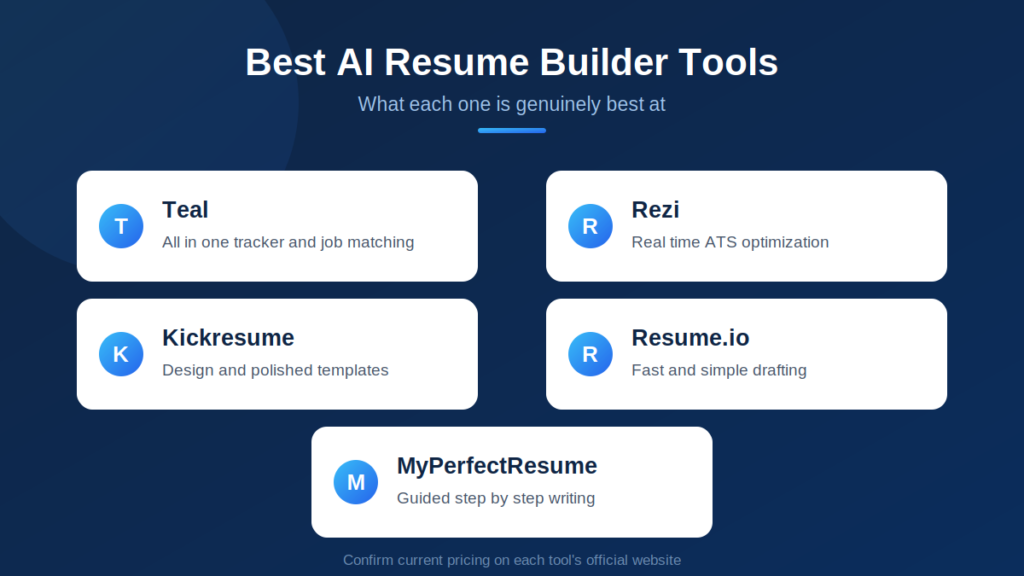
Teal is one of the most popular all in one options. It combines a resume builder with a job tracker and a browser extension, and its standout feature is side by side matching that scores how well your resume fits a specific job description. Founded in 2019, it offers a genuinely useful free tier with unlimited resumes and job tracking, while its advanced AI features and keyword matching sit behind a paid Teal+ plan. It suits job seekers who want a single command center for tracking applications and tailoring resumes.
Rezi leans heavily into ATS optimization. It scores each section of your resume in real time against criteria like keyword density and formatting compliance, which makes it a strong choice for people targeting large companies with sophisticated screening systems. If your main worry is getting parsed correctly by big employer systems, Rezi is built around that concern.
Kickresume is the design focused option. It pairs an AI writer with polished, modern templates and a drag and drop interface, and it can pull information from an existing resume or a LinkedIn profile. It appeals to roles where presentation carries weight, though its emphasis on aesthetics means you should double check that your chosen template stays ATS friendly.
Resume.io is built for speed and simplicity. Its AI helps fill templates with summaries and work histories, handles spacing and fonts automatically, and makes it easy to spin up multiple versions for different applications. It is a good fit for job seekers who want a professional document quickly without navigating a complex feature set.
MyPerfectResume combines AI suggestions with a guided, step by step process and pre written phrase suggestions, which helps people who want more hand holding while they write. It walks you from summary to skills with tutorials along the way.
Two honest cautions apply across the category. First, several builders offer generous free tiers but restrict exports or advanced AI behind subscriptions, and some have billing cycles that generate frequent complaints, so read the terms before committing. Second, no tool removes your responsibility to edit. The strongest results come from combining any of these builders with your own judgment.
It is also worth considering whether you even need a dedicated resume builder. General purpose AI assistants can help draft and refine resume content when guided with good prompts, an approach we explore in our comparison of ChatGPT and Claude for professional work. A dedicated builder mainly adds formatting, templates, and job matching on top of that writing help.
How to Choose the Right AI Resume Builder
Since tools vary widely, it helps to evaluate them against a consistent set of criteria rather than picking whichever one advertises most aggressively.
The table below summarizes the factors that matter most.
| Factor | Why It Matters | What to Look For |
|---|---|---|
| Output quality | Determines how usable the draft is | Natural, specific wording rather than vague filler |
| Editing control | You need to shape the final result | Easy manual editing, not locked templates |
| ATS friendly formats | Affects how systems read your resume | Clean layouts and standard export formats |
| Job matching | Helps tailor to each role | Keyword suggestions tied to a pasted job description |
| Data privacy | Protects your personal information | Clear policy on storage and use of your data |
| Export options | Affects where you can use it | Standard file formats you can edit later |
| Free tier value | Lets you test before paying | Meaningful free features, not just a locked preview |
Beyond the table, pay attention to how much a tool encourages genuine personalization. The best builders help you articulate your real achievements. The weakest ones simply generate confident sounding text with little connection to your actual work. If a tool makes it hard to inject your own specifics, that is a warning sign.
How to Use an AI Resume Builder Without Sounding Generic
This is where most job seekers go wrong, so it is worth being specific about the process.
Start with your real material, not a blank prompt. Before you open any tool, write down your actual achievements in plain language, including any real numbers, outcomes, and specifics. The AI should refine your truth, not invent a story for you. Tools that generate text from thin input produce the most generic results.
Treat the output as a draft, never a final product. Read every line the AI produces and ask whether it is accurate and whether it sounds like you. Rewrite anything that feels hollow or overstated. The goal is a resume that is polished but still recognizably yours.
Add specificity the AI cannot know. Real projects, named tools, concrete results, and industry context are what make a resume memorable. AI can structure and phrase, but you supply the substance. If you understand how to prompt these systems well, you will get far better results. Our library of prompts for professionals shows the kind of specific, context rich prompting that produces stronger output, and the same principles apply to resume writing.
Finally, tailor each application. A generic resume sent everywhere performs worse than a focused one aimed at a specific role. Use the tool’s job matching features, but make the final judgment yourself about what to emphasize.
Practical Example
Imagine a marketing coordinator applying for a digital marketing role. Their original note reads: “Handled the company’s social media and email.”
A weak AI output might expand this into confident but vague language about driving engagement and building brand presence, with no real substance. It sounds professional and says almost nothing.
A stronger approach uses the AI for phrasing but keeps the candidate’s real detail: “Managed organic social media across three platforms and ran a monthly email newsletter to roughly two thousand subscribers, coordinating content with the sales team.” The difference is not the AI. It is the specific, truthful input the candidate provided. This illustrative example shows the pattern that separates useful AI assistance from generic filler.
Who Should and Should Not Rely on AI Resume Builders
These tools suit some situations better than others.
They are a strong fit for people who struggle with writing, job seekers applying to many roles, career changers who need help reframing their experience, and anyone facing a blank page with no idea where to start. In these cases, the time saving and writing support are genuinely valuable.
They are a weaker fit for senior professionals with highly specialized experience, people in fields where a distinct personal voice matters, and anyone applying for a small number of high stakes roles where a bespoke, carefully crafted resume is worth the extra hours. In those situations, AI can still help with early drafts, but heavy reliance is a mistake.
Frequently Asked Questions
Are AI resume builders worth it for job seekers?
For many people, yes, particularly if writing is not their strength or they are applying to multiple roles. The value comes from speed and improved phrasing. The key is to treat the output as a starting point and add your own real detail rather than accepting generic text.
Which AI resume builder is best?
It depends on your goal. Teal suits people who want an all in one tracker and matcher, Rezi is strong for strict ATS optimization, Kickresume leads on design, and Resume.io is fast and simple. Try the free tiers before paying, since the best tool is the one that fits your specific job search.
Can recruiters tell if a resume was written by AI?
Sometimes. Experienced recruiters often recognize the generic, pattern based language that unedited AI output produces. This is precisely why personalizing and editing the draft matters. A resume that keeps your authentic voice and specific achievements is far less likely to read as machine generated.
Will an AI built resume pass applicant tracking systems?
It can, because most ATS platforms mainly need clean formatting and relevant keywords, both of which AI tools handle well. What matters is that the keywords genuinely reflect your skills. Checking the official help documentation for a given system is the most reliable way to confirm formatting requirements.
Is it safe to enter my personal details into these tools?
You are sharing detailed personal information with a third party, so review the tool’s privacy policy before you do. Look for clear statements about how your data is stored and whether it is used to train models. When in doubt, limit the sensitive detail you provide.
Final Thoughts
An AI resume builder is a useful assistant, not a replacement for thinking about your own career. It can save hours, fix weak writing, and help you present your experience clearly. It cannot decide what makes you a strong candidate, and it should never be trusted to invent detail on your behalf.
The job seekers who benefit most treat these tools as a collaborator. They bring the real, specific material, use the AI to sharpen and structure it, and then edit carefully so the final resume sounds like a real person with a real track record. Do that, and an AI resume builder becomes a genuine advantage rather than a shortcut that backfires.
For more practical, honest guidance on applying AI to real work, explore our Business and AI section or browse the full AI Insights Hub.
A strong resume opens employed roles, but a growing number of professionals are using the same AI skills independently instead. Our guide on the AI consultant skills clients pay for breaks down published US and UK rate data before you decide which route fits.

Ahmad Hussain
ACCAAhmad builds advanced Excel models, Power BI dashboards, and AI automation for businesses. He writes AI Foresight 360 himself, and every pricing figure and feature claim is verified against official documentation at the source.
Connect on LinkedIn