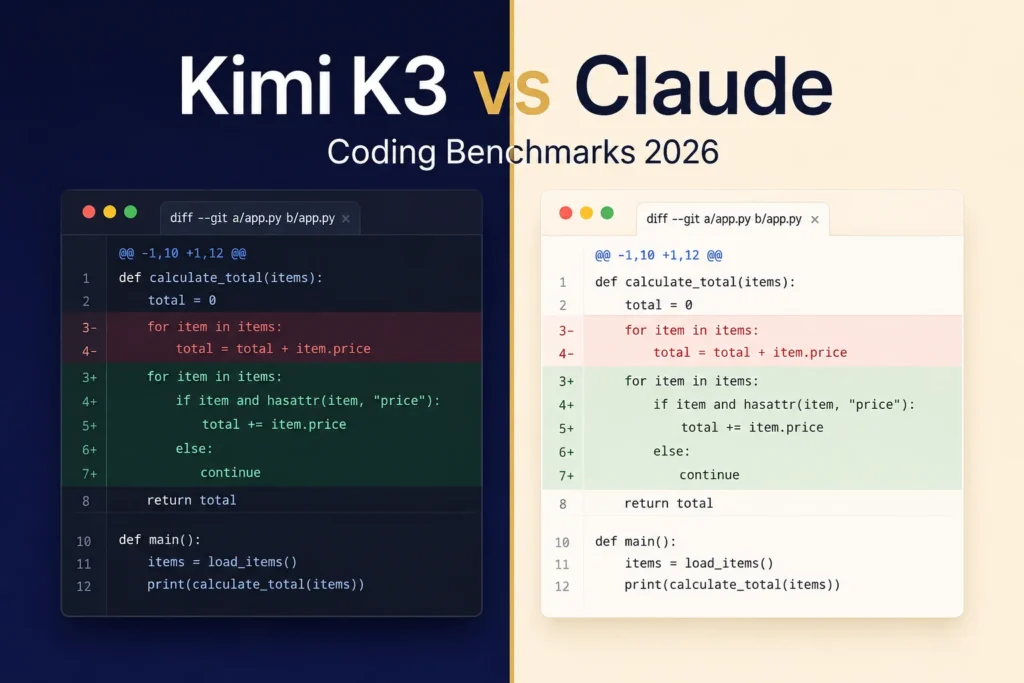
On 16 July 2026, Moonshot AI released a 2.8 trillion parameter open weight model and the coding leaderboards rearranged themselves within 48 hours. Eight days later, Anthropic shipped Claude Opus 5 and rearranged them again. That is why the Kimi K3 vs Claude question is harder than most launch week coverage suggests: the answer changed twice in nine days, and almost every benchmark screenshot circulating right now was taken before Opus 5 existed.
This comparison takes a different route. Instead of quoting the numbers each lab chose to publish, it leans on evaluations where every model ran through the same testing setup, then separates those from vendor reported figures. That distinction is the single biggest reason two honest Kimi K3 vs Claude articles can reach opposite conclusions about the same two models.
How this analysis was built: every figure below comes from published primary sources, namely Anthropic’s official pricing documentation, Moonshot AI’s API documentation, Artificial Analysis, and the Vals AI SWE-bench Verified board. No first hand testing was performed for this article. Where a number is self reported by the lab that built the model, it is labelled as such.
What Is Kimi K3 and Why Did It Shake the Coding Leaderboards?
Kimi K3 is Moonshot AI’s flagship model, released on 16 July 2026. It uses a sparse mixture of experts design with 2.8 trillion total parameters, activating 16 of 896 experts per token, and carries a context window of 1,048,576 tokens with native image understanding. It is the largest open weight model any lab has announced.
The architecture is the interesting part. According to Cloudflare’s model documentation, K3 is built on Kimi Delta Attention, a hybrid linear attention mechanism, combined with Attention Residuals. In practice this is an efficiency play: it lets a very large model decode quickly enough to sustain long engineering sessions rather than short question and answer turns.
The market reaction was loud. Fortune reported that Moonshot claimed K3 performed competitively with Claude Fable 5, and CNBC noted that the model beat Claude Opus 4.8 and GPT 5.5 on coding and agentic benchmarks according to Moonshot’s own testing. Demand was heavy enough that Moonshot suspended new subscriptions within two days of launch.
Which Claude models are actually in this race?
Anthropic does not ship one coding model, which is why a fair Kimi K3 vs Claude comparison needs three of them. Claude Fable 5 sits at the top of the publicly available lineup. Claude Opus 5 arrived on 24 July 2026 and is now the strongest model on Claude Pro. Claude Sonnet 5, released 30 June 2026, is the price and performance tier most working developers actually run.
Kimi K3 vs Claude: How Do They Compare on Independent Benchmarks?
On Vals AI’s SWE-bench Verified board, updated 22 July 2026, Claude Opus 5 leads at 97.00%, followed by GPT-5.6 Sol at 96.20% and Claude Fable 5 at 95.00%. Kimi K3 scores 93.40%, ahead of Claude Opus 4.8 at 88.60%. Every model on that board runs through one identical harness, which makes it the cleanest Kimi K3 vs Claude comparison available.
Vals AI gives every model a single tool, bash, and requires it to navigate, search and edit using standard command line utilities via the open source mini-swe-agent harness. No model gets a custom scaffold. The original SWE-bench paper built the benchmark around 500 human validated GitHub issues, each solved inside an isolated container and graded by running the repository’s real unit tests.
| Model | SWE-bench Verified (Vals AI, common harness) | Provider |
|---|---|---|
| Claude Opus 5 | 97.00% | Anthropic |
| GPT-5.6 Sol | 96.20% | OpenAI |
| Claude Fable 5 | 95.00% | Anthropic |
| Kimi K3 | 93.40% | Moonshot AI |
| Claude Opus 4.8 | 88.60% | Anthropic |
Read that table carefully before drawing conclusions. In this Kimi K3 vs Claude matchup, K3 is 3.6 points behind Anthropic’s current flagship and 1.6 points behind Fable 5. Those are real gaps, but far smaller than the gap between K3 and anything else in the open weight category. Vals AI itself notes a consistent trend: closed models outperform open ones, and the clearest separation shows up on tasks taking between fifteen minutes and one hour.
On Artificial Analysis’s Intelligence Index, a composite of nine evaluations, Kimi K3 scores 57.1 and ranks third overall, behind Claude Fable 5 and GPT-5.6 Sol Max. On AA-Briefcase, an agentic knowledge work evaluation, K3 posts an Elo of 1,543, second only to Fable 5. On LMArena’s Frontend Code Arena, K3 took first place outright and won 76% of blind matchups against Fable 5.
Why do vendor benchmark numbers disagree so violently?
Because a coding benchmark does not test a model. It tests a model plus its scaffold: the prompt, the tools, the retry logic, the timeouts and the context management. Change the scaffold and the score moves by double digits.
The clearest documented example involves Claude Opus 4.8, which scores 69.2% on SWE-bench through Anthropic’s own scaffold and 51.9% on Scale AI’s standardized SEAL board. Same model, same benchmark, 17.3 points of difference. Moonshot’s published coding table has the same issue in reverse: its headline 88.3% on Terminal-Bench 2.1 was produced inside Kimi Code, while competing entries used Claude Code, Codex or other harnesses.
The practical rule for anyone reading Kimi K3 vs Claude coverage this month: treat vendor reported scores as directional evidence about a whole system, and treat common harness boards like Vals AI and Artificial Analysis as the closest thing to a model level comparison. If an article does not tell you which harness produced a number, the number is not comparable.
Kimi K3 vs Claude: How Much Does Each Model Cost for Coding?
Kimi K3 costs $3.00 per million input tokens, $0.30 per million cache hit input tokens and $15.00 per million output tokens on Moonshot’s first party API. Anthropic’s official pricing documentation lists Claude Sonnet 5 at $2.00 and $10.00 during introductory pricing, Claude Opus 5 at $5.00 and $25.00, and Claude Fable 5 at $10.00 and $50.00 per million tokens.
Here is the detail almost every launch article missed. Sonnet 5’s introductory rate runs only through 31 August 2026. From 1 September it moves to $3.00 input and $15.00 output, with cache hits at $0.30. That is Kimi K3’s exact price, to the cent, on all three lines.
| Model | Input per 1M | Cache hit input | Output per 1M | Context |
|---|---|---|---|---|
| Kimi K3 | $3.00 | $0.30 | $15.00 | 1M tokens |
| Claude Sonnet 5 (from 1 Sep 2026) | $3.00 | $0.30 | $15.00 | 1M tokens |
| Claude Sonnet 5 (to 31 Aug 2026) | $2.00 | $0.20 | $10.00 | 1M tokens |
| Claude Opus 5 | $5.00 | $0.50 | $25.00 | 1M tokens |
| Claude Fable 5 | $10.00 | $1.00 | $50.00 | 1M tokens |
The cheap Chinese model framing that carried DeepSeek coverage in 2025 does not survive that table, and it reshapes the Kimi K3 vs Claude value argument entirely. K3 is roughly five times the price of Kimi K2.6, and The Decoder characterised the move as the end of super cheap Chinese AI. Moonshot is no longer selling a discount. It is selling capability at a mainstream frontier price.
Cost per unit of work tells a friendlier story for K3. Artificial Analysis measured average spend per Intelligence Index task at $0.94 for Kimi K3, against $1.04 for GPT-5.6 Sol and $1.80 for Claude Opus 4.8. K3 also consumed 132 million output tokens across the index versus 166 million for K2.6, a 21% reduction, meaning it reaches better answers with less rambling.
What actually moves your bill in agentic coding
Prompt caching, not the headline rate. Anthropic’s documentation prices cache reads at 10% of standard input across every current Claude model, and Moonshot’s cache hit rate for K3 is likewise a tenth of the cache miss rate. In a long session that reuses the same repository context on every turn, most input tokens bill at the cached rate on both platforms. Anthropic’s Batch API additionally halves both input and output for asynchronous work, which Moonshot does not publish an equivalent for.
Kimi K3 vs Claude on Speed and Long Horizon Tasks
Artificial Analysis clocks Kimi K3 at roughly 33 output tokens per second and classifies it as notably slow relative to its class. For an interactive coding loop where you are watching a diff appear, that is a real quality of life difference in any Kimi K3 vs Claude workflow, and it is the sort of thing benchmark tables never capture.
Long tasks show a second split. On the Vals AI board, Kimi K3 resolves 92% of tasks estimated under fifteen minutes and 95% of tasks in the fifteen minute to one hour band, which is genuinely frontier behaviour. On the small set of tasks estimated to take over four hours it resolves 67%, where Claude Opus 5 and Claude Fable 5 both resolve 100%. That top band contains only three tasks, so it proves very little on its own and should not be treated as a verdict.
Moonshot’s own testing points the other way on sustained work, reporting 42.0 on SWE Marathon against 35.0 for Fable 5. Those are vendor figures on a vendor selected harness. Long horizon performance is the least settled part of this comparison and the area most likely to change once independent reproductions land.
Kimi K3 vs Claude: Is Open Weight Actually an Advantage?
Kimi K3 is open weight rather than open source, and as of 25 July 2026 the weights had not yet been published. Moonshot’s documentation commits to releasing full model weights by 27 July 2026 under a Modified MIT license, the same license family used for Kimi K2. Until those files appear, K3 is an API only product.
Even after the drop, self hosting is theoretical for almost everyone. At 2.8 trillion parameters, a 4 bit quantisation lands near 1.4TB of weights, roughly 2.7 times the memory of a fully specified 512GB Mac Studio. This is not a model that runs on a workstation. It runs on a cluster.
So what does open weight actually buy you in a Kimi K3 vs Claude decision? Three things, all organisational rather than individual. You can run inference inside your own infrastructure if you have the hardware. You can fine tune on proprietary code without sending it to a vendor. And you are insulated from a provider deprecating or repricing the model underneath you, which teams running older Claude and GPT versions have repeatedly experienced. For a solo developer or small agency, none of these apply, and the choice collapses back to price, speed and quality.
Kimi K3 vs Claude: What Should Business Teams Weigh First?
Two considerations sit outside the benchmark tables and matter more than a few percentage points for regulated work: factual reliability and data jurisdiction.
On reliability, Artificial Analysis found K3’s accuracy on the AA-Omniscience benchmark rose from 33% on K2.6 to 46%, while its hallucination rate rose in parallel from 39% to 51%. K3 attempts more questions and gets more of them confidently wrong. To be fair to Moonshot, Claude Fable 5 posts a comparable 54.9% on the same measure, so this is a frontier model problem rather than a K3 problem. Neither model should be treated as authoritative on factual claims inside generated code comments, documentation or financial logic without review.
On jurisdiction, using Moonshot’s hosted API routes your prompts through a company under Chinese law, which is a live procurement question for regulated industries and government adjacent work. Anthropic publishes data residency controls and zero data retention options for most models, though notably not for Fable 5. If you are automating anything touching client financial records, this belongs in your evaluation before the benchmark scores do.
This is where the Kimi K3 vs Claude question stops being a coding decision and becomes a governance one. If your team is building AI into finance workflows, reporting pipelines or CFO dashboards, model choice should follow your data policy rather than lead it. The same logic we applied to Claude for Excel in accounting workflows and to Claude’s QuickBooks integration for accountants applies here.
Kimi K3 vs Claude: Which Should You Choose for Coding in 2026?
For most professional coding work today, Claude wins the Kimi K3 vs Claude comparison on raw quality, with Claude Opus 5 leading the independent SWE-bench Verified board at 97.00%. Kimi K3 wins on frontend work, on cost per completed task, and on the strategic option value of weights you can eventually run yourself.
Choose Kimi K3 if
You do heavy frontend and UI work, where K3 holds first place on LMArena’s Frontend Code Arena. You need weights you can host or fine tune inside your own infrastructure. You are cost sensitive at scale and can tolerate slower generation. Or you want a hedge against depending on a single American provider.
Choose Claude if
You need the highest resolution rate on real repository issues, which Claude Opus 5 currently holds. You want interactive speed in tools like Claude Code. You need a documented data residency and retention posture for compliance. Or you want Claude Sonnet 5 at $2.00 and $10.00 per million tokens before 1 September, currently the strongest quality per dollar position in this entire comparison.
Choose neither yet if
You are evaluating for a long horizon autonomous agent. The evidence on multi hour tasks is thin on both sides, contradictory between vendor and independent boards, and will look materially different in a month.
Kimi K3 vs Claude: Frequently Asked Questions
Is Kimi K3 better than Claude for coding?
Not on the strongest independent measure available. On the Vals AI SWE-bench Verified board updated 22 July 2026, Claude Opus 5 scores 97.00% and Claude Fable 5 scores 95.00%, while Kimi K3 scores 93.40%. Kimi K3 does lead on LMArena’s Frontend Code Arena, where it won 76% of blind developer matchups against Claude Fable 5, so frontend work is the exception.
How much does Kimi K3 cost compared to Claude?
Kimi K3 costs $3.00 per million input tokens and $15.00 per million output tokens on Moonshot’s first party API, with cache hits at $0.30. Claude Sonnet 5 matches those exact rates from 1 September 2026 and undercuts them at $2.00 and $10.00 until 31 August. Claude Opus 5 costs $5.00 and $25.00, and Claude Fable 5 costs $10.00 and $50.00 per million tokens.
Can I run Kimi K3 on my own computer?
No. Moonshot committed to publishing full weights by 27 July 2026 under a Modified MIT license, but at 2.8 trillion parameters a 4 bit quantisation is roughly 1.4TB, about 2.7 times the memory of a maxed out 512GB Mac Studio. Kimi K3 requires cluster class hardware, so open weights benefit organisations with serious infrastructure rather than individual developers.
Why do different articles report completely different Kimi K3 scores?
Because benchmark scores measure a model plus its agent scaffold, not the model alone. Claude Opus 4.8 scores 69.2% on SWE-bench through Anthropic’s scaffold and 51.9% on Scale AI’s standardized SEAL board, a 17.3 point swing on identical model and benchmark. Any Kimi K3 vs Claude table that does not name its harness is not comparable.
Does Kimi K3 hallucinate more than Claude?
Slightly less than Claude Fable 5, but the trend is worse. Artificial Analysis measured K3’s hallucination rate on AA-Omniscience at 51%, up from 39% on Kimi K2.6, while its accuracy improved from 33% to 46%. Claude Fable 5 sits at 54.9% on the same benchmark. Neither model should be trusted on factual claims without human verification.
Which Claude model competes most directly with Kimi K3?
Claude Sonnet 5, on price. From 1 September 2026 it costs exactly what Kimi K3 costs on input, output and cached input. On the Vals AI board Kimi K3 resolves a higher share of SWE-bench Verified tasks than Sonnet 5 does, so the Kimi K3 vs Claude trade at that tier is K3’s higher resolution rate against Claude’s faster generation and compliance tooling.
Kimi K3 vs Claude: The Verdict
The Kimi K3 vs Claude story that ran during launch week was accurate for about eight days. Kimi K3 genuinely reached the frontier, genuinely leads on frontend generation, and genuinely ended the era of open Chinese models competing purely on price. Then Claude Opus 5 arrived on 24 July 2026 and reclaimed the top of the independent coding board at 97.00%.
The durable takeaway is not which model is ahead this week. It is that Moonshot closed the gap to roughly three points on a common harness while shipping weights anyone can eventually download, and that the pricing floor for frontier capability has stopped falling. For teams choosing today, Claude Opus 5 is the quality answer, Claude Sonnet 5 is the value answer, and Kimi K3 is the answer if frontend quality, self hosting or provider independence outweighs a few points of resolution rate.
Watch two dates. The weights drop on 27 July 2026 will tell you whether the open license is real. Independent reproductions on common harnesses over the following weeks will tell you whether the vendor coding numbers hold. Until then, be sceptical of any Kimi K3 vs Claude comparison that does not name its harness.
If you are working out how AI models should fit into your reporting, automation and finance workflows rather than just your code editor, that is the work our consulting practice does every day, covering Power BI dashboards, financial and CFO reporting, and AI automation for finance teams. You can start a conversation with our team. For more head to head analysis, browse our AI comparisons library, our breakdown of ChatGPT versus Claude for accountants, our guide to how AI agents actually work, and the full AI Insights Hub.

Ahmad Hussain
ACCAAhmad builds advanced Excel models, Power BI dashboards, and AI automation for businesses. He writes AI Foresight 360 himself, and every pricing figure and feature claim is verified against official documentation at the source.
Connect on LinkedIn